


It starts with a single question.
A shopper opens ChatGPT or Google, asks where to find a new pair of running shoes, and has a handful of store recommendations back in seconds. There’s no browsing and no scrolling through pages of search results. For a growing number of consumers, that answer is where the purchase decision begins, and increasingly where it ends.
More than half of North American shoppers have already used AI to help make shopping decisions, according to a new Censuswide survey commissioned by Lightspeed Commerce. A companion study released today suggests that when they do, independent retailers are often left out.

“AI is becoming a new front door to retail,” Dax Dasilva, founder and CEO of Lightspeed, told 6ixRetail. “A shopper can ask one question and get a shortlist of where to buy before they ever visit a retailer’s website or walk into a store. If an independent retailer isn’t on that shortlist, they may never get the chance to win that customer. Lightspeed was built around helping independent businesses compete, and discovery is becoming another part of that equation.”
The research, conducted by AI research consultancy Vaer AI, ran 20,000 shopping prompts across 10 product categories in Los Angeles, San Francisco, New York and Montreal through ChatGPT, Google AI Mode and Google AI Overviews. It analyzed roughly 460,000 responses and more than 2.4 million links. None of the prompts mentioned store size, chains or independents, yet the tools consistently favoured national retailers over smaller competitors. Even with live web search turned on, national chains accounted for 46% to 58% of responses. Google AI Overviews showed the strongest lean, recommending no local store at all in 68% of shopping responses, while ChatGPT and Google AI Mode surfaced a local retailer in roughly 70% of theirs. For Dasilva, though, the most revealing findings sat beneath those averages.
“What surprised me was where the gap got widest. Local retailers appeared as the top recommendation in roughly one-third of broader shopping searches, but when someone searched for a specific product, that fell to as little as one in ten. In head-to-head comparisons, AI selected the larger national retailer up to 94% of the time when relying on its own training data. The closer a shopper gets to buying, the harder it can become for an independent business to make the list.”
That’s where the stakes are highest. A search for a specific product is rarely idle browsing. Someone asking where to buy a particular model of running shoe or a specific espresso machine has usually done their homework and is ready to spend. Those are the customers independents can least afford to lose, and they’re making exactly the kind of search where AI is least likely to point to a local store. Adoption is also growing fastest among younger shoppers: nearly three-quarters of consumers under 35 have already used AI to help make shopping decisions.
Dasilva brings two decades of perspective to the question. He founded Lightspeed in Montreal in 2005 and took it public on the Toronto Stock Exchange in 2019, in a listing the Financial Post described as the most successful IPO by a Canadian tech company in almost a decade. Today the company is listed on both the TSX and NYSE, generates more than US$1 billion in annual revenue, and powers retail, golf and hospitality businesses in more than 100 countries. He returned as CEO in 2024 after two years as executive chair.
“I’ve watched retailers adapt to ecommerce, mobile, search, social and now AI,” he said. “Each shift changes how customers discover businesses and where retailers have to show up. AI can shape the shortlist very quickly, but the encouraging part is that the outcome isn’t fixed. In a controlled follow-up, adding ‘independent’ to a shopping prompt cut large-chain recommendations from about 44% to as little as 9%, while more than doubling the number of small and local businesses surfaced.”
That finding cuts both ways. It shows the lean toward national chains can shift depending on how a question is framed. It also shows how much currently depends on the shopper knowing what to ask. Most people typing a quick question into ChatGPT or Google won’t think to add a qualifier, which leaves independent retailers relying on the AI to surface them without being prompted.
“Independents aren’t locked out of this,” Dasilva added. “They’ve always competed differently by knowing their customers, their products and their communities. The opportunity now is to make sure those strengths are visible when AI is helping a customer decide where to buy.”
Shoppers’ own expectations point in a different direction from what the technology is delivering. A third of those surveyed believe AI should prioritize small or local businesses in its recommendations, compared with 13% who think large brands should come first. Trust is already significant: 41% of respondents said they trust AI shopping recommendations, and nearly 60% of consumers aged 25 to 34 said the same. The more shoppers rely on those answers, the more it matters which businesses they include.
“The demand for local is already there,” Dasilva explained. “In Canada, 77% of Canadians say supporting small or locally owned businesses is important to them, and half say they’d be more likely to shop local if AI made nearby businesses easier to discover.
“The gap is between that intent and what people actually see when they ask AI where to shop. An independent retailer can have exactly the product someone wants, great service and a strong local following, but if they never make the shortlist, they never get the opportunity to win that customer. The opportunity is to make sure technology reflects what shoppers already say they want. If someone wants to support a local business, AI should make that easier, not accidentally steer them away from it. Done well, AI can become a powerful tool for local commerce, helping more independent businesses enter the consideration set.”
The issue hits close to home in Toronto, where shoppers have already shown they’ll go out of their way for local. When Lightspeed surveyed Toronto consumers last year, 84% said they were buying or planning to buy Canadian over U.S. alternatives, and 38% said they research Canadian brands or stores before making a purchase. Yet 66% reported having difficulty finding Canadian alternatives. More and more, the research meant to close that gap now happens inside an AI tool.
Getting found is only the first step. Once a shopper walks through the door, independents hold advantages no algorithm can replicate. Leger’s 2025 WOW In-Store study surveyed more than 11,000 Ontarians and found that specialty retailers dominated the province’s customer experience rankings. The strongest driver was a “sense of belonging”: whether customers feel a store was designed with their needs and lifestyle in mind.
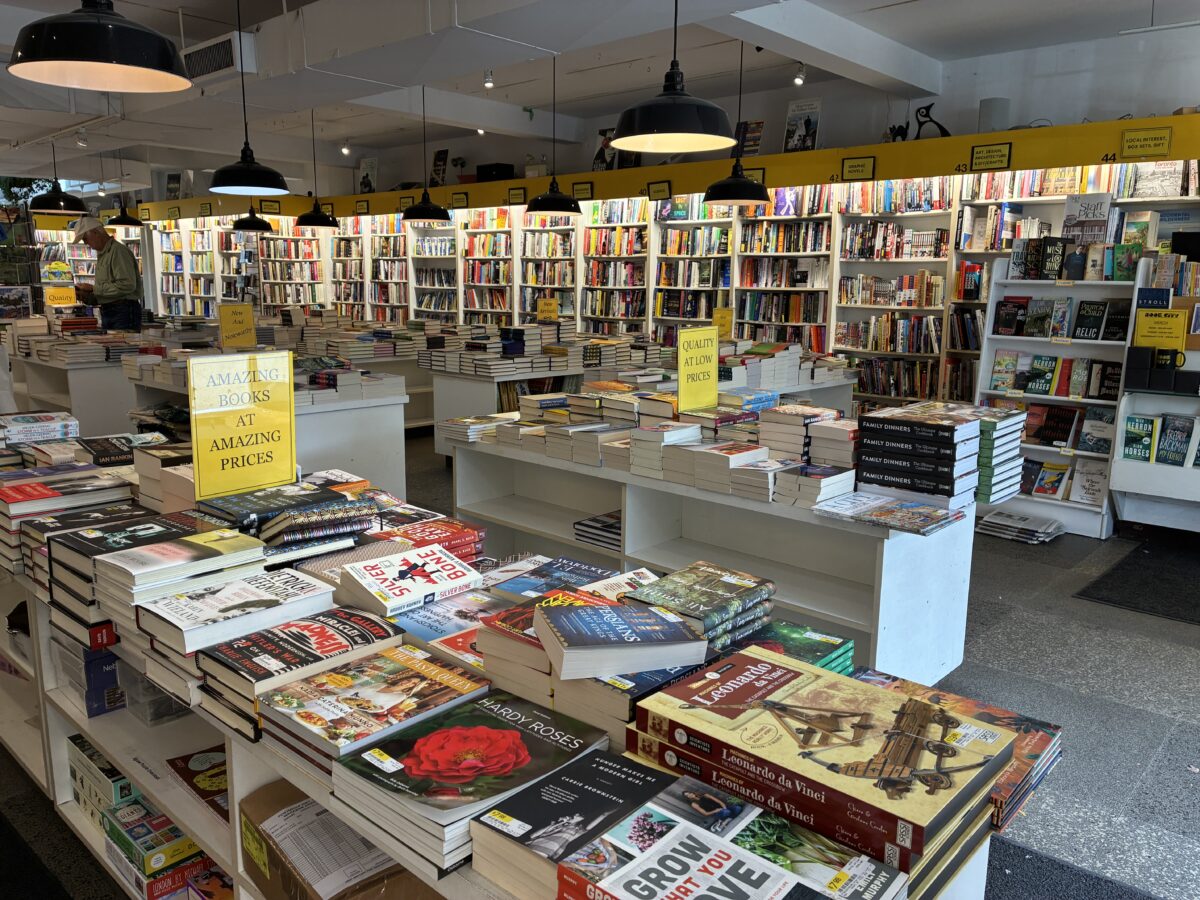
Book City, which marked 50 years in business this month, shows how that plays out. Owner Ian Donker told 6ixRetail that the four-store independent competes with Amazon and Indigo on staff knowledge and special orders rather than price or speed. Book City built its website within weeks of the 2020 shutdown, and online orders for hard-to-find titles are now routine. Yet most of those customers still choose in-store pickup, because they want to make the trip. That kind of loyalty is earned in the aisles, not in a search result. What AI increasingly influences is whether a new customer ever walks in at all.
Lightspeed’s own AI work has so far focused on what happens inside the business. In January the company launched Lightspeed AI, conversational assistants built into its retail and restaurant platforms that it plans to develop into more autonomous agents over time. In May it appointed Bhawna Singh as chief technology officer as it accelerates its AI roadmap, and its suite now includes tools such as AI Blog Builder, which helps merchants publish search-optimized content, and AI Showroom. Dasilva applies the same test to each of them.
“The way we think about AI at Lightspeed is simple: it has to solve a real merchant problem. A retailer has inventory to manage, customers to serve, staff to support and a business to grow. If they have to become an AI expert just to get value from the technology, we haven’t done our job.
“We’ve focused first on helping merchants turn the information already inside their business into something useful, so they can understand what needs their attention, where there’s an opportunity and what action to take next. The goal is to help merchants move from insight to action faster.”
The study pushes that thinking beyond the four walls of the store. Many of Lightspeed’s merchants are the kinds of businesses the research found at a disadvantage, from neighbourhood boutiques to specialty shops competing with national chains for the same customer. Tools designed to help them run a better business now sit alongside a newer question: whether customers can find that business in the first place.
“Discovery is becoming another part of that picture,” Dasilva said. “AI is increasingly influencing how customers decide which businesses make the shortlist. For an independent retailer, being great at what you do isn’t enough if you’re invisible at that moment. Discovery fits within that same focus. It’s another merchant problem emerging from the same shift. Our job is to use AI where it can remove friction, create real merchant value and help businesses compete.”
Lightspeed is backing the research with a public awareness campaign. It begins with an interactive storefront activation that shows in real time how AI builds its shopping recommendations. The campaign will give independent retailers practical guidance on earning a place in those results, and encourage shoppers to seek out local businesses by adding words like “independent” or “locally owned” to their prompts.
Dasilva’s advice for retailers doesn’t require a new budget line or a technology overhaul. It’s a familiar exercise for anyone who remembers the early days of search, when owners typed their own business name into Google to check what customers would find. The difference now is that the question a customer asks rarely includes a store’s name at all.
“Start paying attention now. Retailers don’t need to become AI experts, but they should know whether they show up when a customer asks for what they sell. Open the tools your customers are using, search for a product you carry and see whether your business appears.
“If it does, understand why. If it doesn’t, understand the gap. Retailers learned to think about this with websites, search and social. AI is becoming another place where customers decide which businesses make the shortlist. The mistake would be waiting until that behaviour is fully established before paying attention to it. If you’re not showing up today, that’s a visibility gap worth understanding now.”

Dustin Fuhs is the founder and Editor-in-Chief of 6ix Retail, Toronto’s premier source for retail and hospitality industry news. As the former Editor-in-Chief of Retail Insider, Canada’s most-read retail trade publication, Dustin brings over two decades of expertise spanning retail, marketing, entertainment and hospitality sectors. His experience includes roles with industry giants such as The Walt Disney Company, The Hockey Hall of Fame, The Canadian Opera Company, Starbucks Canada and Blockbuster.
Recognized as a RETHINK Retail Top Retail Expert in 2024, 2025 and 2026, Dustin delivers insider perspectives on Toronto’s evolving retail landscape, from emerging brands to established players reshaping the city’s commercial districts.