
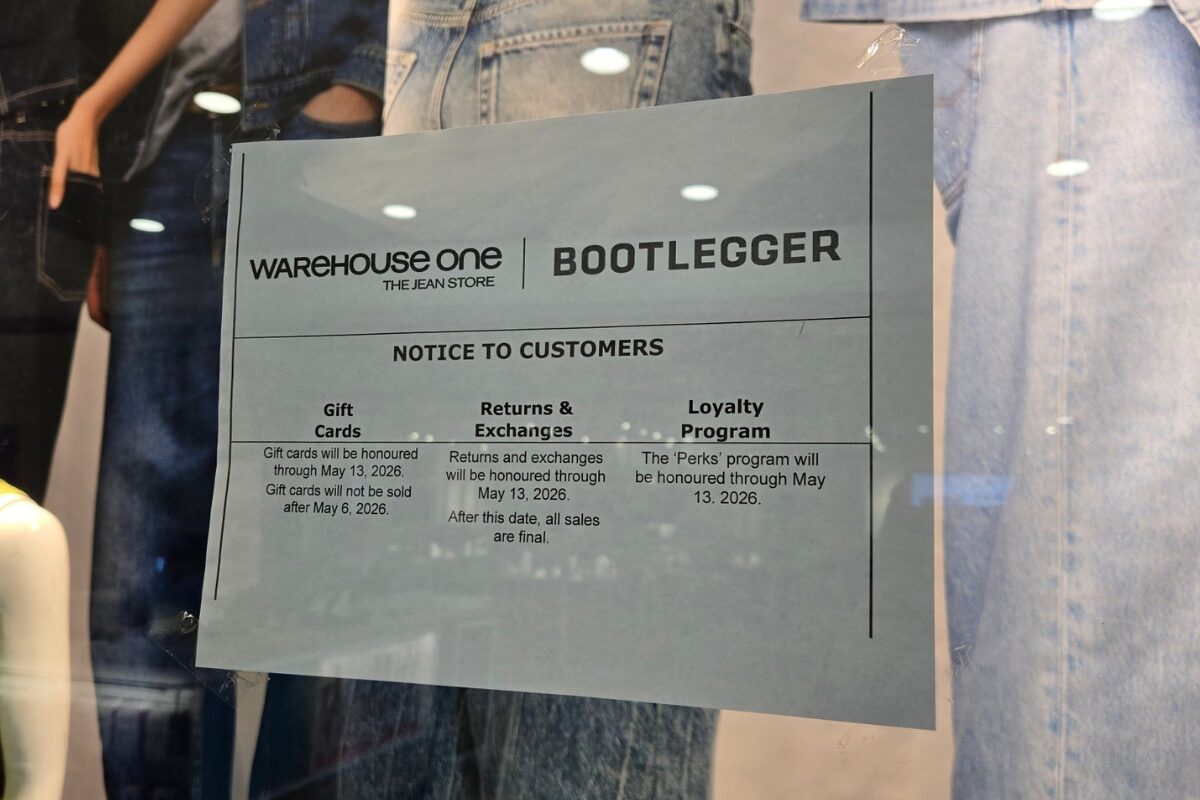
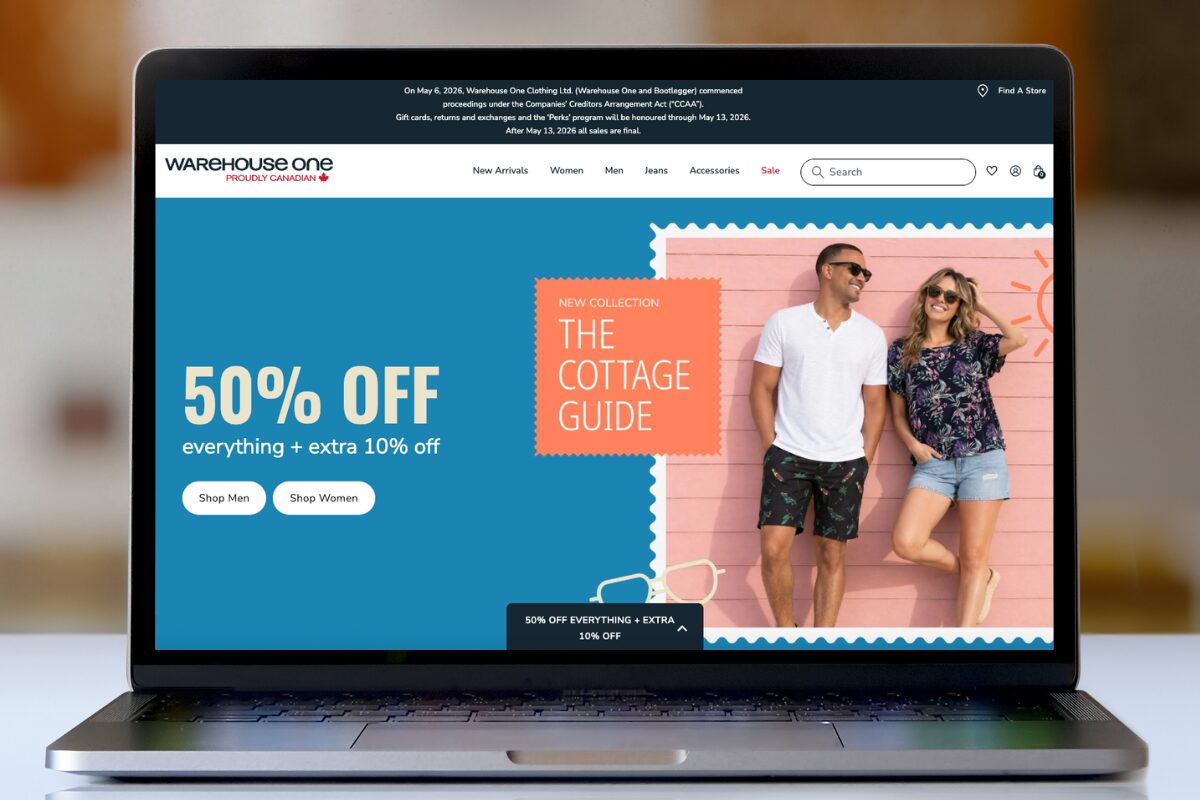
Warehouse One Clothing Ltd. filed for creditor protection on May 6, 2026. All 128 stores operating under the Warehouse One and Bootlegger banners are closing. The company is insolvent, cannot pay rent or payroll, and is not looking for a buyer or a path forward. The Court of King’s Bench of Manitoba granted the initial order the same day. Alvarez and Marsal Canada Inc. has been appointed monitor. A comeback hearing is set for May 15 to seek court approval for liquidation sales. Shoppers have until May 13 to use gift cards and process returns.
982 people are out of work.
Alex Hennick has been in this situation before. The president of Toronto-based A.D. Hennick and Associates has handled some of Canada’s most significant retail liquidations in recent years, including Factory Direct and the Hudson’s Bay wind-down. He has appeared on CP24 with Amanda Lang, on 680 News, and has been quoted in the Globe and Mail as one of Canada’s foremost voices on retail insolvency and distressed assets. He is not involved in the Warehouse One sale, but he knows better than almost anyone what the next few weeks look like for the people inside those stores.

“This is everyone’s livelihood,” he said. “You have employees who have been there for decades, people from the stores, the production team, head office, the warehouse. It is an incredibly sensitive situation. And the hard reality is that you’re telling them they’ve just lost their job and their livelihood, but for the next three months we need you to work overtime and give everything you have to run a successful closing sale.”
He says the only way a wind-down like this works is if the people running it put employees first, not last. “You want to have almost a dedicated team focused entirely on making sure those employees are ready for their next step. Help them with the paperwork so they can access unemployment support quickly. Connect them with referrals and job interviews. Sometimes you pay a retention bonus, sometimes you just make sure someone is there to talk to. They are lost. They don’t know what to do. But if you can help them transition, you have a much better chance of getting the team you need to actually execute the sale properly.”
For many of these 982 workers, particularly those in places like Thompson, Flin Flon, Whitehorse, Dawson Creek, and Slave Lake, there is no obvious next step waiting. Warehouse One was not a flagship urban retailer. It was Canada’s small-city jeans store, built in regional malls and smaller communities where it was often the only store of its kind for miles. The full national footprint spans Alberta, British Columbia, Manitoba, Saskatchewan, Ontario, Nova Scotia, New Brunswick, Newfoundland, Yukon, and Prince Edward Island. The complete store list is at the bottom of this article.
When liquidation sales begin, likely around May 16 pending court approval, the impact will extend well beyond Warehouse One’s own stores. Hennick explains that the mechanics are straightforward even at this scale. “At the right price you can move anything. If something is 20 percent off you’re not going to sell very many. But as the sale goes on and prices come lower, there is a magic number where people will come in and buy for everyone they know, family, friends, everyone. Whatever that number is, whether it’s 80 or 90 percent off, there is always a number.”
The broader effect on surrounding retailers is significant. “All it does is take the dollars that you would otherwise spend somewhere else. If you can buy similar clothing at a Warehouse One closing sale for pennies on the dollar, why would you go anywhere else while that sale is on? It directly affects every competitor in those markets for as long as the wind-down takes, and in some of these smaller communities, that is almost everyone.”
The landlords holding those 128 leases, mostly in regional and secondary market shopping centres, face a harder question than just lost rent. Hennick does not see an easy answer for them. “I don’t believe there are lineups of tenants looking to go into these locations. For years this was the kind of store that people would go to for a big event, a dinner, a celebration, something to look forward to. Now you go online and you have it delivered. I can’t imagine another retailer with a similar model going into those same locations and suddenly having success. The more likely beneficiary is online retail, which doesn’t need the space.”
The filing itself tells a familiar story. Shareholders and affiliates advanced more than $39 million into the business since 2020. When Comark Holdings collapsed in early 2025 with no buyers for Bootlegger, Warehouse One stepped in. Costs jumped approximately 50 percent year over year after the acquisition. Revenue went up. Costs went up faster. Eventually shareholders stopped writing cheques.
Hennick says the acquisition was less a strategic play than a last attempt to hold something together that was already under serious strain. “A lot of these brands still have value in the market, but they have value more for their name than for the actual business, the locations, and the debt that comes with them. It was a last-ditch effort. I don’t know if it accelerated the timeline, but I don’t know that there was ever a clear path to survival without fundamentally changing the model.”
The model, he says, is the core problem. “These mid-market apparel brands are having a tough time because they can’t win on price and they can’t win on quality. On one side you have ultra-low-cost international platforms where people are finding great styles at prices that are hard to argue with. On the other you have premium brands where quality and experience justify the spend. The middle has no defensible position. People aren’t buying less necessarily, but they are buying differently, and they are being pulled in both directions away from the middle.”
Consumer loyalty, he adds, has fundamentally shifted. “A lot of people don’t care about name recognition the way they used to. They care about quality and they care about price, and in this environment price is becoming more and more crucial. If you’re not on e-commerce, if you’re not on TikTok Shop, if you’re not where the customer actually is, they are simply not going to find you.”
He points to HBC as the clearest illustration of where this ends. “We saw it with HBC. The writing was on the wall for over a decade. They didn’t adapt, didn’t grow their e-commerce, didn’t shrink their physical footprint in time. If you continue to do things the same way and don’t adapt with the times, it is only a matter of time before your expenses overwhelm you and you are sitting on a tremendous amount of debt. And sometimes,” he adds, “the IP ends up being the most valuable thing that comes out of it.”
Warehouse One was founded in Winnipeg in 1977 by Max Maryk, who started by selling denim out of the trunk of a car before opening the company’s first store on Henderson Highway. Bootlegger dates to Vancouver in 1971. Between them, more than a century of Canadian retail history is ending in a court-supervised liquidation.
Hennick does not expect the pace of closures to slow. “We will unfortunately be seeing a lot more of this happening unless these brands decide to make the changes necessary to be more relevant. The model of relying entirely on mall locations and foot traffic will not work no matter who you are. That era is over.”
Court updates are available at alvarezandmarsal.com/WarehouseOne.
ALBERTA (31 stores) Lloydminster, Lethbridge (Centre Village Mall), Red Deer (Gaetz Avenue Crossing), Fort McMurray, Medicine Hat, Whitecourt, Drayton Valley, St. Albert, La Crete, Olds, Cold Lake, Spruce Grove, Okotoks, Leduc, Edmonton (West Point Centre), High Level, Hinton, Calgary (Sunridge Mall), Sherwood Park (Emerald Hills), Lac La Biche, West Edmonton Mall, Calgary (CrossIron Mills), Sherwood Park (Sherwood Park Mall), Edmonton (Londonderry Mall), Red Deer (Parkland Mall, combined), Camrose (Duggan Mall, combined), Grande Prairie, Slave Lake, Strathmore, Lethbridge South, Rocky Mountain House, Peace River
BRITISH COLUMBIA (22 stores) Fort St. John, Kelowna (Spall Plaza), Prince George, Terrace, Kamloops (SmartCentres), Quesnel, Trail, Dawson Creek, Prince Rupert, Penticton, Nanaimo, Victoria (Hillside), Abbotsford, Kelowna (Orchard Park), Vernon, Kamloops (Aberdeen Mall), Salmon Arm (combined), Williams Lake, Cranbrook, Chilliwack, Langford, Smithers
MANITOBA (14 stores) Winnipeg (Garden City), Brandon (Corral Centre), The Pas, Steinbach, Winnipeg (Kildonan Place), Flin Flon, Thompson, Winkler, Winnipeg (St. Vital Centre), Selkirk, Brandon (Shoppers Mall), Portage la Prairie, Dauphin, Winnipeg (Outlet Collection)
SASKATCHEWAN (13 stores) Yorkton, Regina East, Moose Jaw, Weyburn, Meadow Lake, Humboldt, Regina (Southland Mall), Prince Albert (Gateway Mall), Swift Current (combined), North Battleford (combined), Regina (Victoria Square, combined), Prince Albert, Saskatoon, Estevan
ONTARIO (10 stores) Kenora, Dryden, Sault Ste. Marie, Cornwall, Sudbury, Timmins (combined), Lindsay (combined), Thunder Bay, Burlington, Welland
NOVA SCOTIA (4 stores) Truro, New Glasgow, Yarmouth, Dartmouth
NEWFOUNDLAND (5 stores) St. John’s, Corner Brook, Grand Falls-Windsor, Gander, Stephenville
NEW BRUNSWICK (1 store) Fredericton
YUKON (1 store) Whitehorse
PEI (1 store) Charlottetown

Dustin Fuhs is the founder and Editor-in-Chief of 6ix Retail, Toronto’s premier source for retail and hospitality industry news. As the former Editor-in-Chief of Retail Insider, Canada’s most-read retail trade publication, Dustin brings over two decades of expertise spanning retail, marketing, entertainment and hospitality sectors. His experience includes roles with industry giants such as The Walt Disney Company, The Hockey Hall of Fame, The Canadian Opera Company, Starbucks Canada and Blockbuster.
Recognized as a RETHINK Retail Top Retail Expert in 2024, 2025 and 2026, Dustin delivers insider perspectives on Toronto’s evolving retail landscape, from emerging brands to established players reshaping the city’s commercial districts.