
The warehouse sale has a perception problem that the numbers don’t support. For decades it sat at the bottom of the retail hierarchy — a last resort for brands with nowhere else to turn, something handled quietly and never discussed in a strategy meeting. That positioning has changed significantly, and the data driving that change is hard to argue with.

“The warehouse sale model is no longer just about liquidation — it’s become a legitimate sales channel,” says Oliver Berg, Executive Vice President of StyleDemocracy, the Toronto-based company that has run over 600 events across North America since its founding in 1999. “Brands are using it more frequently, in different markets, and not always because they have excess inventory. They’re seeing it as an opportunity to reach new customers, move current product, and collect real customer data that feeds back into their broader retail strategy.”
That last point — customer data — is more significant than it might appear on the surface. StyleDemocracy collects shopper data through its platform at every stage of an event: pre-event marketing registration, in-person transactions, and post-event analytics. That data goes back to the brand. For companies accustomed to the anonymity of wholesale channels or the limited visibility of outlet store transactions, having actual customer profiles attached to off-price purchases is a different kind of asset — one that has changed how brands think about what the format is actually worth.
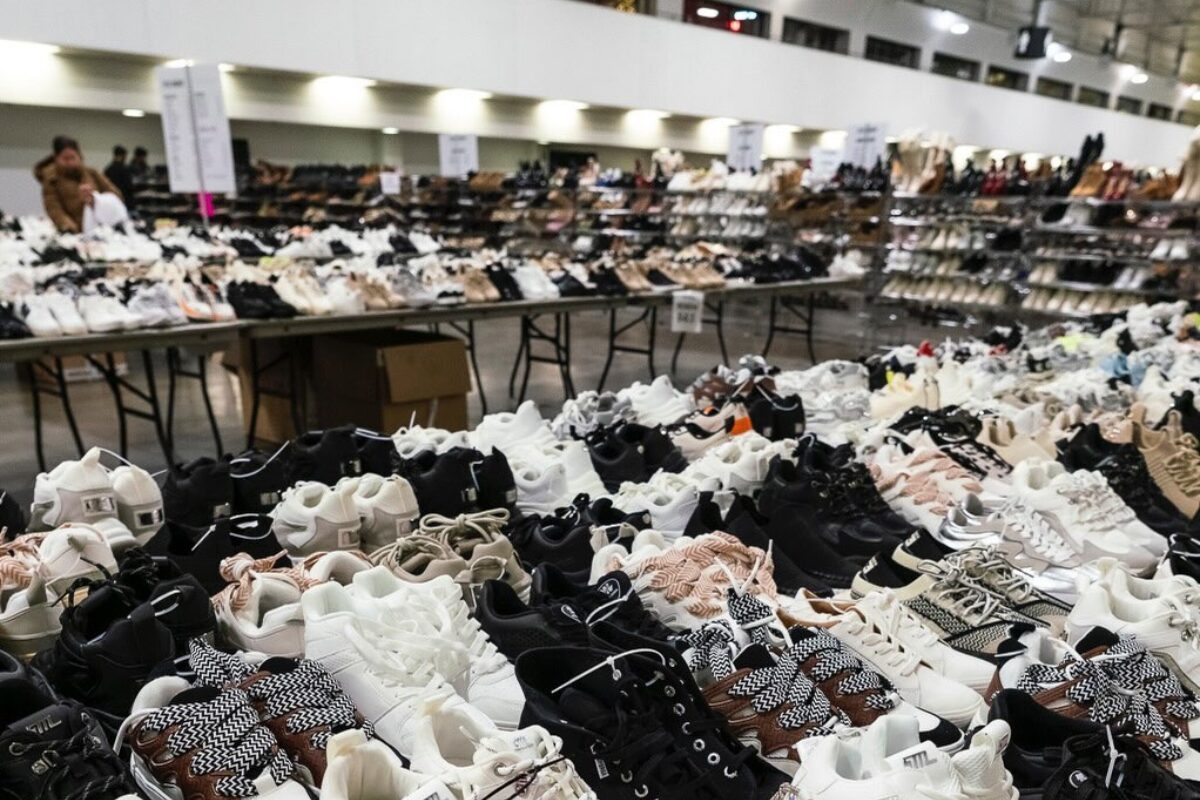
The shift in how brands are approaching warehouse sales is significant enough that Berg describes clients now building it into long-term planning rather than reaching for it in moments of crisis. One client — unnamed under a confidentiality agreement — recently chose to build StyleDemocracy permanently into their annual strategy as a direct alternative to opening outlet stores.
“They’ve found it to be a far more efficient and profitable way to handle inventory,” Berg says. “That’s a brand I never thought would do this ten years ago.”
The outlet comparison matters more than it might seem. For years, outlet stores were considered the gold standard for brands needing to move excess product while maintaining some control over presentation, pricing, and brand environment. They remain a significant part of the retail landscape — but they come with fixed costs that don’t flex with inventory reality. They’re expensive to build, expensive to staff, and running year-round regardless of whether the inventory pipeline demands it. The event model offers something the outlet fundamentally can’t: flexibility, precise targeting, and a built-in sense of urgency that drives consumer behavior in ways a permanent off-price location is structurally unable to replicate.
Berg describes the business as having tripled in the two years following the immediate post-COVID period, as brands that had been forced to rethink their inventory strategies discovered that the format delivered results that were difficult to walk away from. StyleDemocracy went from running 10 to 12 events per year pre-pandemic to 27 in 2024, including a growing number in the United States.
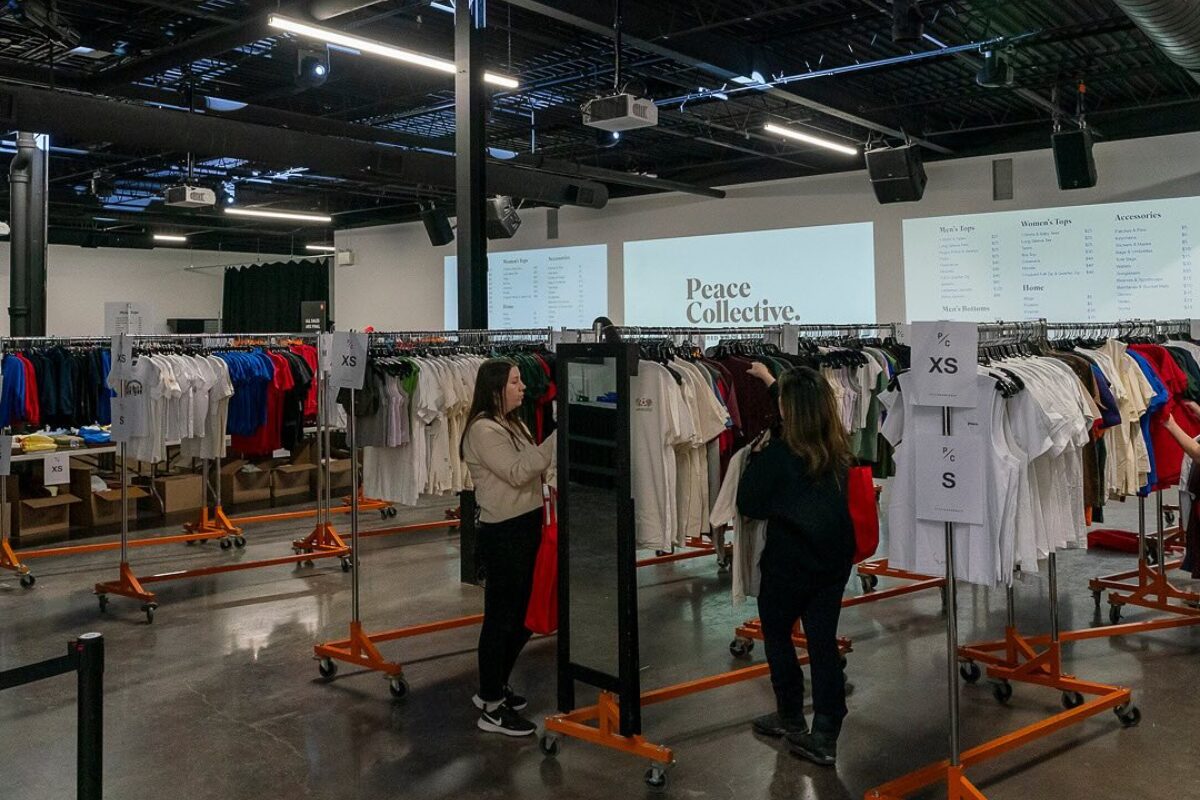
The conversion rate data is where the format’s efficiency becomes most concrete. In-person warehouse sales run between 50 and 80 percent conversion on foot traffic. Industry standard for a strong e-commerce conversion rate sits at roughly 2 percent. The consumer who travels to a venue, finds parking, and waits in line has already made a significant investment of time and effort before they walk through the door — and that investment pays off at the register at a rate no digital channel approaches.
“To replicate that volume online, you’d need a completely different level of traffic,” Berg says. “A lot of people think the scale of online has so much more potential — and they’re not necessarily wrong. But on a per-transaction basis, the in-person model is far more efficient because of how strong that conversion is.”
StyleDemocracy has tested the digital side directly, launching an e-commerce platform during the pandemic as an operational necessity when live events became impossible. The platform, which runs on Shopify, remains part of the business — positioned as a solution for brands with smaller inventory quantities that don’t warrant a full in-person event. But Berg is clear about where the ceiling is for digital in this specific context. Online warehouse sales compete for attention on the same internet as every other retailer. In-person events don’t have that problem. The audience shows up, and once inside, they buy.
The brand image concern has been the industry’s most persistent objection for as long as the format has existed, and it remains the first conversation Berg has with brands that haven’t done this before. The fear is intuitive: put your product in a warehouse at 60 percent off and you risk signaling distress, upsetting wholesale and retail partners, and training consumers to wait for the discount. It’s a reasonable concern on paper. In practice, the data has complicated it considerably.
“We’ve had clients tell us they actually saw a lift in their regular retail sales the week after we ran a sale for them,” Berg says. “What was once a fear turned out to be the exact opposite.”
The mechanism is the marketing footprint the event generates. StyleDemocracy operates a database that has grown to over 400,000 shoppers, a social community of over 100,000 followers, and runs influencer and external media activity around every event. The reach extends well beyond the consumers who attend. For those who see the marketing but don’t make it to the sale — whether because of distance, timing, or simple interest — the brand awareness still registers. The sale creates noise, and noise drives traffic back to full-price channels in the days that follow.
“We really like to see ourselves as an integration into a brand’s retail strategy, versus just an end-of-life solution,” Berg says.
The practical implication for brands still treating warehouse sales as something to be managed quietly is significant. The marketing value alone — the reach, the impressions, the new customer acquisition — represents a meaningful return that doesn’t show up in a traditional inventory recovery calculation. When brands start accounting for it, the format looks considerably more attractive.
Inventory accumulation itself is frequently misread as a management failure when it’s often just the normal friction of how retail works at scale. Design and production cycles run approximately two years ahead of delivery. Consumer preferences, macroeconomic conditions, and global disruptions can all shift substantially in that window. The post-COVID period demonstrated this at scale — supply chains froze, then flooded, and brands that had never considered a warehouse sale arrived with urgent, significant inventory needs and no established process for solving them quickly.
“A global pandemic, a shift in consumer trends, a two-year production cycle where a lot can change — there are so many variables,” Berg says. “An inventory problem looks different for every brand.”
Many of those brands, having discovered the channel under pressure, didn’t leave when the pressure eased. What started as an emergency measure became a recognized strategy, and the brands that went through that experience are now among the format’s most consistent users. The emergency became the annual plan.
The current macroeconomic environment — U.S. tariffs creating new uncertainty for Canadian apparel sourcing, consumer spending under pressure, and a retail landscape still absorbing the structural changes of the past five years — is generating conditions that historically drive inventory accumulation. Berg doesn’t speculate on specific brands or categories, but the pattern is consistent: external disruption creates inventory pressure, and inventory pressure brings new participants into the warehouse sale channel who don’t leave.
The categories actively moving into the format tell their own story about where this is heading. StyleDemocracy has historically been a fashion business — apparel, footwear, accessories, with a client list that has included Nike, Adidas, Puma, OVO, Ted Baker, Max Mara, Off-White, and others across the brand spectrum. The Endy and Hush warehouse sales running simultaneously this past week at Exhibition Place in Toronto represent a meaningful departure: two digitally native, direct-to-consumer home brands — mattresses and sleep essentials — using the warehouse sale format to connect with consumers in person for the first time.
“We’ve predominantly been in fashion, but over the last few years the home and beauty categories have really started to embrace this model,” Berg says. “That’s a meaningful shift in who sees this as a viable retail strategy.”
Cosmetics is growing in the space. Outdoor and sporting goods entered the conversation through StyleDemocracy’s 2025 acquisition of the Toronto Bike and Outdoor Sale, which the company expanded to include golf, ski, and snowboard alongside its original cycling focus — a move Berg described at the time as part of a deliberate diversification strategy. Luxury, historically the most resistant segment, is moving quietly. StyleDemocracy has been running a series of ticketed, RSVP-required luxury outerwear sales in cities including Vancouver, Houston, and New Jersey, with the brand name intentionally withheld from event listings — a format that protects brand image while still accessing the channel’s core benefits.
“There are probably half a dozen different models within the warehouse sale space depending on a brand’s goals,” Berg says. “Mass market brands need big open spaces and wide reach. Luxury calls for boutique settings, private events, ticketed access. The format is more flexible than most people realize.”
That flexibility is what’s driving adoption across categories and brand tiers simultaneously. The warehouse sale isn’t a single format anymore — it’s a framework, and the brands figuring that out are the ones finding the most creative applications for it.
The experience layer has become as important as the inventory layer in determining whether an event succeeds. Consumer expectations have risen alongside brand participation, and the presentation standards that StyleDemocracy applies to its events — merchandising, signage, flow, atmosphere — reflect that shift. The format’s scarcity and urgency still do the heavy lifting, but the environment in which consumers experience those things has changed considerably from the folding-table-and-fluorescent-light era.
“It’s not just a place to pick up a discounted product,” Berg says. “We put a lot of effort into the merchandising, the signage, the details — everything that makes it a memorable experience. When someone goes home and uses what they bought, we want them to remember how they got it.”
The next evolution of the format may extend beyond retail entirely. Berg confirms that StyleDemocracy has begun exploring how its operational infrastructure — staffing, logistics, point of sale, merchandising, on-site management, marketing — translates into the live event world more broadly. The company’s expansion into the Toronto Bike and Outdoor Sale was an early indicator of that direction, and Berg suggests there is more to come in spaces that have nothing to do with traditional retail inventory.
What’s already clear is that the business of moving excess inventory has become one of the more strategically interesting conversations in retail. The brands that recognized it early have built it into their core channel mix. The ones still treating it as a fallback are increasingly in the minority — and the gap between those two groups continues to grow.

Dustin Fuhs is the founder and Editor-in-Chief of 6ix Retail, Toronto’s premier source for retail and hospitality industry news. As the former Editor-in-Chief of Retail Insider, Canada’s most-read retail trade publication, Dustin brings over two decades of expertise spanning retail, marketing, entertainment and hospitality sectors. His experience includes roles with industry giants such as The Walt Disney Company, The Hockey Hall of Fame, The Canadian Opera Company, Starbucks Canada and Blockbuster.
Recognized as a RETHINK Retail Top Retail Expert in 2024, 2025 and 2026, Dustin delivers insider perspectives on Toronto’s evolving retail landscape, from emerging brands to established players reshaping the city’s commercial districts.