

There was a time when showing up in a Google search was enough. Build a website, collect some reviews, maybe run a few ads, and customers could find you. That playbook is changing faster than most retailers realize.
Chris Parsons is not someone who arrived at his opinions from a boardroom. Over 25 years, he built his career on the floor, in the data, and in the relationships that define how retail actually works. He has held senior roles at Walmart, Home Hardware, and Newegg, and most recently served as VP of Partner Growth and Marketing at Hale, the performance marketing agency behind brands like ASICS, Saje, and Orangetheory Fitness. Last fall, he published Retail Rewired: How Modern Retail Leaders Drive Growth and Reinvention, a book that challenged the industry’s most comfortable assumptions about loyalty, legacy systems, and what customers actually want. We covered that story when it launched.

Now Parsons is back with something more urgent. His newly released white paper, The AI Moment of Discovery, makes the case that the way Canadian consumers find businesses has fundamentally shifted. Drawing on exclusive data from Caddle in partnership with the Retail Council of Canada (RCC), Parsons argues that AI tools like ChatGPT are no longer just a novelty. They are actively shaping which businesses get considered and which ones get skipped entirely, before a customer ever types a word into a search bar.
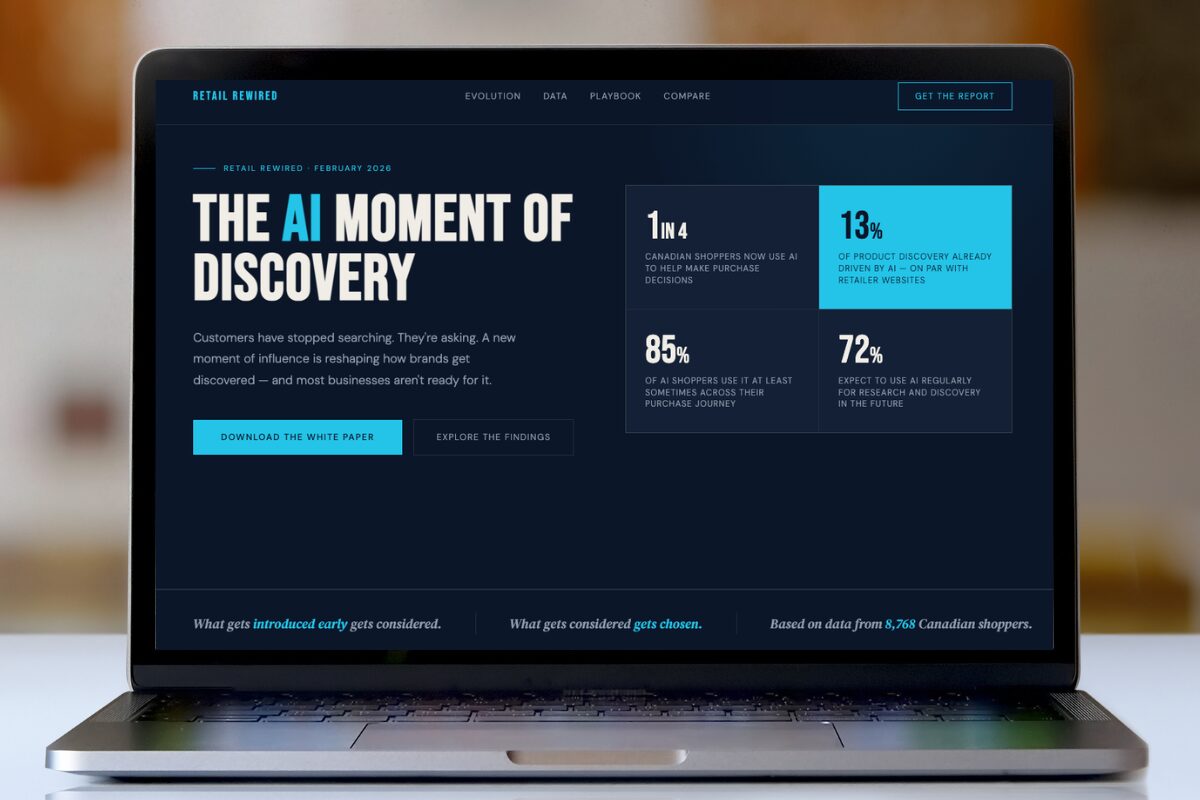
The numbers are hard to ignore. More than one in four Canadian shoppers (28%) now use AI to help make purchase decisions, and 72% expect to use it regularly for product research and discovery in the future. For retailers, restaurateurs, and hospitality operators, that represents a significant shift in how discovery works and who wins.
The full white paper is available at AIMOD.ca.
FROM SEARCHING TO ASKING
The core argument is straightforward. The way Canadians begin their shopping journey has changed. Where they once opened multiple browser tabs and assembled information themselves, they are now describing their situation to an AI and receiving a synthesized starting point in seconds.
Parsons traces the evolution through three distinct phases. It is a framework he has been thinking about for most of his career. A mentor at Walmart introduced him early on to Procter and Gamble’s First Moment of Truth, the idea that the shelf was where decisions happened, that placement and packaging were everything. Then Google introduced the Zero Moment of Truth, and the whole industry had to rethink how customers were forming opinions before they ever walked into a store.
“I learned about the First Moment of Truth early in my career, and it completely changed how I thought about retail,” Parsons said. “Then Google introduced the Zero Moment of Truth and we all had to rethink how customers were arriving at decisions before they ever walked into a store. What we are living through right now is that same kind of shift, but it is happening faster and it goes deeper.”
The moment that crystallized this for Parsons was personal. Planning a move from Ontario to Edmonton, he entered a single prompt asking for a route that accounted for his two cats, his loyalty programs, and preferred rest stops. Within seconds, he had a complete itinerary, including which gas stations aligned with his CAA membership.
“What would have taken a dozen different searches and a lot of mental math was handled in a single conversation,” he said. “But what really struck me was that it was not just giving me information. It was giving me a point of view. That is a completely different relationship between a customer and a search, and once you experience it, you do not go back.”
KEY STAT: AI now accounts for 13% of how shoppers discover products, on par with retailer websites and flyers, and closing the gap with Google Search itself.
What makes the shift significant for retailers is not just the speed. It is what happens to the consideration set. When AI provides a starting point, shoppers are no longer exploring everything available. They are refining a shortlist that was assembled before they began. Brands that are not part of that initial synthesis are effectively invisible, regardless of how strong their website or social presence may be.
“The customer is no longer your only audience,” Parsons said. “You are also writing for the systems that decide what gets recommended. If those systems cannot interpret what your brand stands for and what problem it solves, they cannot include you. And if you are not included, the journey ends before it starts.”
This connects directly to a core argument Parsons made in Retail Rewired: that retailers too often build strategies around their own operational convenience rather than how customers actually behave. The AI shift makes that gap more expensive than ever.
THE OPPORTUNITY FOR INDEPENDENT OPERATORS
One of the more encouraging takeaways from the report is that the early stages of AI-driven discovery may actually favour independent businesses, if they move quickly. Parsons draws a parallel to the early days of Google Search, when a well-positioned independent could outrank a national chain simply by being in the right place with the right content at the right time.
“The big national chains have more content behind them, but content alone is not what wins in this environment,” Parsons said. “AI is going much deeper than your website. It is reading forums, reviews, community discussions, and social posts. A local business that is genuinely embedded in its community and has real advocates talking about it online has a meaningful advantage, if they understand how to activate it.”
For small operators feeling overwhelmed, Parsons’ advice is to resist the urge to chase complexity and start with what is already within reach.
“Think about what it means to be hyper-local,” he said. “Do you support local charities? Do you show up at community events? Do you have customers who genuinely love what you do? Those stories are content. The challenge is making sure they exist somewhere that an AI can find and make sense of.”
In Retail Rewired, Parsons made a similar argument about customer immersion, using his time at Newegg as an example. Rather than commissioning traditional market research, he embedded himself in customer environments and listened. What he heard defied every assumption his team had made. The lesson was the same one showing up now in AI discovery: understand the situation your customer is actually in, not the one you have projected onto them.
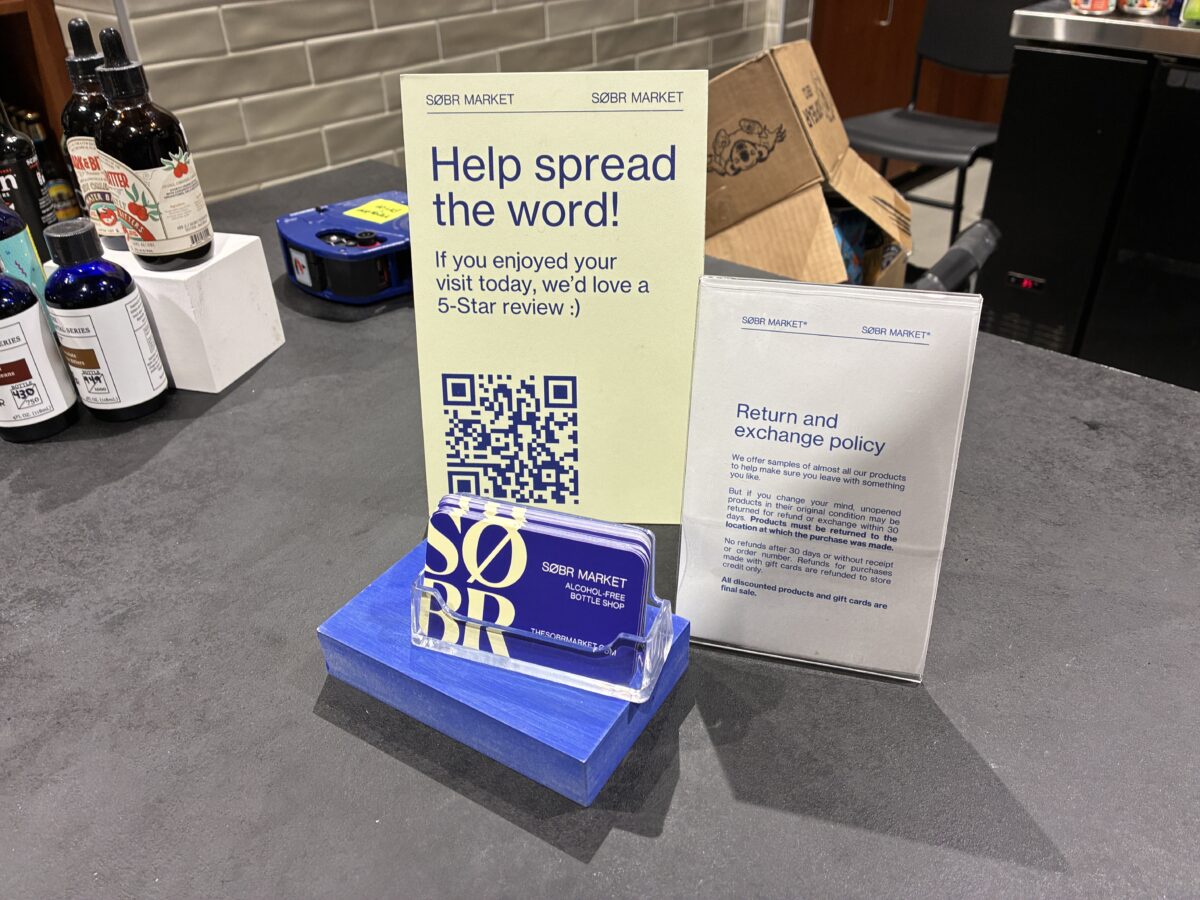
He also pushes back on the idea that chasing five-star reviews tells the whole story. What matters is not perfection but pattern. AI is not counting stars. It is interpreting what reviews collectively say about a business, the situations it serves well, and the outcomes customers consistently experience.
“If every review sounds identical, it starts to look manufactured,” Parsons said. “What builds credibility in an AI-driven world is real people talking about real experiences in their own words. That authenticity is what the algorithm is looking for.”
WHY MALLS AND THEIR TENANTS NEED TO WORK TOGETHER

The white paper’s implications extend well beyond individual retailers. Parsons sees a significant opportunity and a real risk for shopping centres and their tenants. In the AI era, a customer looking for a specific business inside a mall can now receive directions to the exact parking entrance and escalator to use. That level of specificity requires the mall and its tenants to be working from a shared, well-structured digital presence.
“The old experience was that you would walk into a mall and spend twenty minutes trying to figure out where you were going,” Parsons said. “Now a customer can ask AI exactly where to park, which entrance to use, and the fastest path to the store they want. That is a remarkable customer experience if the data is there to support it. And a significant missed opportunity if it is not.”
He argues this creates a genuine business case for collaboration between property managers and their tenants, one that has not existed in quite the same way before.
“A customer might not be searching for a specific retailer by name. They might ask which location carries a particular product, or which property is easiest to reach on a Saturday. If the mall is not indexed well for those kinds of questions, the tenants pay the price. This is a conversation that shopping centre marketing teams need to be having right now.”
He also points to a broader shift in how AI assembles recommendations across categories. When a customer asks for an outfit for a specific occasion, the AI may pull pieces from several different retailers rather than a single brand. The winner is not necessarily the retailer with the biggest marketing budget. It is the one whose product is most clearly described in the context of that specific situation.
“Collaboration is going to matter more than it ever has,” Parsons said. “The more partners are referencing your business, the more signals exist for AI to find and trust. That is not a nice-to-have anymore. It is a core part of how you get discovered.”
REVIEWS ARE NOW TRAINING DATA
One of the report’s sharpest insights concerns the role of customer reviews. The data shows that 88% of shoppers believe reviews improve AI recommendation accuracy, and 94% say AI tools would be more useful if verified reviews were integrated directly into recommendations. Reviews are no longer just social proof for human readers. They are the signals AI uses to form its understanding of a business.
Parsons is direct about what operators are getting wrong. A poor-performing product left on a website is no longer just a minor housekeeping issue. It is a signal being fed into the system every time a customer rates it poorly.
“If you know a product consistently earns poor ratings and you are still promoting it, you are not just disappointing customers,” he said. “You are teaching the algorithm that your brand is associated with poor outcomes. Go back to your suppliers. Fix it or pull it. The tools and the pace of change today mean there is no reason to let that kind of problem sit.”
This echoes one of the harder arguments in Retail Rewired, where Parsons took aim at the self-checkout loyalty paradox: the idea that retailers were asking customers to perform unpaid labour and then rewarding them with points that barely covered the cost of a bag. The underlying problem was the same. Retailers were optimizing for their own metrics while quietly undermining the experience that builds real trust.
On the flip side, operators who invest in creating genuine experiences that customers want to talk about are building something more durable than any advertising campaign.
“The goal is not to manufacture reviews. It is to create moments worth writing about,” Parsons said. “A birthday experience that goes above and beyond. A staff member who solved a problem in a way that surprised someone. When those moments happen, people share them. And when they share them consistently, the algorithm starts to build a picture of your brand that no paid media can replicate.”
KEY STAT: 86% of AI shoppers write product reviews after a purchase, meaning the people most likely to discover your business through AI are also the ones most likely to feed the system that shapes future recommendations.
THE DASHBOARD IS NO LONGER TELLING THE WHOLE STORY
For retail executives, the white paper raises a less obvious but equally critical concern. The metrics most businesses rely on are no longer capturing where influence begins. A spike in traffic combined with a drop in time-on-site may look like poor engagement in the old model. In the AI era, it may signal a highly motivated customer who already knew exactly what they wanted before they arrived.
“The customer who arrives via an AI recommendation is not browsing. They are transacting,” Parsons said. “If you are measuring success by time-on-site or pages visited, you may be misreading your best customers as your least engaged ones. The dashboard is telling you a story that no longer reflects what is actually happening.”
The more urgent concern is what the dashboard is not showing at all. If a brand is being filtered out of AI recommendations entirely, there is no traffic to measure. The journey ends before it reaches the website, and the analytics have no record of the loss.
“You could be losing customers you never even knew were considering you,” Parsons said. “That is the gap. And until you start measuring whether you are being included in AI recommendations for your category, you have no idea how significant that gap actually is.”
In Retail Rewired, Parsons made a parallel argument about organizational language, specifically how retailers called online sales cannibalization while calling a new store location growth, even when both were taking volume from the same customer base. The metrics framed the story and the story drove the wrong decisions. The same trap is now playing out at a larger scale with AI.
THE WINDOW IS OPEN BUT IT WON’T STAY THAT WAY
Parsons is direct about the risk of delay. He draws a comparison to executives who dismissed mobile commerce in 2011 because smartphone purchasing was still a small share of total sales. By the time the majority arrived, the brands that had invested early had already become the default answer.
“I hear executives say that 28% is still a minority and they can afford to wait for broader adoption,” Parsons said. “That is exactly the wrong way to think about it. By the time this reaches 60%, the AI models will already have decided which brands are the right answers. If you are not in the system by then, you are not catching up. You are effectively starting over.”
His practical starting point for any business is an honest audit of what he calls situational DNA, whether the digital presence of a business answers not just what it offers, but when and why a customer should choose it.
“Stop thinking about your content as something customers read and start thinking about it as something AI interprets,” he said. “Every article, every product description, every review response is a signal. The question is whether those signals are clear enough and consistent enough for AI to build a recommendation around your brand. If the answer is no, that is where the work begins.”
It is the same urgency that ran through Retail Rewired, where Parsons argued that the retailers most likely to fall behind were not the ones facing the hardest problems. They were the ones most comfortable with the current ones. The AI Moment of Discovery is not a new chapter in that story. It is the next one.
The full white paper, including a practical playbook for retailers ready to act, is available at AIMOD.ca.
Chris Parsons is the founder of Retail Rewired and the author of Retail Rewired: How Modern Retail Leaders Drive Growth and Reinvention. Dustin first covered Chris and his book when it launched in September 2025 on TheImmersiveLab.com. You can read that profile here: theimmersivelab.com/2025/09/retail-rewired-chris-parsons-challenges-modern-retail
Data in this article is sourced from Caddle in partnership with the Retail Council of Canada (RCC), from their February 2026 report Growing AI Influence in Shopping.

Dustin Fuhs is the founder and Editor-in-Chief of 6ix Retail, Toronto’s premier source for retail and hospitality industry news. As the former Editor-in-Chief of Retail Insider, Canada’s most-read retail trade publication, Dustin brings over two decades of expertise spanning retail, marketing, entertainment and hospitality sectors. His experience includes roles with industry giants such as The Walt Disney Company, The Hockey Hall of Fame, The Canadian Opera Company, Starbucks Canada and Blockbuster.
Recognized as a RETHINK Retail Top Retail Expert in 2024, 2025 and 2026, Dustin delivers insider perspectives on Toronto’s evolving retail landscape, from emerging brands to established players reshaping the city’s commercial districts.