
The entertainment chain will open this fall along Kingston Road in Pickering, bringing 29 lanes of 10-pin bowling, VIP service, a sprawling arcade, and a full bar and restaurant to The Shops at Pickering City Centre. It’s the latest sign that major brands are wagering on a radical reimagining of this eastern Toronto suburb—one where thousands of new residents will live in condominium towers rising beside what was once just another shopping mall.

Petr Kafka and his team have spent the past two years carefully curating a tenant mix that showcases the present, the future, and the potential. As Principal, Leasing at Salthill Capital, which manages the retail centre, Kafka has assembled a portfolio of entertainment and lifestyle tenants that serve both existing neighbourhoods and the wave of urbanites about to arrive—all while positioning the property as a community hub rather than a traditional mall.
“Selecting Splitsville for the 30,000-square-foot Kingston Road frontage was very intentional,” Kafka said. “Professionally curated entertainment is one of the most compelling ways to draw people in, enrich their daily lives, and increase time spent on site.”

Splitsville will join Cineplex Cinemas, which already operates VIP theatres at the centre, and Pickleplex, an indoor pickleball facility that opened last February and quickly became a marquee attraction. The seven-court facility occupies a former Target space and has been running packed Nike Pickleball Clinics since March.
Salthill has also launched a Community Hub program that includes space for local groups in the shopping centre for workshops and classes, as well as an indoor playground for utilization by families—the kind of programming more common at community centres than shopping centres. This program in addition to the active marketing program at the shopping centre makes way for engaging, community-focused initiatives that drive foot traffic throughout the year.
The strategy reflects how developers are rethinking suburban retail as density arrives in places that were built around cars and parking lots. Pickering is one of several Greater Toronto Area municipalities racing to build what planners call “complete communities”—places where residents can live, work and play without driving everywhere.

The difference here is scale and speed. Construction crews broke ground last October on the first residential towers of Pickering City Centre, a 55-acre development that will eventually house more than 6,000 people across at least 10 buildings. Shoring and excavation are actively underway. An enclosed pedestrian bridge crosses Highway 401 to connect directly to Pickering GO Station, where trains depart for downtown Toronto every 15 minutes during rush hour.
“The shift from Pickering Town Centre to Pickering City Centre reflects the community’s rapid evolution,” Kafka said. “People are choosing Pickering for its proximity to downtown Toronto, diverse employment opportunities, housing affordability, and exceptional transit connectivity.”
The retail centre changed its name in May 2024—from Pickering Town Centre to The Shops at Pickering City Centre—to match that evolution. New tenants have followed. Sephora opened last June. JD Sports joined the athletic retail mix. Chipotle and Dave’s Hot Chicken brought fast-casual dining options.

Even existing tenants are recommitting. Mastermind Toys reconfigured its flagship location last August and renewed its lease. Ardene has relocated and expanded.
“Pickering has become a powerful retail node on its own,” Kafka said. “Instead of travelling to neighbouring cities, residents now expect full-range retail options close to home, especially as congestion increases.”
The trade area already numbers more than 323,500 people within 10 kilometres, with a median age of 55 and average household income exceeding $162,000. The centre draws 5.5 million visitors annually, boosted by the 3.5 million passengers who pass through the connected GO station.
But those numbers will surge. Beyond Pickering City Centre itself, another 36,000 residential units are in various stages of approval or construction in the broader area. That could bring more than 60,000 new residents to Pickering within a decade—a population roughly equal to Peterborough or Brantford arriving in a single neighbourhood.
“The Shops at Pickering City Centre already serves as a key retail destination for the region, even before the new residential population arrives,” Kafka said. “But the scale of future growth pushes us to think carefully about the role this site will play in daily life.”

One space looms over those calculations. Hudson’s Bay, the 355-year-old department store chain, closed all 80 Canadian locations last June, including its anchor position at Pickering. The empty box represents an opportunity.
All the planned residential towers will rise on the southeast portion of the site, away from the former department store, giving Kafka time to be deliberate.
“The centre can support meaningful densification regardless of the future of the former Hudson’s Bay space,” he said. “As for the former HBC box, we’re evaluating several potential paths forward.”
That measured approach extends to a smaller vacancy. The former Beer Store unit closed last November and is also being marketed.
“We’ll be thoughtfully selecting users for the former Beer Store unit and exploring options for Hudson’s Bay. The interest is strong, but we remain focused on our overarching principle: creating a lifestyle centre that supports the daily needs of a rapidly growing urban community.”
The phrase “lifestyle centre” appears often in retail development pitches, usually describing outdoor shopping complexes with wide sidewalks and restaurants. Kafka argues Pickering qualifies for more fundamental reasons: the density, the transit connections, the office tower on site, the hundreds of thousands of square feet of existing retail.
“Although phrases like ‘live, work, learn, and play’ are often overused, in our case the ingredients genuinely support that vision,” he said.
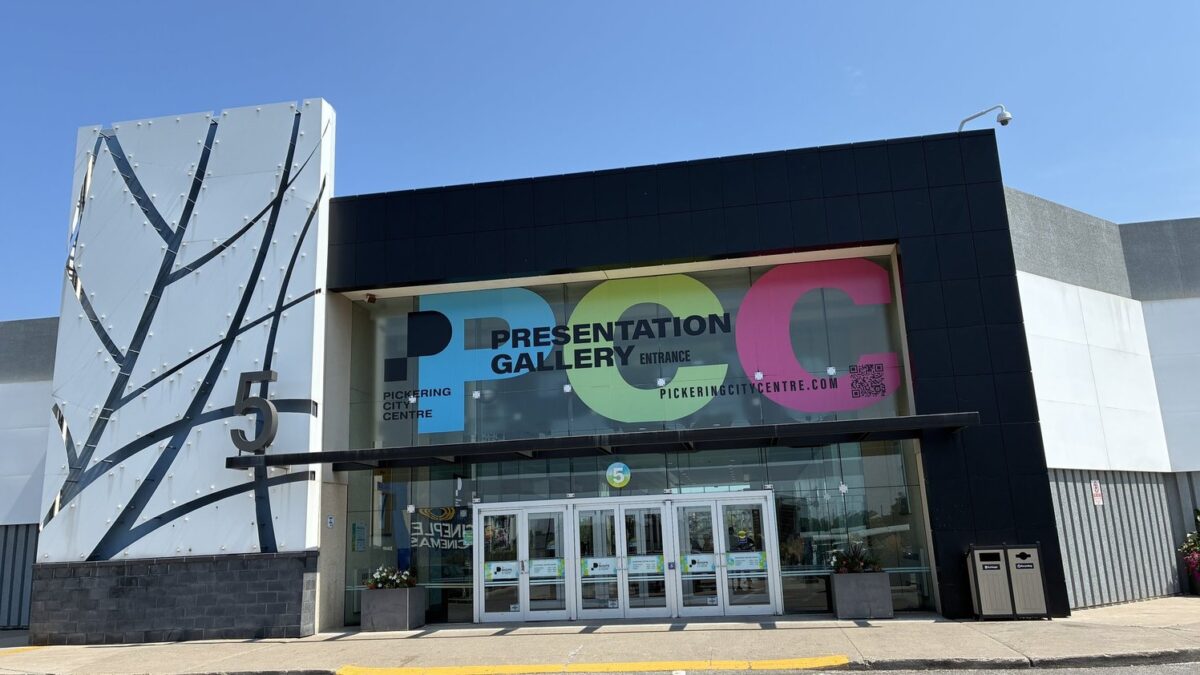
The development partners—Salthill Capital, Cowie Capital and residential developer CentreCourt—are building what they call “a truly self-sufficient urban centre.” The on-site Class A office tower and enclosed GO station connection will allow residents to walk from their condominium to the train or to work without stepping outside. Bus rapid transit is planned. Highway 401 access remains steps away for those who still need to drive.
Splitsville’s commitment—30,000 square feet is a substantial investment—suggests some companies believe the vision. So do Sephora, and JD Sports, brands that typically demand strong demographics and traffic before entering a market.
“The commitments from Sephora, JD Sports, Pickleplex and Splitsville reflect that confidence,” Kafka said.
He sees Pickering following a path already travelled by Vaughan and Mississauga, suburbs that built their own downtowns as the Greater Toronto Area expanded. The next few years will test whether Pickering can pull off the same transformation—and whether the model can be replicated elsewhere as Canadian cities grapple with housing shortages and sprawl.
“Pickering City Centre is no longer simply adapting to growth—it’s helping shape what the future of suburban-urban living can look like in Canada. As residents move in, retail evolves, and public spaces come to life, this site has the potential to become not just the heart of Pickering, but a new model for how communities can be built around connection, convenience, and experience.
“The next few years won’t just transform the property—they’ll redefine the identity of the city itself.”

Dustin Fuhs is the founder and Editor-in-Chief of 6ix Retail, Toronto’s premier source for retail and hospitality industry news. As the former Editor-in-Chief of Retail Insider, Canada’s most-read retail trade publication, Dustin brings over two decades of expertise spanning retail, marketing, entertainment and hospitality sectors. His experience includes roles with industry giants such as The Walt Disney Company, The Hockey Hall of Fame, The Canadian Opera Company, Starbucks Canada and Blockbuster.
Recognized as a RETHINK Retail Top Retail Expert in 2024, 2025 and 2026, Dustin delivers insider perspectives on Toronto’s evolving retail landscape, from emerging brands to established players reshaping the city’s commercial districts.