

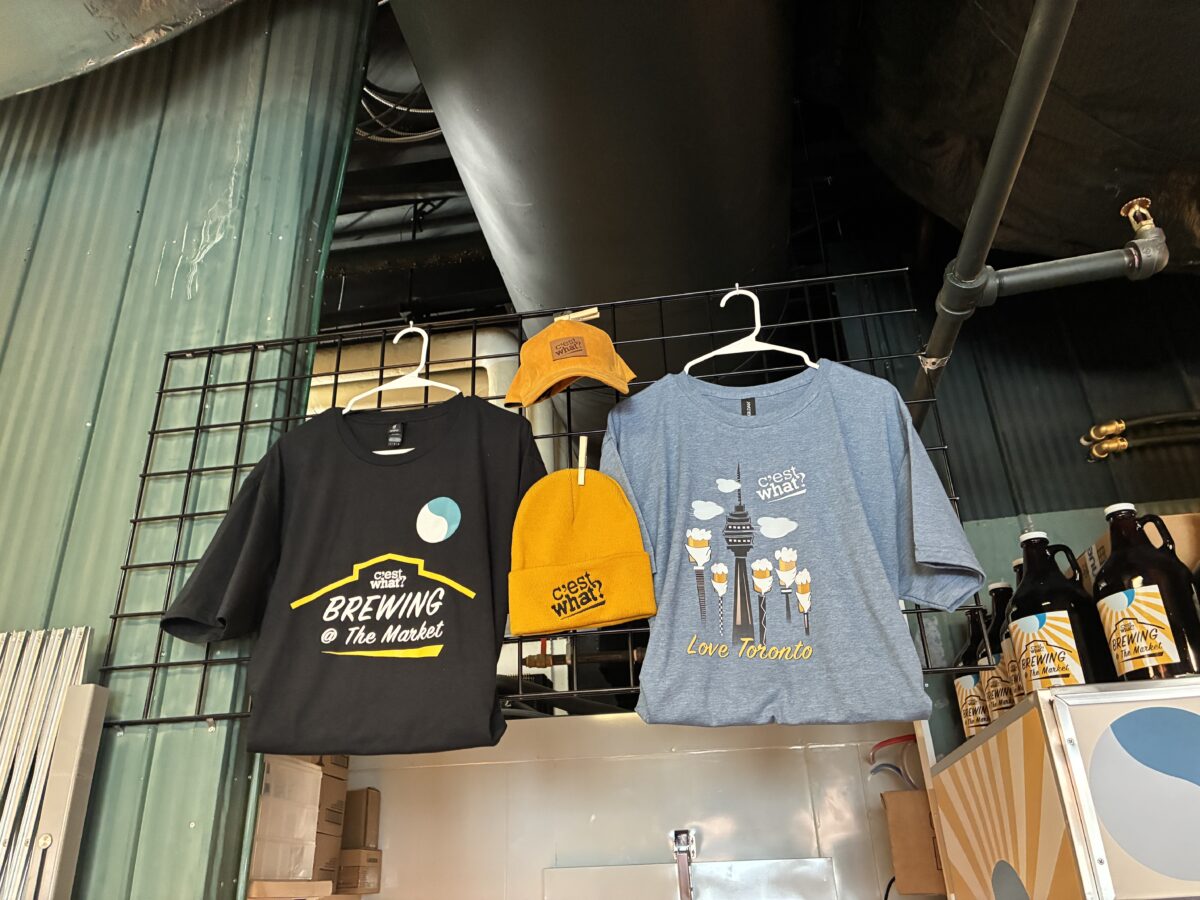
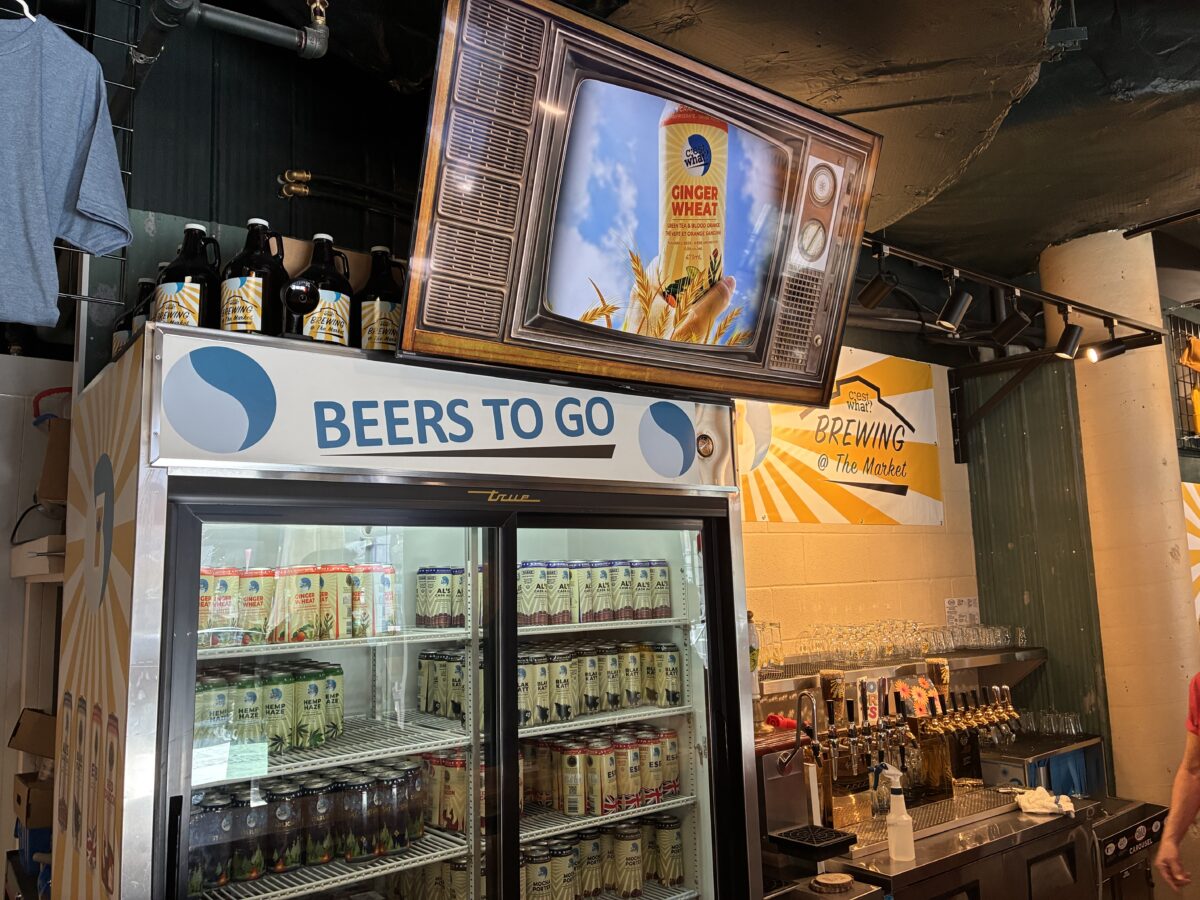
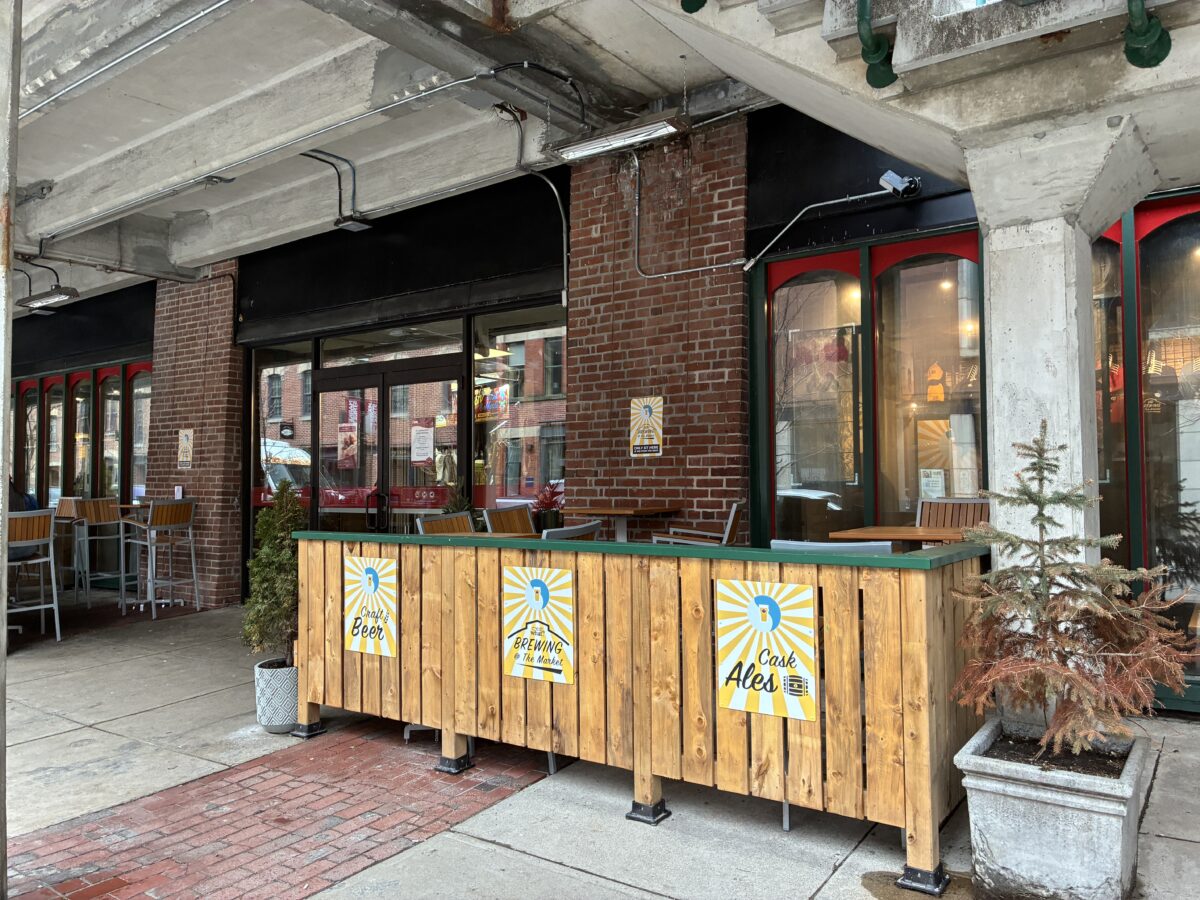
Walk down to the lower level of St. Lawrence Market, near the Market Street and Esplanade entrance, and something is different. A hand-built patio sits out front, framed in fresh wood with signs reading Craft Beer and Cask Ales catching the light. Step inside the newly opened C’est What and you will find live edge bar tops, brewing tanks humming in the background, merch hanging from the rafters, and a fridge stocked with beers to go. From day one, the place was already packed.
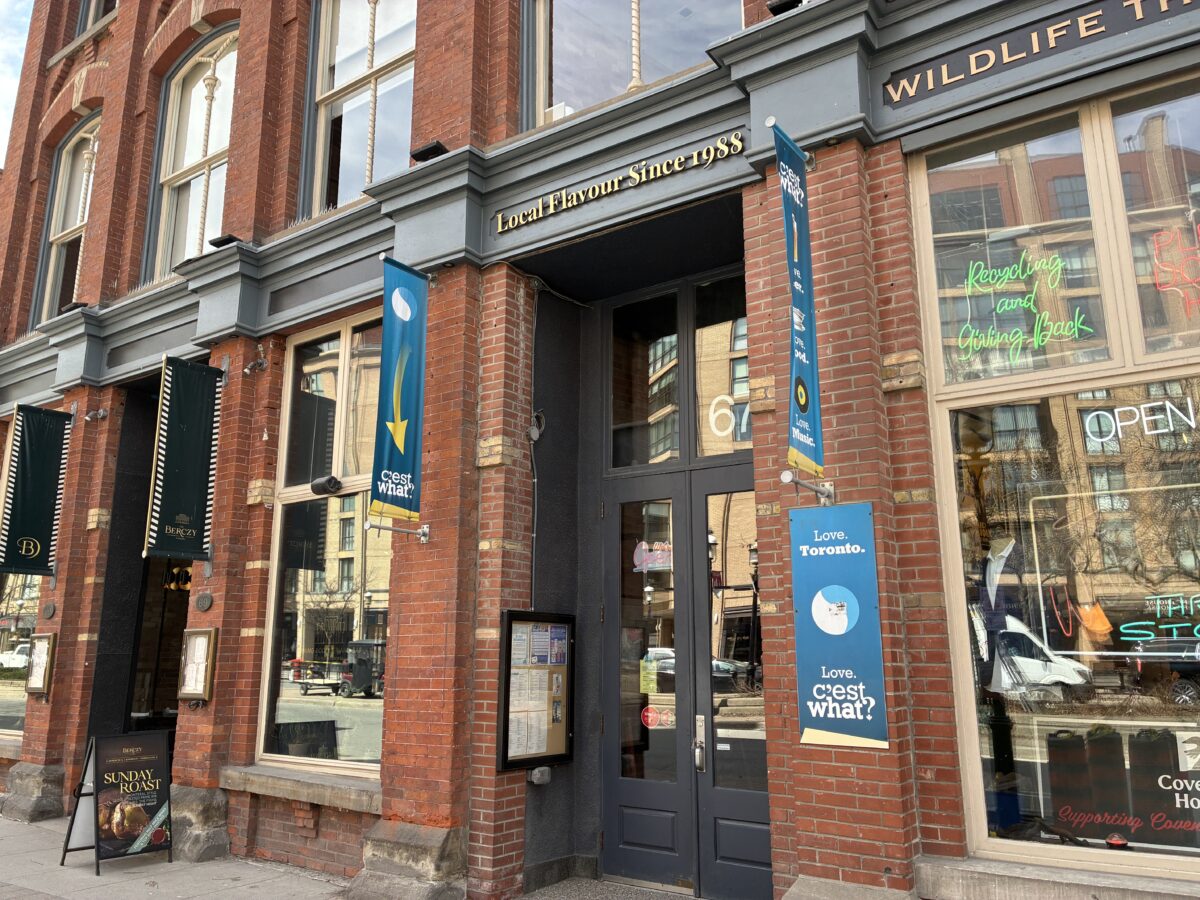
George Milbrandt has been part of this neighbourhood for nearly four decades. You may not know his face, but there is a good chance you know his bar. C’est What at 67 Front Street East has been a fixture in the St. Lawrence neighbourhood since 1988, Toronto’s original craft beer and wine destination and the first bar in the city to offer an exclusively local tap list. Generations of Torontonians have walked down those stairs, settled in beside one of the fireplaces, and never wanted to leave. That kind of loyalty does not come from marketing. It comes from a founder who genuinely loves what he built and the people who keep coming back to it.
Now that same love has found a new home inside one of Toronto’s most cherished landmarks.
It Started With an Idea Nobody Acted On
About a decade ago, Milbrandt was sitting in on a St. Lawrence Market precinct advisory committee meeting when he floated a thought. “The mezzanine on the east side has never been used, ever,” he recalls. “Wouldn’t it be lovely to see a craft brewery up there? Maybe convert the kitchen into a taproom?” Nothing came of it at the time. But the idea never really left him.
When space opened up in late 2024, he came back with a proposal for a unit on the upper level. That one did not come together the way he hoped. But the market manager believed in what Milbrandt was trying to do and came back with an alternative. The lower level corner near the Esplanade. Once they worked with the market to relocate an existing clothing tenant into a vacant unit next door, the space finally had enough room to breathe.
From there, Milbrandt and his partners did what they have always done. They rolled up their sleeves. The entire build-out was done by hand, working evenings over several months. “You kind of have to go with the bones that you’re given,” he says. “You don’t fight it.” The patio fence out front was built from scratch. Lumber from the store they cleared out was repurposed throughout. “The side of the bar is an old farm building roof,” Milbrandt says. “Leftover bricks. The store that we took out, we used most of the lumber in different things.” Nothing was brought in to manufacture a feeling.
“We wanted this place to look like it’s always been here in the market,” he says. “Certainly, from the way this looked before we moved in to now, it’s a big difference.”
Walking inside for the first time, even Milbrandt had to adjust. After nearly four decades running a bar with no windows, deep in the cellar of a Front Street building, the new space was different in one visible way. “That’s one thing that’s completely night and day for C’est What,” he laughs. “So many years in the cellar with no light. And suddenly here we are, sitting here, and there’s light streaming in the window. It’s a little disorienting.”
City Time
Getting to opening day was its own story. “Six months of licensing hell from all levels of government,” Milbrandt says plainly. A federal excise license required to legally sell beer brewed on site meant floor plans, inspections, and federal requirements that seemed to multiply with every submission. Through all of it, the signed lease did not arrive until four months after construction was already underway. “The funny part about the licensing process is that you don’t know what’s next,” he says. “It’s a lot of hurry up and wait. Very little of it makes sense. City time is like island time.”
There was a moment, not long ago, when Milbrandt experienced what it could feel like if the city actually worked with operators instead of against them. When the pandemic hit and the city needed businesses to survive, someone from City Hall called him directly. “For the first time ever, I had somebody from City Hall actually call me and say, ‘How can we help you get this across the finish line?'” he recalls. “It was like, this is the way it should be. But they quickly fell back into their old ways.”
The team doing the renovation was, as Milbrandt puts it, on the older side of the spectrum. Which turned out to be its own silver lining. “If things had moved quickly, we would have had to be in here every night doing the renovation work,” he says. “As it was, we could do it every other night. So, you know, silver lining.”
The grand opening on April 7th drew Mayor Olivia Chow. After seeing the space she floated the possibility of licensing Market Street itself, with a potential World Cup screening as a test concept. Milbrandt is not counting on it anytime soon. But he is not dismissing it either.
A Tap List Born From This Neighbourhood
The name C’est What has its own origin story, and it is a very Toronto one. “The legend we spin involves a quantity of beer and a loud party,” Milbrandt says. “I was asked the name of the yet to be built restaurant and responded: Say what?” That spirit, loose, honest, rooted in the moment, has guided every decision since.
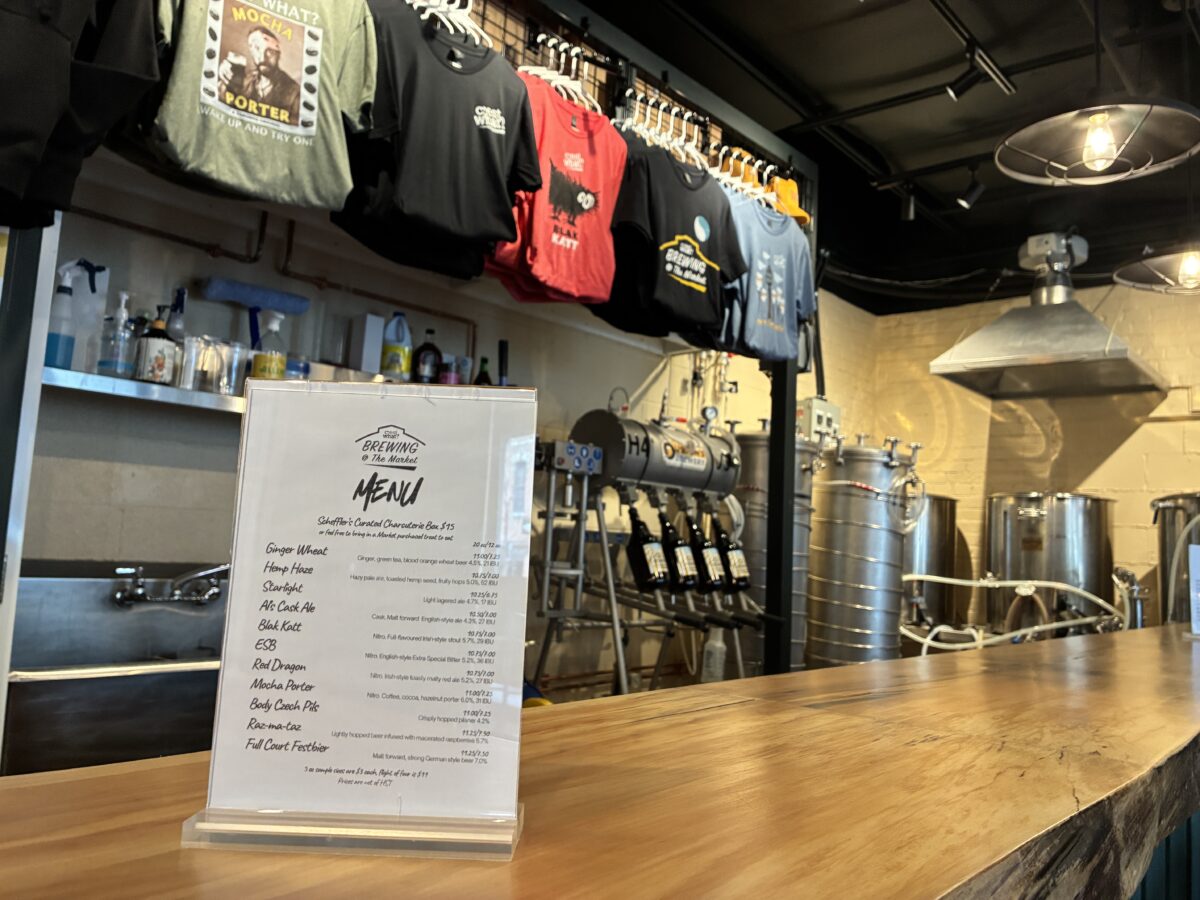
Walk up to the bar at the market location and the menu tells you exactly who this place is. Ginger Wheat. Hemp Haze. Al’s Cask Ale. Blak Katt. Mocha Porter. Body Czech Pils. Full Court Festbier. These are not generic options pulled from a distributor catalogue. These are C’est What beers, built on a brewing philosophy that stretches back to the early 1990s when Milbrandt was doing things the hard way. “We jury-rigged up contraption to make 50-litre carboys at a brew-your-own place,” he recalls, “which we then transported back to C’est What to pitch the yeast, because that was the magical act of making beer.”
“At C’est What we’ve always been about local and community from day one,” Milbrandt says. “We were the first people for an exclusive craft beer list, exclusive VQA wine list. It’s important for us to showcase the best of Toronto. And the market is ground zero for showing off the best of Toronto. So that makes so much sense for us.”
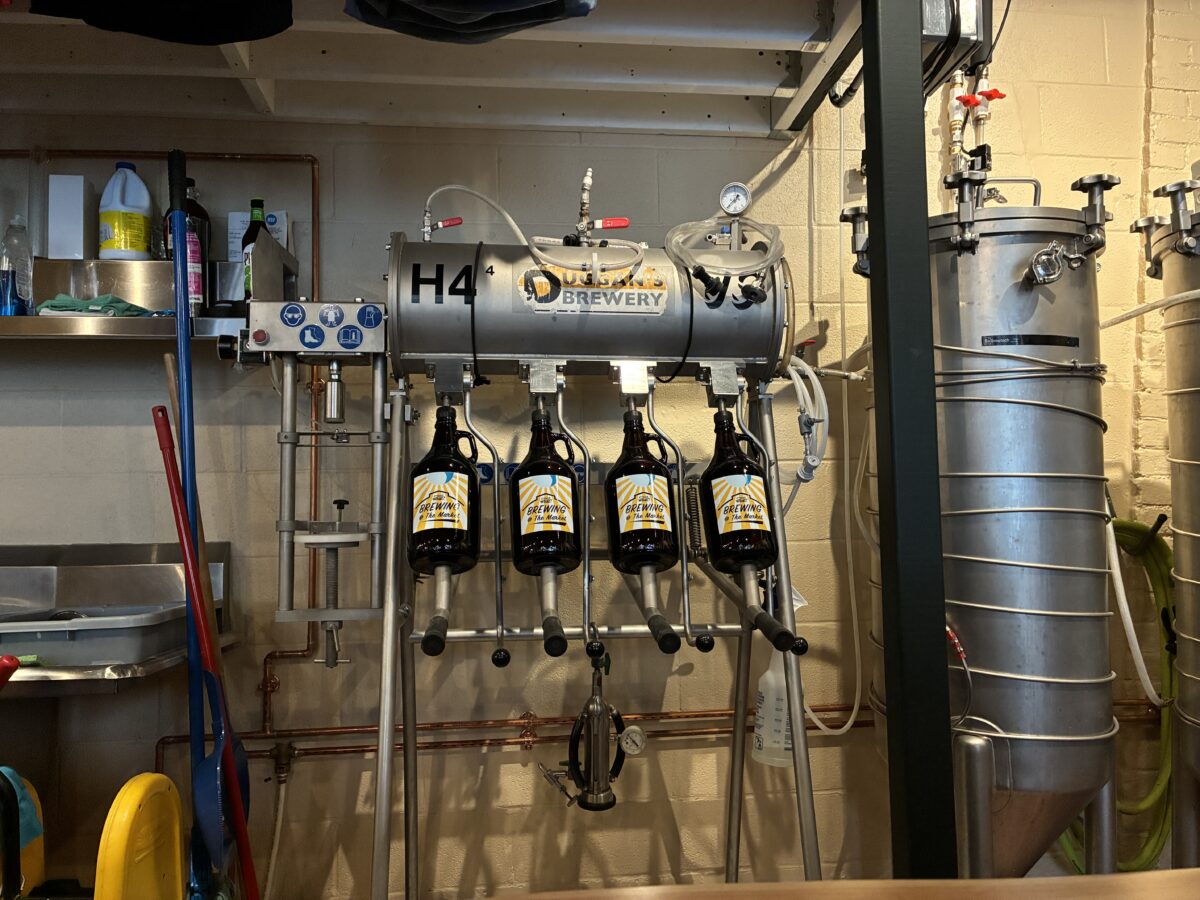
The brewing tanks visible right behind the bar are not decoration. A small test brewing system is already running and a maple beer is currently in the kettles. The longer vision is to brew in direct collaboration with market vendors, building beers around the ingredients and stories already living upstairs. “Either things that would have a source to the market, like we already do with our local quarter that has coffee roasted here that goes to the market,” Milbrandt explains. “But it can also be making the perfect beer for the specialty of whatever store we’re partnering with. The sky’s the limit,” he says. “Just a matter of herding the cats.”
A Place to Sit Down in the Middle of It All
Anyone who has spent a Saturday morning at St. Lawrence Market knows how it feels. The bag is getting heavy. The place is buzzing with vendors, regulars, tourists, and locals all moving in every direction. It is wonderful and a little overwhelming all at once. “The market is always short on space for people to sit and just take a load off,” Milbrandt says. “It’s a big hectic place to go shopping. Sometimes you just need to take a breath. And personally, I think taking a breath with a beer is a great way to do it.”
Twenty-five seats inside, fifteen on the patio out front. Grab a flight, bring your food from upstairs, and figure out your next move. “Any friends that come down and share three flights and talk about it and have fun,” Milbrandt says. “That’s what we’re here for.” You can also grab a beer to go from the fridge on your way out.
Milbrandt is also thinking about the generation of visitors who are redefining what a night, or a Saturday morning, actually looks like. “The experience is a big part of the younger generation’s outlook on life,” he says. “Being able to offer small little glasses of beer. We’re not overindulging. We’re having an experience.” The menu at the restaurant backs that up. Low and no-alcohol options from brands like Bellwoods’ Jelly King, Heartwood Sparkle, Easy Tiger, and Groovi Sangria sit right alongside the full tap list. Everyone is welcome here.
If You’re Going to Do Something, Do It Well
That line is not a slogan. It is how Milbrandt has run C’est What for thirty-eight years and it shows up in every corner of the new space. “People know that we’re going to have solid choices,” he says. “It might not be to their tastes, but we put in the effort.” The Front Street location is proof that this approach works. Still packed on weekend nights. Still pouring from a tap list built entirely around Canadian craft beer. Still hosting live music, trivia, and the kind of unhurried evenings that feel increasingly rare in a city that moves as fast as Toronto does. “There’s a certain timelessness,” Milbrandt says. “We do change, but it’s gradual. Nothing jarring.”
One good thing did come out of the pandemic. “One good thing that the pandemic left us was the ability to put a patio on that parking lot,” he says of the Front Street location. Before that, the city’s own red tape had made it nearly impossible. The moment the rules changed, so did the conversation. It is a reminder of what this city’s hospitality community can do when the path is clear.
The People Running It
Leading the new location is Anne, a C’est What original who first served behind the bar in the 1990s, left to raise a family, and has now come back to the fold twenty-five years later. “This is going to be her baby,” Milbrandt says. The Front Street team is unchanged and happy exactly where they are. This is not a staffing expansion. It is a new chapter for someone who helped build the first one.
The vendors around them have been nothing but warm. “Lots of people dropping by saying, ‘Oh it’s a really good idea. Hope you do well. This end of the market needs a little bit of life,'” Milbrandt recalls. Yianni’s nearby was already excited about extra seating for overflow customers. The market community recognized something good being built and showed up for it. “We hope to be good neighbours,” Milbrandt says, “and become part of the fabric of the market.”
As for getting the word out, Milbrandt is refreshingly honest. “I’ve got to admit that we are terrible at social media.” For now the plan is simple. Let the market do what the market does. Be good to the people who walk through the door. Let the work speak for itself. It has worked for thirty-eight years on Front Street.
Come Find It
“This was a forgotten part of the market,” Milbrandt says. “And now it’s becoming, hopefully, a central hub.”
The Brewing at the Market signs are up. The patio is open. The taps are flowing. The merch, including the Love Toronto tee and the Brewing at the Market cap, is hanging and ready to go home with someone who wants to remember they were here early.
C’est What has been part of this neighbourhood for thirty-eight years. St. Lawrence Market has been part of this city for over two hundred. Two Toronto institutions, now sharing a corner of the lower level and inviting the community in.
Head to the Market Street and Esplanade entrance of the St. Lawrence Market and go say hello to the latest iteration of a Toronto classic. This is exactly the kind of thing worth supporting.

Dustin Fuhs is the founder and Editor-in-Chief of 6ix Retail, Toronto’s premier source for retail and hospitality industry news. As the former Editor-in-Chief of Retail Insider, Canada’s most-read retail trade publication, Dustin brings over two decades of expertise spanning retail, marketing, entertainment and hospitality sectors. His experience includes roles with industry giants such as The Walt Disney Company, The Hockey Hall of Fame, The Canadian Opera Company, Starbucks Canada and Blockbuster.
Recognized as a RETHINK Retail Top Retail Expert in 2024, 2025 and 2026, Dustin delivers insider perspectives on Toronto’s evolving retail landscape, from emerging brands to established players reshaping the city’s commercial districts.