
Toronto Public Library closed a deal on November 21 for 339 Queen Street East. Purchase price: over $30 million. The building will house a new 30,000-square-foot district library opening in 2028, replacing the current St. Lawrence branch at 171 Front Street, which at 4,800 square feet has been inadequate for years.

“This strategic investment responds directly to the rapid growth we’re seeing in this part of the city and the increased demand for library services from residents here,” says Alim Remtulla, Toronto Public Library Board Chair.
The purchase caps a 17-year search for the right location. It also creates two distinct neighbourhood stories: one area gaining a major institutional anchor, and another losing its daily community hub.
Seventeen Years, Three Failed Sites
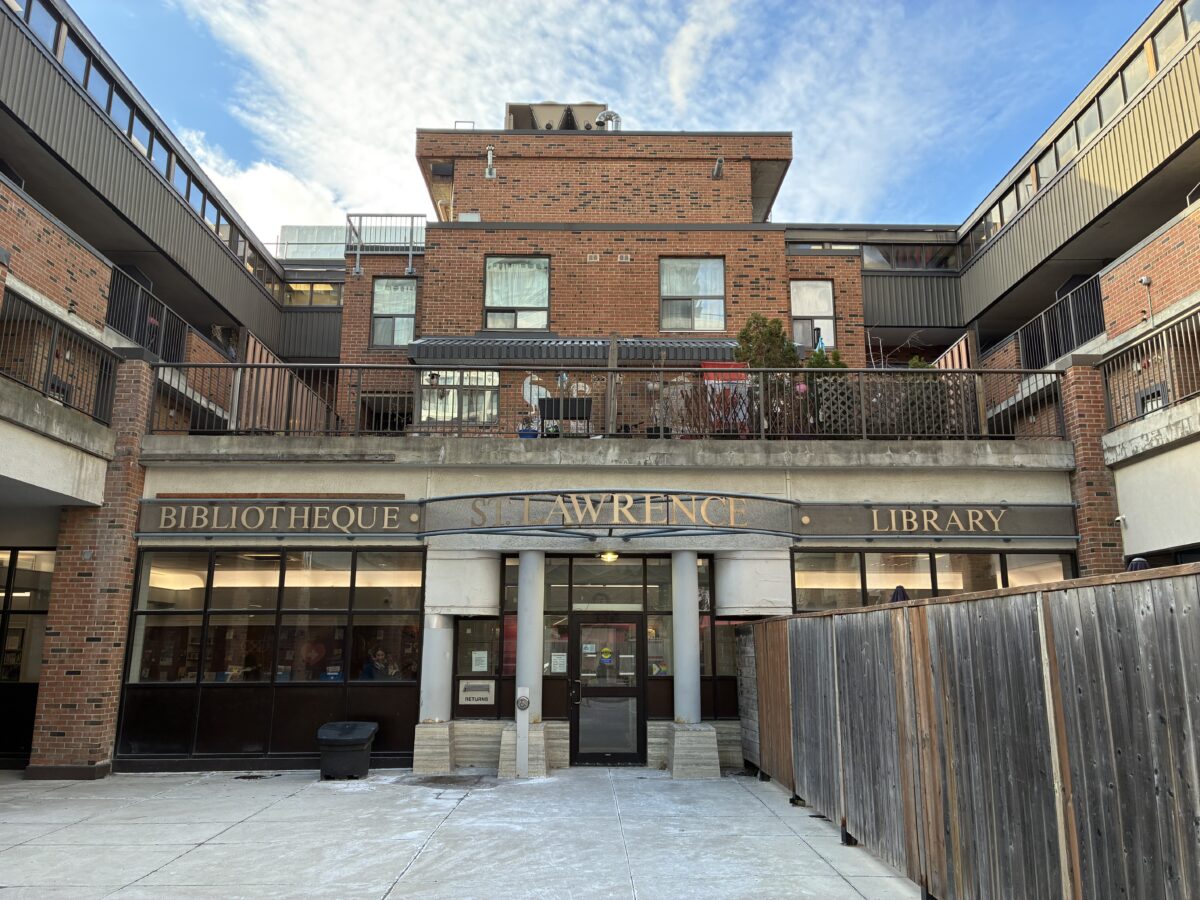
TPL has been trying to relocate the St. Lawrence branch since 2008. The current branch sits in a Toronto Community Housing building with space constraints and ongoing maintenance issues from the residential housing above it.
The first attempt focused on 281 Front Street East, the former library processing centre. TPL exchanged this property to the City in 2012 as part of a land swap to acquire the First Parliament site at 271 Front Street East. Council approved the move in 2013, with construction slated for 2016. That plan died when the province expropriated the site for Ontario Line construction.
The third try centered on 125 The Esplanade, approved in 2022. Council asked TPL and CreateTO to explore adding affordable housing above the library. But feasibility reviews uncovered serious problems: potentially contaminated soil, archaeological issues, and a constrained layout. According to the TPL staff report, building residential units above the library “would have compromised the layout of the branch and resulted in increased costs, extensive delays associated with assessments and residential rezoning and protracted construction timelines.”
The 339 Queen Street East solution addresses multiple needs at once. It’s a renovated three-story heritage building that WE Charity restored in 2017. The structure provides 40,000 square feet: 30,000 above grade for the district library, and 10,000 in the lower level for TPL’s Information Technology Services department, currently at 120 Martin Ross Avenue. Moving IT operations frees up the Martin Ross property for other City priorities.
Total project budget: $43.1 million. The current St. Lawrence branch stays open during construction.

What’s Being Built: Over 700,000 Square Feet
TPL’s purchase lands in the middle of one of Toronto’s most active development corridors. Over 15 towers are either under construction or approved for Queen Street East, Richmond Street East, and Adelaide Street East.
On the same block as the library, Generation Capital is building 333 Queen East: 50 storeys with 545 units and 41,000 square feet of ground-floor commercial space. A development application proposes a 49-storey tower at 329-345 Queen East that would keep the heritage library building while replacing surrounding low-rises.
Three blocks away, ROQ City at 261 Queen is under construction, bringing 859 rental units across two towers. Additional projects include 225 Queen East (45 storeys) and 245 Queen East (25 storeys).
South of Queen, development extends along Richmond and Adelaide: 494 Richmond (45 storeys), 517 Richmond (45 storeys), 550 Adelaide (29 storeys), Berkeley House (36 storeys), 134 Parliament (46 storeys), and 49 Ontario (46 and 50 storeys). These projects add up to roughly 700,000 square feet of ground-floor commercial and retail space coming between 2027 and 2032.
The area is also getting major transit infrastructure. Two Ontario Line stations open in 2031: Moss Park Station at Queen and Sherbourne, and Corktown Station at King and Berkeley. Both sit about 450 metres from the library. Moss Park Station projects 7,300 riders during peak hours and will serve 23,600 residents within a 10-minute walk, including 4,100 households without cars.
The City is putting $52 million into John Innes Recreation Centre and $7.5 million into Moss Park revitalization. These commitments signal coordinated institutional confidence, not just isolated private development.
Councillor Chris Moise has directed $3 million in community benefits toward upgraded programming space, virtual interview rooms, and a digital innovation hub with fabrication studio.
What St. Lawrence Loses

The relocated library sits approximately 950 metres from the current location—roughly a 14-minute walk. That puts the new facility at the northeastern edge of what’s traditionally considered the St. Lawrence neighbourhood, in an area many residents see as Moss Park.
St. Lawrence has been investing heavily in transformation. St. Lawrence Market North opened in May 2025. The neighbourhood is getting Market Lane Park and David Crombie Park revitalizations. New residential development is filling in gaps.
But the library’s departure removes something specific. Libraries generate predictable foot traffic throughout the week. Parents bring children to storytime. Seniors use computers. Students study. Residents pick up holds. Community groups book meeting rooms. This happens Monday through Saturday, year-round.
This pattern differs from weekend tourism. St. Lawrence Market North generates crowds on Saturdays, and restaurants benefit from evening and weekend visitors. But Tuesday at 2pm or Thursday morning is different. The library brought neighbourhood residents through during off-peak times—the same people who support local cafés, run errands at neighbourhood shops, and create the daily vitality that sustains businesses between peak periods.
Councillor Chris Moise acknowledged conversations with Deputy Mayor Ausma Malik, who represents residents south of The Esplanade. According to Moise, Malik “expressed concern that her residents south of The Esplanade in Ward 10 may be forced to travel over a kilometre to do something as simple as picking up a hold or dropping off of a borrowed book.”
Moise stated he “brought these comments directly to TPL and have emphasized that while I support the relocation of the St. Lawrence branch to 339 Queen Street, I also support exploring opportunities to bring new library services closer to residents in Old Town Toronto.”
The St. Lawrence Neighbourhood Association stated it “will continue to advocate strongly with TPL to provide selected neighbourhood library services in the western portion of the St. Lawrence Neighbourhood.”
No specific plans, timeline, or funding have been announced for any library services near Front Street.
It Doesn’t Have to Be Either/Or

The conversation has framed this as zero-sum—one neighbourhood wins, another loses. But Toronto Public Library’s own structure shows another path.
TPL operates 100 branches across Toronto: 81 neighbourhood branches, 17 district branches, and two research and reference libraries. Branch sizes vary dramatically. The smallest (Todmorden Room) measures just 554 square feet, while the median sits at 8,496 square feet. Toronto Reference Library is 426,535 square feet.
This range shows library service doesn’t require a single model. Neighbourhood branches serve local populations with smaller footprints. District branches like the new Queen & Parliament location serve multiple neighbourhoods with expanded services.
St. Lawrence doesn’t need another 30,000-square-foot district branch. What it needs is convenient access to basic library services—picking up holds, dropping off returns, quick computer access, browsing new arrivals. These functions don’t require the full programming space, teen zones, and fabrication studios that justify a district branch.
A 2,000 to 5,000-square-foot location near Front Street could handle the majority of daily transactions St. Lawrence residents need. This wouldn’t duplicate the Queen & Parliament investment—it would complement it.
The question is whether TPL and the City see this as a priority. For retail operators, the uncertainty matters. If St. Lawrence maintains some daily library service near Front Street, even in a smaller format, it preserves foot traffic patterns neighbourhood businesses depend on. If the library disappears entirely, retail fundamentals shift.
What Works Around Urban Libraries
Looking at successful library districts internationally reveals consistent retail patterns. These matter because Queen and Parliament is being built knowing a district library is coming, rather than retail evolving organically over decades.
New York’s Bryant Park supports specialty coffee (Culture Espresso, Blue Bottle), health-focused quick-service (Toastique), and Amy’s Bread café inside the library. London’s King’s Cross has Origin Coffee in multiple locations, Coal Drops Yard shopping district, and cafés designed for remote workers. Paris’s Bibliothèque Nationale de France has Café des Globes inside (135 square metres, 130 seats) and the Bercy Village dining district nearby.
The pattern: specialty coffee focused on quality, bakeries and pastry shops, health-focused quick-service (salads, grain bowls, smoothies), independent bookshops with café components, work-friendly spaces with wifi and power outlets.
What these districts avoid: fast food chains, bank branches, generic pharmacies, standard mall retail. The retail that works serves specific library patterns—people working who need caffeine and workspace, families combining library visits with meals, students needing affordable food.
The Timing Window for Queen & Parliament

Ground-floor retail leasing is happening now for buildings opening 2027-2029. This is before the library opens in 2028, before the Ontario Line opens in 2031, and before anyone can prove foot traffic and ridership projections with data.
Operators who understand library-adjacent patterns can lock favorable lease terms now. A specialty coffee operator signing a 10-year lease in 2025 gets rates before the library demonstrates its daily traffic, before transit stations prove ridership, and before residential towers fill with tenants.
The demographics support library-focused retail. The area is adding over 40,000 residents. Moss Park Station will serve 4,100 carless households within a 10-minute walk—residents depending on walking, cycling, and transit. The library will generate predictable daily traffic.
What Queen and Parliament needs:
Multiple specialty coffee locations – One at the library, others at transit stations, creating a corridor between stations and library.
Health-focused fast-casual – Sweetgreen/Freshii concepts emphasizing fresh ingredients and customizable bowls for younger, transit-dependent demographics.
Independent bookshop-café – Toronto lacks these. A bookshop-café near a district library creates obvious synergies with library patrons.
Work-friendly cafés – Freelancers, students, and remote workers cycle between library sessions and cafés. Good wifi, power outlets, communal tables.
Evening activation – The library closes evenings and Sundays, but residents are home and transit runs constantly. Casual dining, bars, entertainment for non-library hours.
The risk: generic tenants (banks, Subway, Shoppers) fill prime corners before operators understand what library-adjacent retail should be. Ground-floor leases typically run 10 years with renewal options, making early decisions consequential for district character.
Two Strategies

For St. Lawrence, the question is what replaces the daily anchor. Solutions could include an independent bookshop-café that becomes a gathering spot, enhanced weekday Market North programming, or community space in the St. Lawrence Centre if that redevelopment proceeds. The challenge is maintaining weekday vitality while the food and cultural destination strategy focuses on peak periods.
For Queen and Parliament, the opportunity is building a library district intentionally. The next 18-24 months set the foundation. With 700,000-plus square feet of commercial space leasing now, the retail mix selected determines what kind of district emerges.
The infrastructure is committed: $43 million library investment, $52 million recreation centre, $7.5 million park revitalization, plus 15-plus residential towers under construction. Two major transit stations opening 2031. Tens of thousands of new residents. Thousands of carless households needing walkable retail.
Toronto Public Library spent $30 million and searched 17 years to find this location. They’re betting on where Toronto’s growth is demonstrably concentrated, supported by both private development and coordinated public investment.
The question for retail operators is whether they read that signal and position accordingly, or miss it and watch the opportunity pass to whoever figures it out faster.

Dustin Fuhs is the founder and Editor-in-Chief of 6ix Retail, Toronto’s premier source for retail and hospitality industry news. As the former Editor-in-Chief of Retail Insider, Canada’s most-read retail trade publication, Dustin brings over two decades of expertise spanning retail, marketing, entertainment and hospitality sectors. His experience includes roles with industry giants such as The Walt Disney Company, The Hockey Hall of Fame, The Canadian Opera Company, Starbucks Canada and Blockbuster.
Recognized as a RETHINK Retail Top Retail Expert in 2024, 2025 and 2026, Dustin delivers insider perspectives on Toronto’s evolving retail landscape, from emerging brands to established players reshaping the city’s commercial districts.