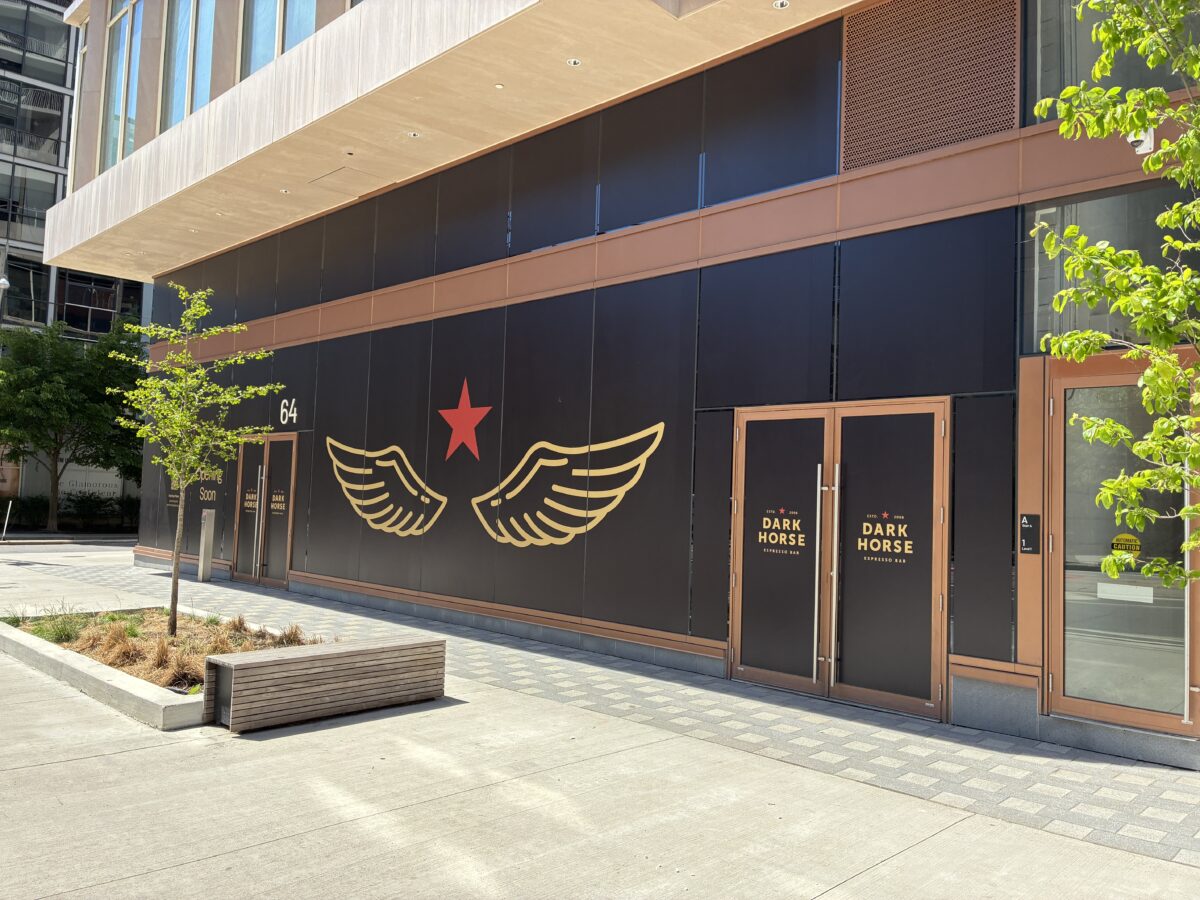

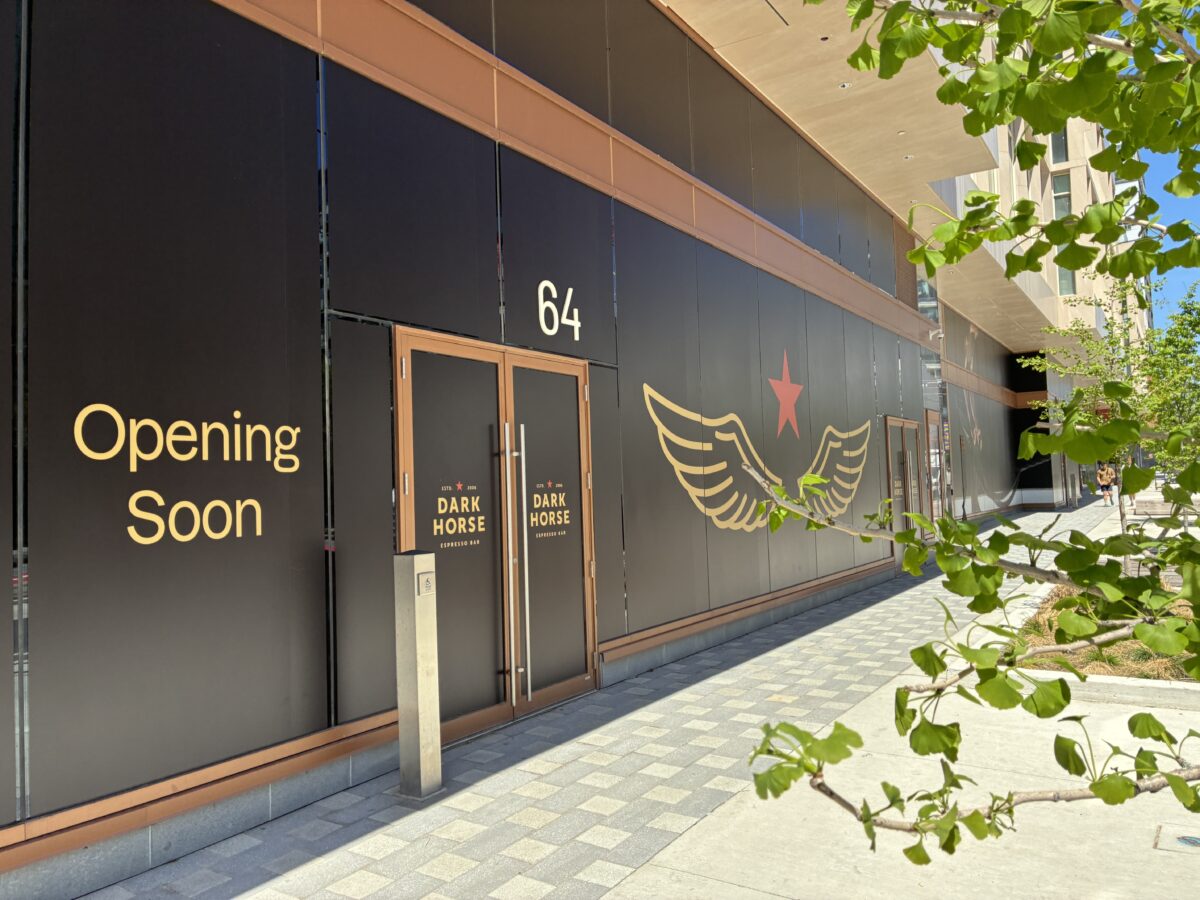
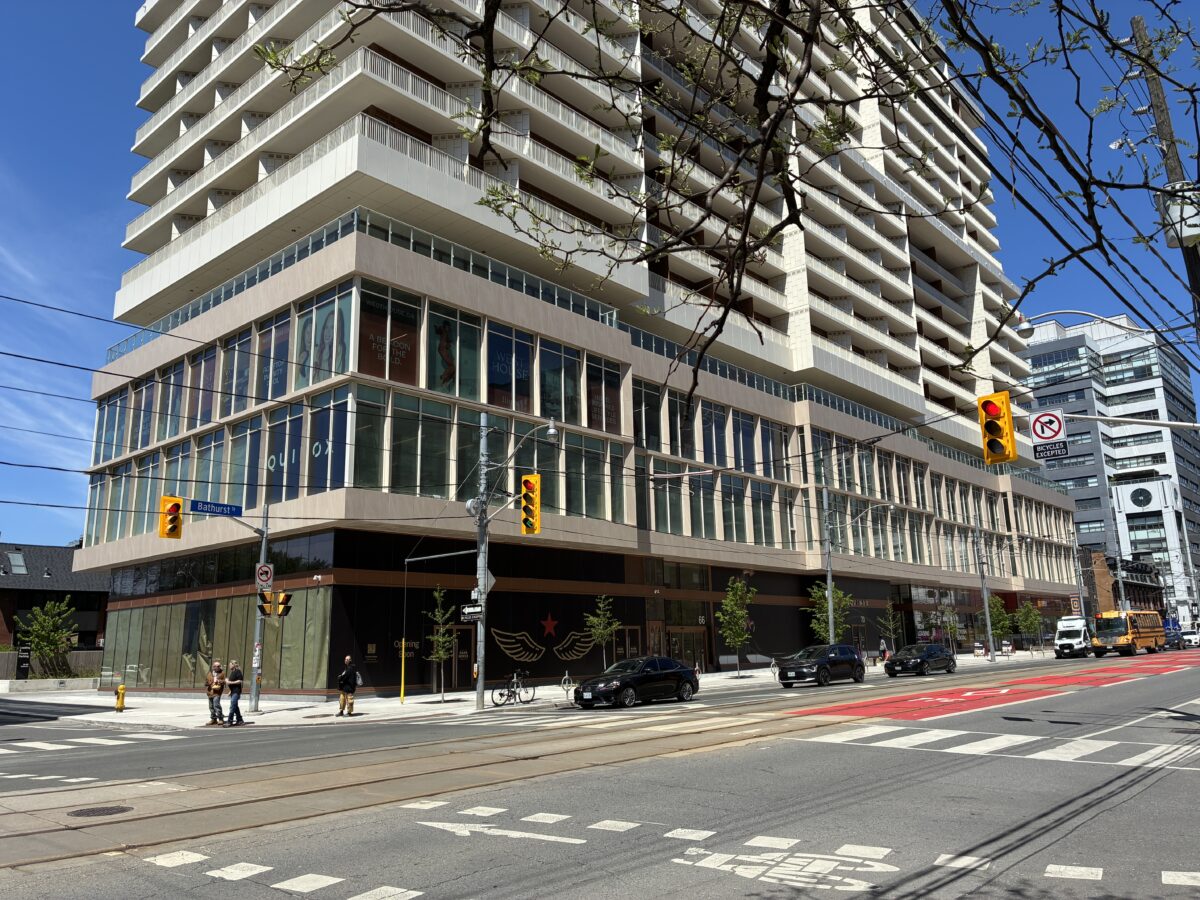
The hoarding is already up on Bathurst Street. Dark Horse Espresso Bar‘s signature winged logo in gold on black, sitting inside West House, the Hines-developed mixed-use building at Bathurst and Wellington that is shaping up to be one of the more deliberately curated retail addresses in King West. The café opens in August. A second location, at 941 College Street at Dovercourt, a former Starbucks directly across from the YMCA, is coming around the same time and may open first.
Two new downtown Toronto locations in the same summer, in two neighbourhoods with very different characters and very different stories about why Dark Horse chose them. For a brand that has been reading Toronto’s streets for two decades, neither choice is accidental.
Dark Horse turns 20 in November. The anniversary lands at a moment when the independent café sector across Canada is under real pressure. Lease costs have not come down, labour has not gotten easier, and the distance between a promising opening and a permanent closure has never been shorter. Against that backdrop, a brand that started with one location in Riverside in 2006 and is now targeting 23 units across Ontario by the end of 2026 is worth examining closely.
West House sets the context for the Bathurst opening. The development is bringing together a tenant mix that signals something deliberate. Article, the Vancouver-based direct-to-consumer furniture brand opening its largest location to date at 9,600 square feet, which we covered in March, is in the same building. Equinox is coming. Dark Horse completes a trio that speaks directly to the design-conscious, higher-income residential density building in this pocket of King West. For leasing professionals watching this corner, it is the kind of tenant combination that confirms a neighbourhood’s trajectory rather than predicts it.
Founder Deanna Zunde is direct about what drew her to Bathurst. King West took a hard hit during the pandemic. Clubs closed, foot traffic thinned, and the energy that once defined the entertainment district largely evaporated. But she sees the corner of Bathurst and Wellington as something different from what that neighbourhood once was, and something different again from what it is right now.
“King West had so much life before the pandemic, and then so much of that was just gone,” she said. “But that part of Bathurst is beautiful. Old buildings, great architecture, lots of brick. There are still people there who really love that neighbourhood for everything it was. It feels like it has had a pause rather than a full stop, and I think it is genuinely waiting to come back, to be full of people and energy and change again.”
The Ontario Line’s future King-Bathurst station, projected to open in 2031 with Metrolinx now hedging toward the early 2030s given delays on other transit projects, is part of the thinking. But getting ahead of infrastructure is how Zunde has always operated. She opened in Riverside before it was Riverside. She committed to Canary District in 2017, years before the neighbourhood had enough residents to sustain the business. The logic has been consistent across 20 years.
“Being early can mean taking the hit before the neighbourhood fully arrives,” she said. “But if you are right, you are not just another tenant moving in after the fact. You become part of the neighbourhood’s foundation. A place people associate with the area as it grows up around you.”
The landlord was represented by Alex Edmison and Jackson Turner of CBRE.
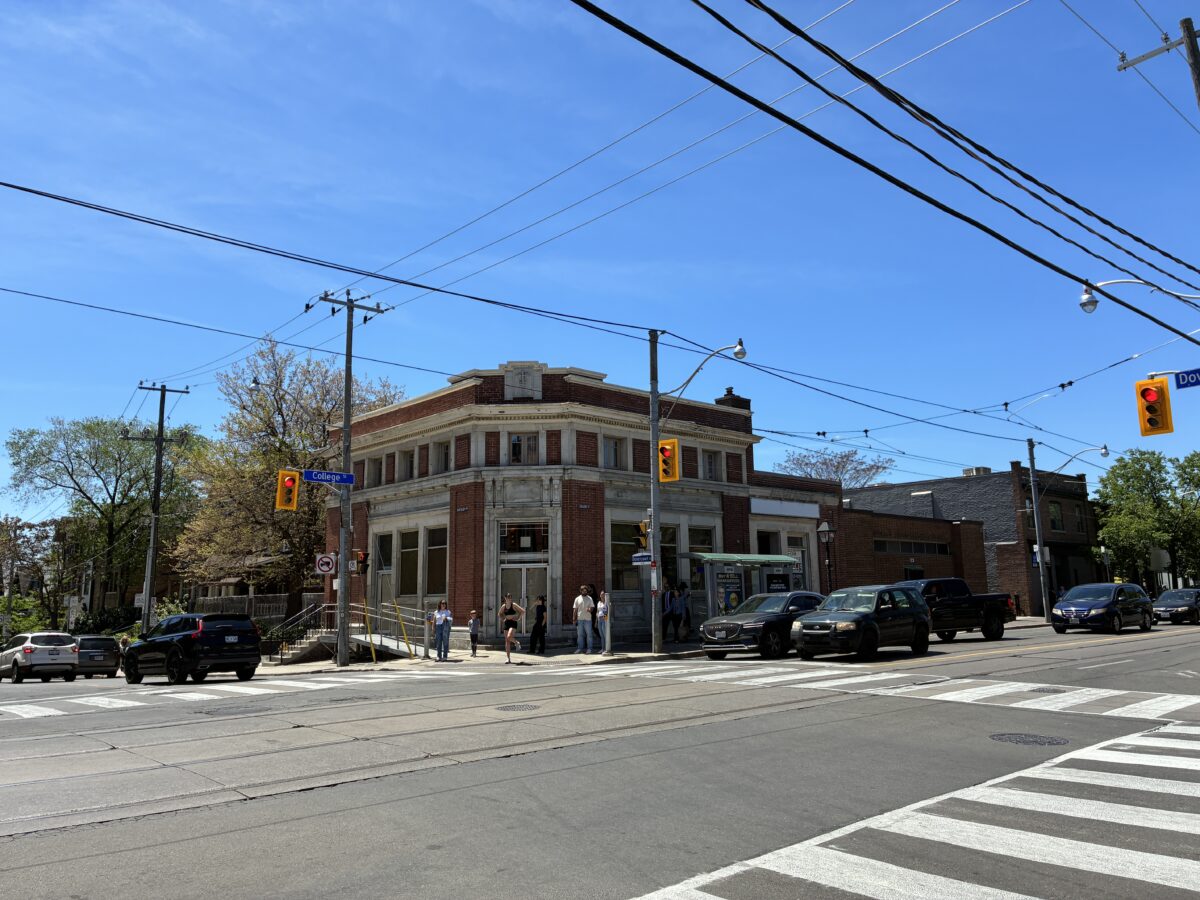
College and Dovercourt is a different kind of decision. The space is personal in a way Bathurst is not. Zunde lived in that neighbourhood throughout her twenties, working at Terroni on Queen West, and the corner at College and Dovercourt was part of her daily life during that chapter. Coming back to it as an operator, and doing something with a space that was most recently a Starbucks, carries its own weight.
The buildout will also have to reckon with what the previous tenant left behind. The original bank vault is still inside the building.
“Who does not want to be in an old bank?” she said. “The vault is still there. It is genuinely something.”
Zunde does not approach any two spaces the same way, and the contrast between Bathurst and College is a clean illustration of why. One is a forward bet on a neighbourhood in transition, inside a purpose-built luxury rental development with premium co-tenants. The other is a return to something familiar, inside a heritage building with a history that goes back well before Dark Horse, or Starbucks, ever set foot on that corner.
“Every space tells you something different if you take the time to listen to it,” she said. “You look at the bones, you think about the neighbourhood, and you let the space tell you what it needs to be. That has never changed for us, whether it is the first location or the nineteenth.”
Scaling that philosophy across 17 current locations, an Ontario-wide retail partnership with Indigo, and a parent company with nine-figure revenue targets is where the real tension lives. Dark Horse operates inside Big League Food Company, which according to a November 2025 press release is targeting 23 Dark Horse units by the end of 2026 and projecting system-wide revenues of over $70 million across its portfolio as it works toward a $100 million revenue milestone by 2028.
Zunde has been asking the same question at every stage of Dark Horse’s growth. It has not gotten easier to answer.
“At some point the brand stopped being just ours,” she said. “The community built it with us. That comes with a real responsibility to keep challenging ourselves, to be honest about whether we are staying true to the roots, and to never just replicate what worked somewhere else.”
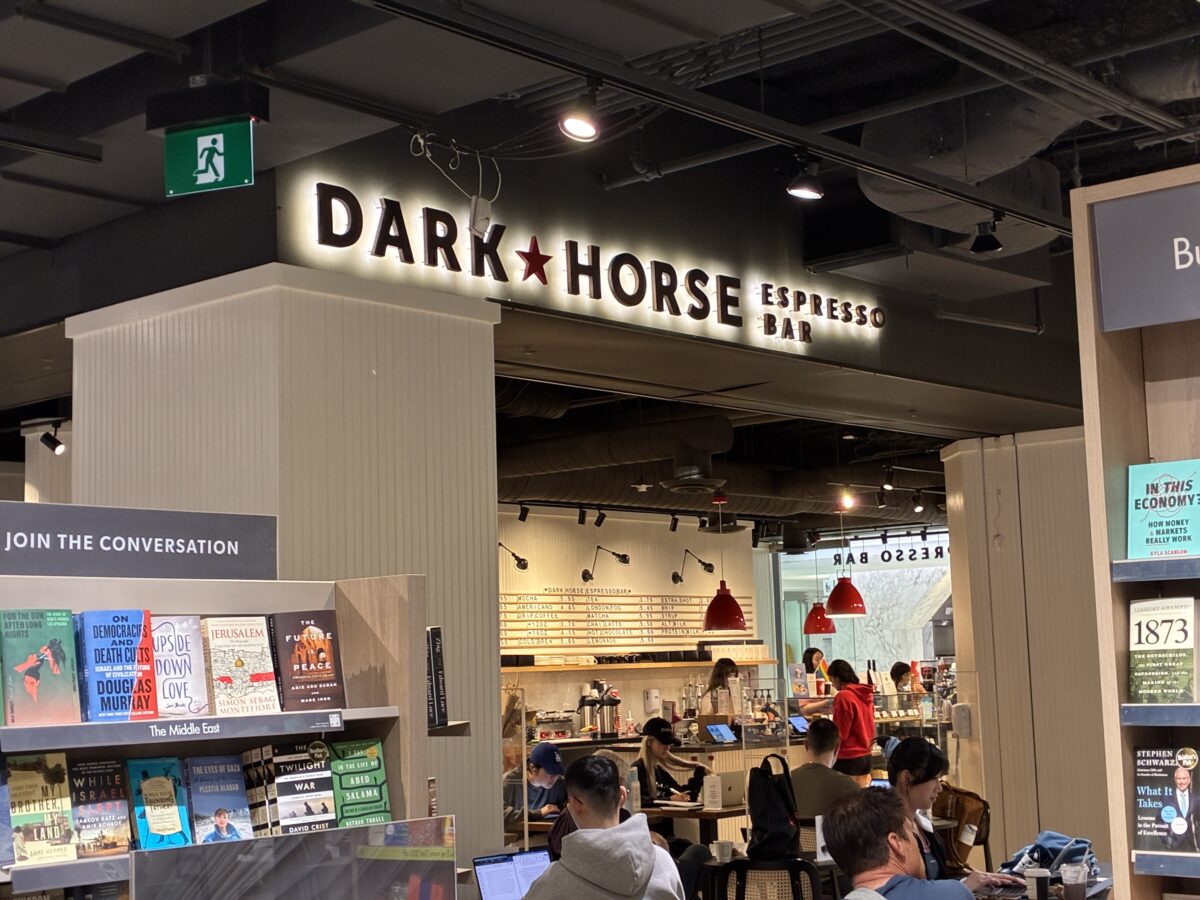
The Indigo partnership is the most visible place where that challenge plays out. Embedding inside Indigo’s retail footprint across Ontario introduces constraints that do not exist in a standalone lease. The format is tighter, the customer context is different, and the design latitude is narrower. Current Indigo locations in Woodbridge, Cambridge, Stoney Creek, Newmarket, Barrie, and London have extended Dark Horse’s reach well beyond what an independent café strategy could have achieved at the same pace. Two more Indigo locations are in the pipeline. The partnership is delivering what it is supposed to deliver for BLFC’s growth targets. But Zunde is candid about what gets compressed in that format.
“The independent locations in the city are where we have no choice but to do the real work,” she said. “There is no template to fall back on. You are responding to the space, the street, the neighbourhood, and the people who are already there. That is where Dark Horse is most itself.”
Ryan McCabe, who serves as Marketing Director for Dark Horse and Director of Coffee at Detour Coffee, the Hamilton-based roastery that has been the brand’s coffee partner since the original Riverside location, described Zunde’s approach in terms that get at something the numbers do not capture. “Dee has always created spaces that feel like they are in conversation with the people around them,” he said. “It is not about broadcasting what the brand is. It is about listening to what a neighbourhood needs and letting the café grow into that.”
The pandemic chapter is the part of the Dark Horse story that does not get told often enough in the context of what the brand is today. When café revenue collapsed in 2020, the company converted several locations into bottle shops and curated food markets, drawing on liquor licences that had mostly sat unused outside of private events. Imported wines from Portugal and Spain. Specialty pantry items. Products the LCBO did not carry. It was not a strategic pivot so much as a survival decision made under pressure.
“There was no strategic plan behind it,” Zunde said. “We looked at what we had and we used it. The marketplace model was survival, and then it turned into something we never expected people to actually love.”
What she did not expect was how much of it would stick. The Canary District location still carries the marketplace today. The volume is lower than it was at the height of the pandemic, but the customer engagement it unlocked, people treating the café as a source for curated food and beverage products, not just coffee, never fully reversed. It is now a thread in the brand’s identity that was never part of the original design.
The coffee program is the thread that has been there from the beginning. Detour Coffee has roasted for Dark Horse since 2006, and the relationship predates any formal business arrangement. Detour’s founder was a longtime Dark Horse regular. Zunde and co-founder Ed Lynds told him that if he ever opened a roastery, they would support him. He did. The house blends, 20 Grand and Northern Dancer, named after legendary racehorses, have been on the bar ever since. A rotating seasonal menu of single-origin and curated blended coffees runs alongside them, sourced through long-term producer relationships at origin. The matcha program uses Kato Spring Harvest Ceremonial Grade, stone-ground in small batches on the Kato family farm in Uji, Kyoto. McCabe’s dual role across Detour and Dark Horse reflects how integrated the two companies actually are, and how the coffee program stays connected to both the sourcing side and the café floor.
November will mark 20 years since Zunde and Lynds opened the doors at 682 Queen Street East in Riverside. The neighbourhood they moved into in 2006 looked nothing like it does today. A block away at the corner of Queen and Broadview sat Jilly’s, the east end’s most notorious strip club, operating out of the ground floor of the old Broadview Hotel, a Romanesque Revival building that had been standing since 1891. Jilly’s closed in July 2014 after 34 years on that corner. Streetcar Developments eventually transformed the building into the Broadview Hotel, which opened in 2017. The lobby restaurant, the Civic, ran for nearly a decade before closing earlier this year. It is being replaced by Archie’s Tavern this spring, a casual neighbourhood spot named after Archibald Dingman, the man who built the original structure. The cocktail menu pays quiet tribute to the Jilly’s era. The Dark Horse original location itself moved from 682 to 630 Queen East in late 2014. The neighbourhood has been reshaping itself the entire time the brand has been in it.
Events and experiences are being planned across the fall to mark the 20th anniversary, with details still to come.
Twenty years is not a common milestone in this category. Most independent cafés in Toronto do not survive a single lease. The ones that do often look very different from what they started as. Dark Horse at 20 is accelerating, not coasting, with two new downtown locations, a growing Indigo footprint, and a parent company pushing toward a scale that would have been unimaginable from that first space in Riverside.
“We did not build this alone,” Zunde said. “The whole third-wave movement in Toronto was a collective thing, a lot of independent operators all pushing in the same direction at the same time. What I am most proud of is that we are still here, still expanding, and still genuinely excited about what comes next.”
Twenty years in. Two new corners. And by every indication, a long way from done.
Dark Horse Espresso Bar currently operates 17 locations across Ontario:
- 630 Queen St E (Riverside, original),
- 215 Spadina Ave (flagship),
- 120 Geary Ave,
- 401 Richmond St W,
- 230 Richmond St W,
- 416 Front St E (Canary District),
- 55 Bloor St W (Manulife Centre),
- 1 York St,
- 100 Queens Quay E,
- and 1187 St Clair Ave W in Toronto;
- 3900 Hwy 7 in Woodbridge;
- and Indigo locations in Cambridge, Stoney Creek, Newmarket, Barrie, and London, Ontario.
West House at Bathurst and Wellington opens August 2026.
941 College at Dovercourt opens summer 2026.
20th anniversary events in November 2026. More at darkhorseespresso.com.
Dustin Fuhs is the founder and Editor-in-Chief of 6ix Retail, Toronto’s premier source for retail and hospitality industry news. As the former Editor-in-Chief of Retail Insider, Canada’s most-read retail trade publication, Dustin brings over two decades of expertise spanning retail, marketing, entertainment and hospitality sectors. His experience includes roles with industry giants such as The Walt Disney Company, The Hockey Hall of Fame, The Canadian Opera Company, Starbucks Canada and Blockbuster.
Recognized as a RETHINK Retail Top Retail Expert in 2024, 2025 and 2026, Dustin delivers insider perspectives on Toronto’s evolving retail landscape, from emerging brands to established players reshaping the city’s commercial districts.