
Canada’s non-alcoholic beverage sector added $5.8 billion to the country’s GDP in 2024 while supporting 45,000 jobs—the highest employment level in a decade—according to a November 2025 Conference Board of Canada report. Canadian households spent $12.5 billion on non-alcoholic beverages in 2024, three percent above pre-pandemic levels, with consumer preferences shifting toward beverages with functional ingredients, reduced sugar, organic certification, and plant-based components.
Against this backdrop, Sobr Market relocated its Toronto flagship from the historic Waterworks Building to Wellington Market inside The Well on December 31, trading a destination retail experience for prime position in one of the city’s busiest food halls. Located on the lower level next to Uncle Tetsu’s, the new store represents a strategic pivot for the Winnipeg-based retailer as it pursues aggressive expansion across Canada.
“Shane‘s mission has always been to make these beverages as accessible to individuals as possible,” said Jessie Halliburton, who co-founded the company with her husband Shane. “At Richmond, you needed to be a destination. At The Well, the whole open front of the store opens into the food hall, so people can see everything. They can stand back and look inside the bottle shop and really observe first before coming in.”

The relocation comes as Sobr Market accelerates expansion across Canada. What began in 2022 as an online marketplace has grown into nine locations spanning four provinces, including three Toronto stores—Wellington Market, Yonge Street, and Danforth—with plans for additional openings in British Columbia and Saskatchewan this year.
Within the broader non-alcoholic beverage sector, the zero-proof and low-alcohol category has shown particularly strong growth. Between June 2023 and June 2024, non-alcoholic spirits sales surged 67.7 percent while non-alcoholic beer—which accounts for 76 percent of the category—grew 23.3 percent, according to NielsenIQ data. Industry research indicates 70 percent of on-premise consumers across beer, wine, and spirits segments intend to continue with non-alcoholic choices beyond Dry January, suggesting sustained demand rather than a temporary trend.
From Arizona Road Trip to Business Plan
The business traces its origins to late summer 2021, when Shane Halliburton decided to stop drinking as the world emerged from pandemic lockdowns.
“In 2021, my husband made the decision at the end of the summer,” Jessie recalled. “The world was just opening back up again. Everyone was back to visiting with friends and family they hadn’t seen in over a year due to the pandemic, and it was an awkward time for many. My husband quickly realized that alcohol no longer served a purpose in his life. We had two young children at the time, and in that social setting, it didn’t allow him to be who he wanted to be.”
But in 2021, abstaining from alcohol came with social stigma. “If you said you didn’t consume alcohol, it was ‘what’s wrong with you, do you have a problem, is something going on’—all of the questions,” she said.

Shane had always loved having a drink in hand. He enjoyed a nightcap and was someone who very much enjoyed craft beer. The couple started looking for alternatives in the Canadian market but found limited options. They began importing bottles from the United States and Europe for personal consumption.
“We started looking to the U.S. and Europe, bringing in bottles for him to try things and see what was out there,” Halliburton said. “Fortunately, we were able to spend the money to bring these in and try them.”
By January 2022, Shane approached Jessie with a business proposal. “He said, ‘There’s got to be other people like me looking for these things, and not everyone has the ability to just blindly order online and pay for these, because it was very expensive to bring them in.’ He said, ‘I want to start a business,’ and I said, ‘Great.'”
Jessie had already conceived the business name—literally. “I had already thought of the name. It seriously was in a dream. It was before Shane and I had even spoken about the business. He had taken a road trip to Arizona with our son and I stayed home with our daughter—we had two children at the time, we now have four—and it was in a dream while he was gone.”
The distinctive spelling, with a slashed ‘O’ replacing the traditional ‘E’, was intentional. “That O is really meant to represent the no-and-low category,” she explained. “I just didn’t want it to be sober spelled out as S-O-B-E-R. More just for some cheekiness to it and not right there in your face, but obviously still very clear that this is non-alcoholic.”
Halliburton was on maternity leave at the time. The business launched with full intention of being an online marketplace only, but the couple attended festivals and markets in Winnipeg to set up tables so people could try and sample products.
“So many people were like, ‘What else do you have?’ If you’re someone who’s shopped with us, you know how heavy these bottles and cans can be,” she said. “When we would do these pop-ups, we could only take a selection of what we actually carried. We would set up these tables and people would say they wanted to see the full selection.”
The couple took feedback from their customer base despite facing resistance. “There were a lot of naysayers still at the time. A lot of people who said, ‘What’s the point?’ Very negative views on what we were doing, including even our family. They did not feel like this was a viable business.”

Halliburton decided not to return to work after maternity leave. The couple opened their first bottle shop in Winnipeg in a shared retail space with a small footprint.
“We knew people needed to try before they purchased, especially the spirits. They’re very expensive. This was the reason why we started the business in the first place—so people could try and experience before they committed,” she said.
The concept resonated. “We very quickly learned that Winnipeg was ready for a full-blown bottle shop and we just continued to build the business based on what we were being asked for from our community.”
They quickly outgrew their shared space and launched their first standalone bottle shop in Winnipeg in May 2023.
Smaller Space, Same Mission

The Wellington Market store occupies significantly less square footage than its 1,600-square-foot predecessor at 511 Richmond Street West, which featured a ground floor and mezzanine level. But Halliburton insists the educational experience remains unchanged.
“Yes, we are compact, but with the way our shelving is set up at The Well, if you remember being in Richmond, you’d walk in and it’s kind of this grandiose space—everything was spaced out,” she said. “We had the pillar that stacked all the cocktails and then we had the mezzanine up top, which is actually where the bottle shop pop-up originally started when it was still the coffee shop at Richmond. Everything was so spaced out our team really did need to assist customers on where to find things. Here we’ve taken all that inventory and really compacted it, so everyone can see everything along the two walls.”
The new location features a center shelf containing spirits and maintains the tasting bar with four bar chairs. “We still have the tasting bar. You can still come and have a seat at our bar and try samples of all of our spirits,” Halliburton said. “We have additional storage on-site for overflow inventory, so there’s no concern about that, which is fantastic, and that’s one of the benefits of being at The Well.”
She emphasized the experience would not be compromised. “The weather has not been great—you guys are very slushy right now—but you can come in and walk around and enjoy, come pull up a chair and still experience what you did at Richmond.”

Franchising and Education
Sobr Market’s rapid growth relies heavily on franchising. Burlington, the Danforth Toronto location, and Vernon, British Columbia, operate as franchises.
Craig Renfrew, who opened the Vernon location in September 2025, is an addictions counsellor with 19 years of sobriety. The Burlington store opened in August 2025. Calgary opened in early December 2025.
“All of our retail locations are either Sobr team members, which are trained by one of our existing team members, and so that mission is really drilled into our team that we are here to educate, we are here to allow people to sample and try and be curious about what is out there,” Halliburton said. “Or they are franchisees. Burlington, Danforth, Vernon—those are all franchise stores, and all of those individuals have come in and wanted to open a bottle shop for the passion of bringing non-alcoholic options into their community. Community members who are bringing us become that source of education and trust. They’re very involved in their community.”
The company maintains control through intensive training and ongoing oversight. “We have constant contact with our franchisees. We do a lot of chatting with them ahead of time on why they’re curious about opening a store, what’s their background,” Halliburton said. “We also do training with them. We have regional managers partnered with franchisees. There’s constant contact. We check in with them weekly. They will either come to Winnipeg or Toronto for training before opening a store, or we send one of our team members out to help them launch their location, so there is a lot of on-site training ahead of time.”
Hospitality as the Next Frontier
Beyond retail, Sobr Market is pursuing the hospitality sector. The company curates the beverage menu at NRG Haus, the social wellness club opening in Liberty Village in February, and recently hired a sales director to travel Canada consulting with bars, restaurants, and hotels.
NRG Haus—short for Nourish, Recharge, Gather—represents a new category of social wellness club that blends contrast therapy with community gathering. Founded by Fit Factory Fitness’s Ivan Ho, the 5,000-square-foot venue features a 60-person sauna, four temperature-controlled cold plunge tubs, and a non-alcoholic bar designed to resemble an LCBO but stocked entirely with dealcoholized spirits and functional beverages. Sobr Market curated over 20 spirits from around the world for the venue, including dealcoholized versions of major brands like Tanqueray and Captain Morgan alongside boutique options infused with adaptogens.
The partnership reflects Sobr Market’s strategy of positioning itself as the go-to supplier for Toronto’s emerging alcohol-free hospitality scene.
“It is our vision because people are looking for these options,” Halliburton said. “Those of us that do not consume alcohol don’t want to go to a venue or a restaurant or anywhere on-premise and be handed—I hate to say it—a kid’s menu with juice and water and pop. We are looking for experiences. We are looking for a crafted cocktail. We are looking to still partake in an adult and sophisticated way. And we are willing to pay for that.”
The pitch to on-premise accounts challenges conventional pricing assumptions. “A lot of conversation we’ve had with certain on-premise accounts is, ‘Well, people aren’t going to pay $14, $16, $18 for a crafted cocktail because it doesn’t have alcohol,'” she said. “We really look to educate and say, but why not? Why are you putting such a high value on something that contains alcohol when those of us who don’t consume are looking for these alternatives and are really just looking for the experience? We are willing to pay for that experience when it’s crafted with care and thought put into it. Don’t put value on the fact that something contains alcohol, because in the end, it’s not a true representation of the industry at all.”
Sobr Market can recreate an existing alcohol menu in non-alcoholic form or develop entirely new offerings. The company is also exploring hotel partnerships.
“You have alcohol offerings for when people check in in their room. That is not necessarily the right option for everyone, so how about we help you create and curate some packages where, when someone books with you, they can ask for the alcohol to be removed but replaced with a non-alcoholic bar offering in their accommodations?” she said.
The company is also in conversations with restaurant and bar associations about mental health for industry workers. “We’re talking with the restaurants association here in Winnipeg really just around that wellness for those who work in the industry as well,” Halliburton said. “It continues to snowball and build into the next thing.”
The company is the presenting partner for Beyond NOA, a Canada-wide non-alcoholic cocktail competition. Running from January 5-26, 2026, the competition invites bartenders across Canada to submit non-alcoholic cocktails inspired by Canadian terroir for a chance to compete at the national finals in Quebec City on April 14, with prizes valued at $10,000.
“That gets non-alcoholic products into the hands of bartenders and really starts to let them play around and see what is possible, what they can do with those products,” Halliburton said.
Product Evolution
When the Halliburtons began sourcing non-alcoholic beverages in 2021, the quality varied. Three years later, the category has transformed.
“We laugh thinking back to some of the initial mimicking spirits—whether it be a tequila or a whiskey—that we tried three years ago versus what is on the market today,” Halliburton said. “We’ve seen red wine evolve so much in the last three years. Rather than have a dealcoholized red wine be an afterthought, you’re seeing wineries over in Europe, especially, where they are taking their cream of the crop, their best wines, and dealcoholizing them rather than just the leftovers.”
She cited Zeronimo, which dealcoholized a 20-year aged red wine. “They thought that they would be selling it as an alcohol red and they chose to dealcoholize it. And it is fantastic.”
Asked if any spirit remains impossible to replicate without alcohol, Halliburton was optimistic. “Is there anything that’s not possible? I don’t think so. I think we will continue to see the product evolution and the chemistry. People are just having fun with it too—there’s just so much to experiment with. I think it’s part of the market right now—who can develop the process and hold it as close to them as they can to produce something that is awe-striking to the masses.”
The Boxcar Social Connection
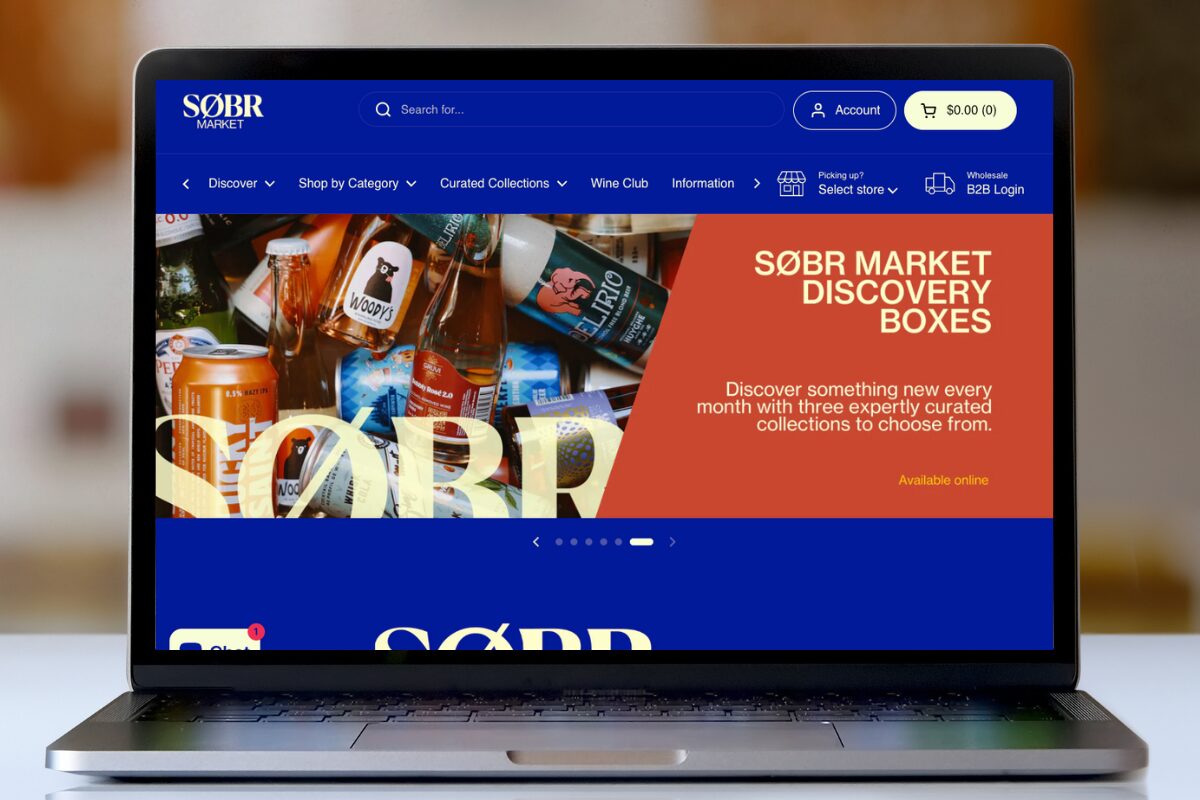
The Toronto expansion gained momentum through partnership with John Baker of Boxcar Social. The relationship began when Beatrice Society, the wellness-focused café previously occupying the Waterworks Building space, sought to expand its non-alcoholic offerings.
“It was a mutual contact between the two of us that reached us and said, ‘Hey, we’ve got someone in Toronto who’s looking to offer non-alcoholic options. They have some space within their coffee shop. They want to create a small bottle shop, but they just don’t know—you seem to be the experts in it, so would you consider?'” Halliburton recalled. “Shane and I flew out to Toronto and met with John and some of the other team out there, and it just seemed to click. The conversation was easy. The motivation behind it, the mission behind why we were doing what we were doing, why they were looking to expand into doing what they were doing—it just worked out really well.”
Sobr Market launched a pop-up on the mezzanine level at Beatrice Society. “Very quickly, John and his team came to us and said, ‘Hey guys, this is going great. Maybe we need to take over the full space,’ and we said, ‘Yeah, great, let’s just keep going.'”
The relationship continues to inform the company’s on-premise strategy. “Boxcar has been a fantastic way for us to trial products in on-premise as well. Where Shane and I are passionate home connoisseurs, Boxcar brings professional palates, and that’s helped us develop the confidence to talk to on-premise accounts. Especially with Winnipeg’s market being so different than the Toronto market, it’s helped us learn a lot and develop those skills that we need to talk to on-premise accounts and grow that way.”
What’s Ahead
Following openings in Calgary in December 2025 and Wellington Market on December 31, Sobr Market has expansion plans across Canada.
“We definitely have further retail expansion,” Halliburton said. “We have plans for an additional B.C. location this year, we have plans for a Saskatchewan location this year. Hopefully further expansion outside of the GTA to create a little bit more of that reach. I know not everyone loves to come into Toronto. We have a lot of fan base out in Ontario.”
The sales director will be traveling across Canada. “He will be on the road, sampling and having those conversations, and really, hopefully by spring and summer, we are going to see a lot more on-premise presence with great options for those who are not completely sober, just even those who are looking to be mindful—have an alcohol cocktail, have a non-alcoholic cocktail.”
The company positions itself as both retailer and consultant. “Our team is here to support—whether this is someone who is looking to consume for themselves, someone who is looking to explore for their commercial office to create an experience for their employees, whether it’s an on-premise account, whether it’s a smaller retail location who’s just looking to include a few options in their offerings—reach out. We are here to support. We are here to provide insight into the market and help curate a selection.”
Halliburton emphasized the company’s willingness to share knowledge. “If you’re curious, if you have questions, if you’re looking to start in the industry, we are here to answer those questions and provide those experiences, provide the samplings. Shane and I just keep saying, we’ve been doing this for a few years. We’ve made some mistakes, but we continue to learn and grow, and we are happy to share that knowledge with those who are curious.”

Dustin Fuhs is the founder and Editor-in-Chief of 6ix Retail, Toronto’s premier source for retail and hospitality industry news. As the former Editor-in-Chief of Retail Insider, Canada’s most-read retail trade publication, Dustin brings over two decades of expertise spanning retail, marketing, entertainment and hospitality sectors. His experience includes roles with industry giants such as The Walt Disney Company, The Hockey Hall of Fame, The Canadian Opera Company, Starbucks Canada and Blockbuster.
Recognized as a RETHINK Retail Top Retail Expert in 2024, 2025 and 2026, Dustin delivers insider perspectives on Toronto’s evolving retail landscape, from emerging brands to established players reshaping the city’s commercial districts.