
Starbucks Canada is launching a completely redesigned loyalty program on March 10, replacing its current structure with a three-tier system that segments members into Green, Gold, and Reserve levels based on annual Star accumulation. The overhaul affects 38 million active members across North America and introduces differentiated earning rates, birthday reward windows, and Star expiry policies designed to reward frequent customers while managing program costs.

“We’re evolving the program based on what our members told us matters most, offering faster, more meaningful benefits that make them feel appreciated,” said Tressie Lieberman, Starbucks global chief brand officer. “This evolution is a key milestone in our Back to Starbucks strategy and will reinvigorate what it means to be a Starbucks Rewards member.”
The timing is notable. While Starbucks invests heavily in rewarding existing customers, the company has closed over 40 Toronto locations since 2021, including 13 stores last September. The loyalty overhaul won’t address those operational challenges, but it represents a strategic bet that smarter rewards can help retain customers who still have a Starbucks nearby.

“A loyalty program is built to drive repeat business. It’s not a fix to operational issues,” says Lia Grimberg, Principal at Radicle Loyalty and loyalty expert with 20+ years experience in the Canadian retail industry. “This is not an acquisition play—this is a repeat business play. It drives better migration between tiers, getting customers more entrenched with the brand.”

The new structure is straightforward on paper. Green members earn 1 Star per dollar spent. Gold members—who accumulate 500 Stars within 12 months—earn 1.5 Stars per dollar. Reserve members, earning 2,500 Stars annually, receive 1.7 Stars per dollar. Reaching Gold requires $500 in annual spend. Reaching Reserve requires $1,833 in total spending over 12 months—more than $150 monthly.
However, there’s a devaluation buried in the details. Currently, members can earn 2 Stars per dollar on preloaded funds. Under the new program, members will only earn bonus Stars on preloads starting at $30—10 Stars for a $30+ reload and 25 Stars for $50+. For heavy users who regularly preload their Starbucks cards, this represents a significant reduction in earning power.
But Grimberg argues the earning rates are the least interesting part of the program. “It’s about perception and status, and only a little bit about motivation,” she says. “Very few members will actually do the math or even know their balance. What matters more are the fine points, usually found in the terms and conditions.”
Where the Real Value Hides

The birthday treat redemption window exemplifies how program details matter more than headline features. Green members get 24 hours to claim their free beverage or food. Gold members get seven days. Reserve members receive 30 days.
“It’s huge,” Grimberg says. “It doesn’t cost Starbucks anything incremental—it’s all about perception. The Green members only get one day—these are not the people they’re trying to impress. Whereas Gold and Reserve members are there all the time.”
Travelling on your birthday? Forget to redeem? As a Green member, you’re out of luck. Gold and Reserve members get actual flexibility. The segmentation is intentional and efficient. “Only 1% of members will qualify for Reserve, about 15 to 20% for Gold,” Grimberg explains. “But everyone has a birthday.”
Birthday rewards represent a significant cost line for loyalty programs—every member gets one annually, making redemption rate management critical to program economics.
Star expiry follows the same strategic thinking. Green members’ Stars expire after six months unless they complete monthly qualifying activities like purchases or redemptions. Gold and Reserve members unlock Stars that never expire.
“They’re betting this on the right people—what they’re doing is 100% smart,” Grimberg says. “The bulk of people will sit in the Green tier. If those members—who are clearly much less engaged—spend or redeem at least once monthly, they can keep their Stars.”
This structure is designed to drive breakage—the industry term for unredeemed rewards that expire. By requiring monthly activity from Green members to prevent expiry, Starbucks ensures occasional visitors contribute to the program’s financial sustainability while engaged customers never lose value.

“We heard concerns about Star expiration, which led us to create new ways to extend Star life, or remove expiration entirely as members move up in the program,” said Deborah Neff, Vice President of Product and Marketing at Starbucks Canada.
For Gold members, the non-expiring benefit costs Starbucks virtually nothing. “At a Gold member level, if they’re spending $500 a year, that’s about $42 a month. They’re clearly stopping by regularly. Because of the monthly activity, their Stars wouldn’t expire anyway,” Grimberg explains. “This is a way to reward the best customers without adding incremental cost.”
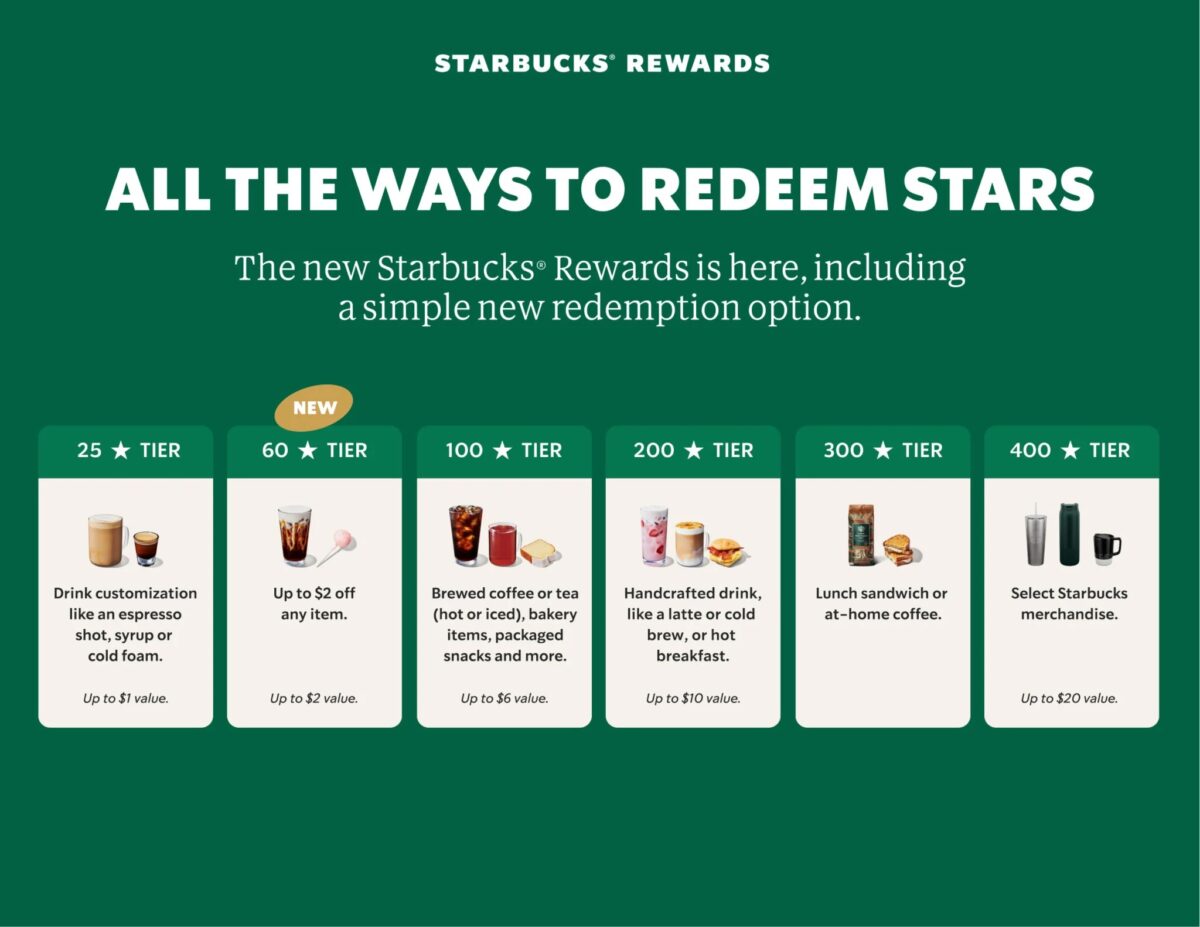
The program also introduces a new 60-Star reward providing $2 off any purchase—achievable in as few as four visits. “The previous iteration was very much dependent on what you were redeeming for, and the dividend was more difficult to calculate,” Grimberg explains. “Whereas ‘take $2 off any item’ is very tangible and very easily attainable. This brings it closer to being transparent.”
Free Mod Mondays—offering Green members one complimentary beverage modification on a selected Monday each month—serves a different tactical purpose. “Monday is not necessarily the day you think of ‘Oh, I really need a coffee,'” Grimberg notes. “So they’re driving traffic on a non-typical day.”
The Partnership Wave in Canadian Loyalty
Grimberg sees the Starbucks redesign as part of a broader shift happening across Canadian loyalty programs in 2026. “Partnerships are going to be big this year, particularly as loyalty budgets are being reduced,” she explains. “The old value proposition was ‘this or that’—in the new world it’s becoming ‘this and that.’ You’re earning in both programs and getting double the value.”
She points to Canadian Tire’s partnership strategy and Blue Rewards adding MTY Food Group properties as examples of this trend. “If I spend $10 with you a month and earn 10 cents, multiply that by 12—I’m not earning anything of value by the end of the year,” Grimberg says. “Partnerships allow members to earn more across different touchpoints and redeem something worthwhile. Unless you’re one of the major players where people spend a lot more money, we’re going to see more brands taking the partnership approach.”
For smaller food and beverage brands entering or expanding in Canada, competing against heavy hitters like Starbucks, Tim Hortons, and McDonald’s requires this kind of strategic collaboration. The economics of standalone loyalty programs simply don’t work unless you have the scale and frequency that major players command.

These industry conversations will continue at The Big Handshake Toronto, a one-day loyalty conference Grimberg is bringing to Canada for the first time on April 21, 2026 at the Sheraton Centre. Grimberg partnered with the European Loyalty Association to bring what’s been called “loyalty’s friendliest meet-up” to North America after successful events in Amsterdam, Berlin, London, and Milan.
“We’re going to have about 120 loyalty practitioners and a few vendors—it’s about an 80/20 ratio—from retail, travel, and financial services, to speak very candidly about what’s happening in the loyalty marketplace,” Grimberg explains. “Where we can help each other out, what are the big lessons, and what are some of the things we’re all struggling with that we can truly talk about.”
The conference features case studies from Canadian Tire, Petro-Canada, WestJet, and Skip, alongside sessions on AI-driven personalization and partnership strategies. With 80% of attendees from brands and retailers, it’s designed for the kind of candid industry discussions that rarely happen at vendor-heavy conferences. Details are available at tbhtoronto.com.
The Starbucks program launches March 10. Members will automatically be assigned tier status based on their 2025 activity, with all existing Stars remaining in their accounts. “Expiry is a necessary evil on the program P&L, but it doesn’t need to be applied equally to all members,” Grimberg says. “What seems like a small detail on your program terms makes a big difference to customers. Members spoke and Starbucks listened.”
For Toronto coffee drinkers, the real question is whether smarter rewards can make up for fewer locations. The answer depends less on how many Stars you earn per dollar, and more on whether the Starbucks you used to visit is still there.

Dustin Fuhs is the founder and Editor-in-Chief of 6ix Retail, Toronto’s premier source for retail and hospitality industry news. As the former Editor-in-Chief of Retail Insider, Canada’s most-read retail trade publication, Dustin brings over two decades of expertise spanning retail, marketing, entertainment and hospitality sectors. His experience includes roles with industry giants such as The Walt Disney Company, The Hockey Hall of Fame, The Canadian Opera Company, Starbucks Canada and Blockbuster.
Recognized as a RETHINK Retail Top Retail Expert in 2024, 2025 and 2026, Dustin delivers insider perspectives on Toronto’s evolving retail landscape, from emerging brands to established players reshaping the city’s commercial districts.