

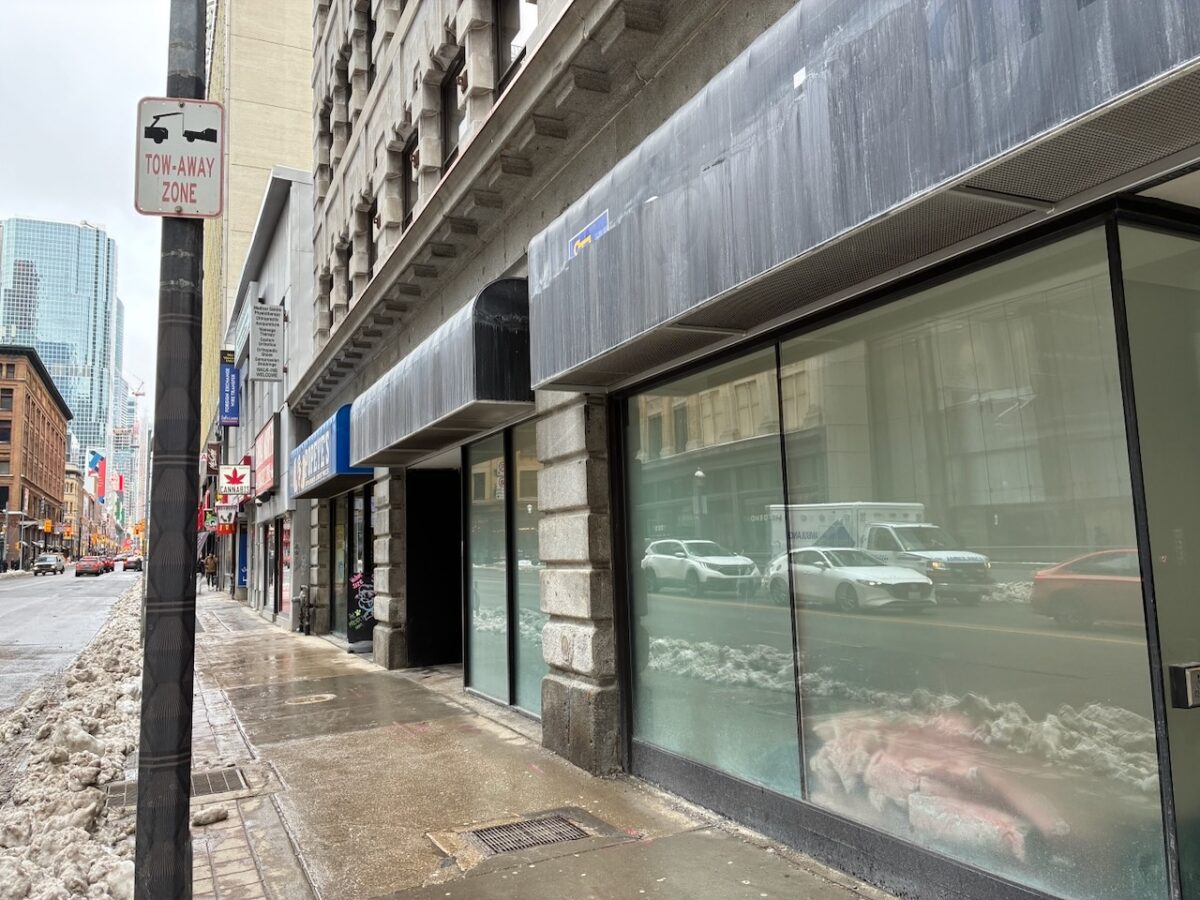
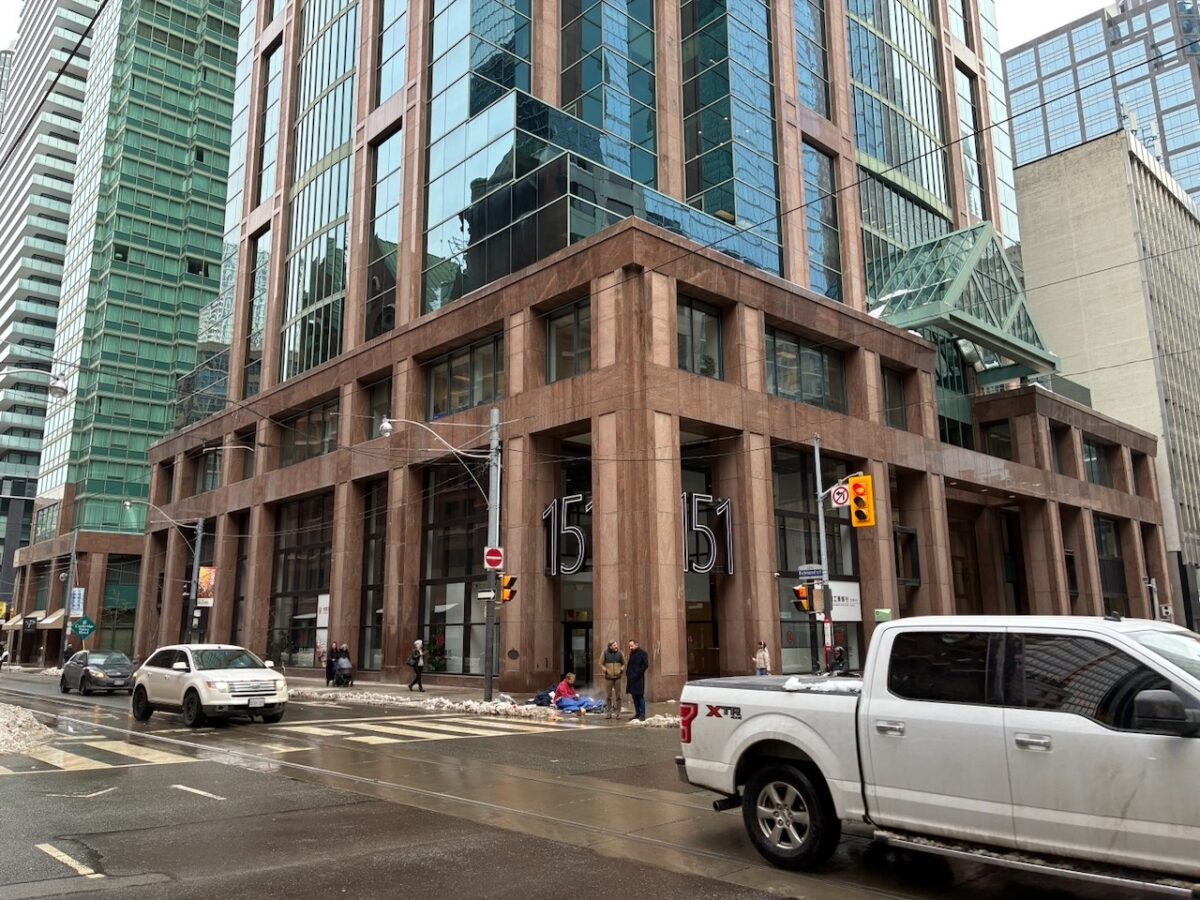
Walk down Yonge Street on any given weekday and you’ll notice the gaps. TD Bank is pulling its street-front presence off Yonge and Adelaide. The RBC in the former Pinstripes location is dark, a casualty of the HSBC-RBC consolidation. A second RBC, at 608 Yonge, north of Wellesley, has also closed and is available for lease. The Industrial and Commercial Bank of China has shuttered at Yonge and Richmond, with that space now listed. National Bank is folding its King and Princess location into an expanded branch at King and York. BMO has closed its Yonge and Queen location, consolidating into a new flagship a block north at CF Toronto Eaton Centre, taking over the former Samsung space. And where branches once kept ATM vestibules open around the clock, many now lock everything down the moment the branch closes.
It’s easy to look at all of this and see an industry in retreat. Jean-Pierre Lacroix has a different read.

Lacroix is the President of Toronto-based brand strategy and design firm SLD, and he has spent decades advising financial institutions across North America, Europe, and Asia on the future of the physical branch. His firm’s research spans hundreds of consumer studies, global conference floors, and branch design projects on multiple continents. When he looks at what’s happening on Toronto’s streets, the closures don’t surprise him — but the industry’s response to them concerns him deeply.
“Every financial institution we speak with is navigating a major transformational program right now,” he says. “Transaction counts have declined dramatically, and that trend will continue. But the branch remains a critical driver of growth. What’s changing is its purpose. It’s no longer a transaction experience. It’s an advisory experience.”


That transition, Lacroix is careful to note, is not unique to Toronto or to Canada. Natwest and Barclays have announced the closure of thousands of branches across the UK. In the US, 1,500 financial institutions have disappeared since 2002, with an average of 250 vanishing every year through mergers, acquisitions, or closures. The numbers are significant, but Lacroix argues they tell a story of structural evolution rather than collapse.
“In Ireland, transaction counts at branches have declined by 80 percent. Effectively zero,” he says. “And yet the branch network remains, because the branch still drives growth. The role has simply changed. That pattern holds irrespective of country — China, the US, the UK. The institutions that are thriving are the ones that understood this early.”
For Toronto specifically, the post-pandemic downtown has compressed the timeline. Hybrid work arrangements have left commercial zones quieter than they were before 2020, and when foot traffic falls below a viable threshold and a lease comes due, the decision to close becomes straightforward. But Lacroix is quick to point out that what’s happening in Canada carries a dynamic that separates it meaningfully from what’s playing out elsewhere.
“In Canada, there are essentially five major institutions. In the US, there are six thousand,” he says. “The average American banks with four institutions. In Canada, we typically bank with two. That changes everything about how a consumer responds when their branch closes.”

SLD’s research confirms the distinction. When a Canadian bank closes a branch without offering a convenient alternative, customers migrate to online banking — but they stay with their institution. It’s a loyalty floor that Canada’s Big Five enjoy and that their American counterparts do not. In the US, a branch closure frequently means a lost customer. In Canada, it doesn’t. Lacroix acknowledges that cushion, but he’s direct about what it may be concealing.
“Consumers aren’t leaving because of branch closures,” he says. “They’re leaving because they’re not getting the financial advice they’re looking for.”
It’s a pointed diagnosis, and the research behind it is unambiguous. SLD’s studies have consistently found that only four to five percent of Canadian consumers view their bank as a place for trusted financial advice. The gap between what banks could offer and what customers actually experience has been a fixture of the firm’s data for years. And the reason for it, Lacroix says, is one that the industry has been slow to confront.
“The feedback from consumers is consistent. They feel the advice they receive at a branch is designed to benefit the institution, not them. It isn’t in their best interest — it’s in the bank’s.”
Closing branches without closing that gap, he suggests, is an institution betting on inertia rather than genuine loyalty. And that bet has a shelf life, particularly as Canada’s Open Banking framework moves into full deployment and consumers gain greater control over their financial data and where they choose to direct it.

Some of Canada’s largest banks have attempted to get ahead of the advisory shift by opening dedicated advisory centres — appointment-only locations where teller transactions are not available. Lacroix has watched that experiment play out with a critical eye.
“RBC, CIBC, Scotia have moved toward advisory centres where routine transactions aren’t available and you need an appointment to meet an advisor. They aren’t working,” he says. “Canadian consumers don’t want to be redirected. They expect the branch to deliver both. And when their financial portfolio grows to a level that warrants it, they want to move into the private wealth environment — the tower. They don’t see the value in an intermediate advisory centre. That step doesn’t resonate here the way it might in other markets.”
The irony, he notes, is that a model closer to what Canadian consumers actually want was piloted in this country two decades ago. SLD worked with TD Waterhouse on a wealth learning centre concept — a space where customers could learn, connect, and begin building their investment relationship before graduating to higher-tier services.
“They were ahead of their time,” says Lacroix. “That’s the model that works. The branch serves as the entry point — the place where the relationship begins and deepens. As the customer’s portfolio grows, they migrate toward the private banking environment. Canadian consumers want that journey to start at the branch. They don’t want to be sent somewhere else to begin it.”
What those consumers want when they arrive at that branch, SLD’s research makes clear, is not what most banks have been focused on delivering. The firm’s Teller Paradox study — drawing on insights from more than 850 North American consumers and 500 banking leaders — dismantled one of the industry’s most persistent assumptions.
“We asked banking leaders to identify the biggest barriers in the branch experience. The consistent answer was speed of service — lineups, wait times,” says Lacroix. “When we asked consumers the same question, the answer was entirely different. Eighty percent of consumers report waiting less than five minutes for a teller. Speed is not the issue. Privacy is.”
Customers want to discuss their finances without doing so in earshot of strangers. They want a seat, a conversation, and the confidence that what they share stays between them and their advisor. The study found that branches designed around that insight — private consultation pods, tiered spaces, human-centred layouts — can increase customer loyalty by up to 47 percent. The architecture of the branch, it turns out, is not a cosmetic consideration. It’s a loyalty driver.
The branch employee is being reimagined in parallel. The skill set required to work in a bank branch is undergoing a fundamental shift, and Lacroix is candid about the gap between where the industry is and where it needs to be.
“The industry refers to them as universal bankers,” he says. “They are skilled tellers. The role that the branch actually needs — an advisor capable of building genuine trust, of having the kind of conversation that guides someone through a mortgage or an investment decision — that’s a fundamentally different hire, and a fundamentally different training model.”
SLD’s research on seamless banking adds another dimension. Regardless of which channel a customer uses — mobile, telephone, or in-person — the defining expectation is consistent access to real people. Not automated responses. Not AI-generated guidance. People. And even among the emerging segment of consumers who are increasingly comfortable using AI tools for financial research — a group SLD identifies as spanning ages 24 to 44 — the branch visit hasn’t been eliminated. It’s been repositioned. These consumers use digital tools to inform themselves, and then they go to the branch to finalize the decisions that matter most.

What the branch that earns that visit looks like is something SLD has been building toward for years. The firm’s design for Chongqing Rural Commercial Bank in China — a 16,000 square foot flagship prototype that won Gold at the 2025 Shanghai Design Awards — represents the clearest expression of where the industry needs to go. The design is rooted in the local landscape: flooring that mirrors the confluence of the Yangtze and Jialing Rivers, a gold pendant light shaped like the rivers themselves, walls that reference Chongqing’s identity as the mountain city. Private consultation pods sit alongside a Smart Banking zone, AR wayfinding near the entrance, and a Community Culture Wall that showcases local art and heritage. It is a branch that gives people a reason to walk through the door that has nothing to do with a transaction.
“That’s the direction,” says Lacroix. “Fewer branches, but built with genuine purpose. A hub and spoke model where the branch serves as the relationship foundation and the private wealth environment serves those whose portfolios have grown to warrant it. The institutions that get this right won’t be the ones with the most locations. They’ll be the ones that understand what the branch is actually for.”
There is one more assumption embedded in the current wave of closures that Lacroix is careful to challenge — the narrative that cash is disappearing and taking the branch with it. Barclays presented data at a major industry conference showing that more money was being printed that year than the year before. The Federal Reserve’s own figures show cash usage stabilized post-pandemic. And SLD’s decade of consumer research points to the same two groups sitting at the top of the loyalty curve, year after year.
“The most loyal banking customer, consistently since 2017, is the older consumer and the small business owner,” he says. “They depend on the branch. They still deposit cash. We designed a bank in downtown Los Angeles recently and debated whether to include a nighttime drop-off box. We kept it — because the branch is surrounded by small businesses, and those businesses still deposit cash at the end of the day. That customer hasn’t gone anywhere.”

The branch isn’t dying. But the version of it built around processing transactions is. What replaces it, if Canada’s banks follow the data that their own industry has been generating for years, is a space built around the one thing that no app, no ATM, and no algorithm has ever been able to provide — the kind of trusted, private, human conversation that actually changes someone’s financial life.
“The differentiating factor is no longer products or service levels,” says Lacroix. “What separates a financial institution is its ability to emotionally connect with consumers — to reduce financial anxiety through genuinely advisory relationships. That is what drives loyalty. And that opportunity, for most banks right now, remains almost entirely untapped.”
SLD‘s Future of Wealth Retail Banking study will be presented in Las Vegas in April 2026.

Dustin Fuhs is the founder and Editor-in-Chief of 6ix Retail, Toronto’s premier source for retail and hospitality industry news. As the former Editor-in-Chief of Retail Insider, Canada’s most-read retail trade publication, Dustin brings over two decades of expertise spanning retail, marketing, entertainment and hospitality sectors. His experience includes roles with industry giants such as The Walt Disney Company, The Hockey Hall of Fame, The Canadian Opera Company, Starbucks Canada and Blockbuster.
Recognized as a RETHINK Retail Top Retail Expert in 2024, 2025 and 2026, Dustin delivers insider perspectives on Toronto’s evolving retail landscape, from emerging brands to established players reshaping the city’s commercial districts.