

A termination notice citing unpaid rent appeared on the doors of Grace O’Malley’s Irish Pub at 14 Duncan Street on January 26th, 2026. The doors have been locked since, but the pub’s website remains active, social media accounts, OpenTable shows reservations resuming March 3rd, and no official statement has been issued.
The situation unfolds against a backdrop already set in 2022: the 1902 heritage building has City Council approval to become the base of a 48-storey residential tower, though the project remains in pre-construction with no announced construction timeline.
Grace O’Malley’s has been part of the Entertainment District since 2005, occupying the ground floor of the Telfer Paper Box Building — a heritage-designated structure designed by prominent Toronto architects Gregg & Gregg. The pub’s 20-year tenure has outlasted most hospitality ventures in a neighbourhood known for rapid turnover, serving theatre-goers, sports fans, and live music crowds through multiple economic cycles.
The termination notice raises immediate questions about the venue’s future, but those questions sit within a larger story already written: the building that houses Grace O’Malley’s is destined for transformation, approved by City Council to preserve its historic brick facades while everything behind them gets rebuilt to support residential units above. The only uncertainty is when that transformation begins — and whether the pub survives until then, or becomes another casualty of the Entertainment District’s relentless evolution.

The Approved Development Plan
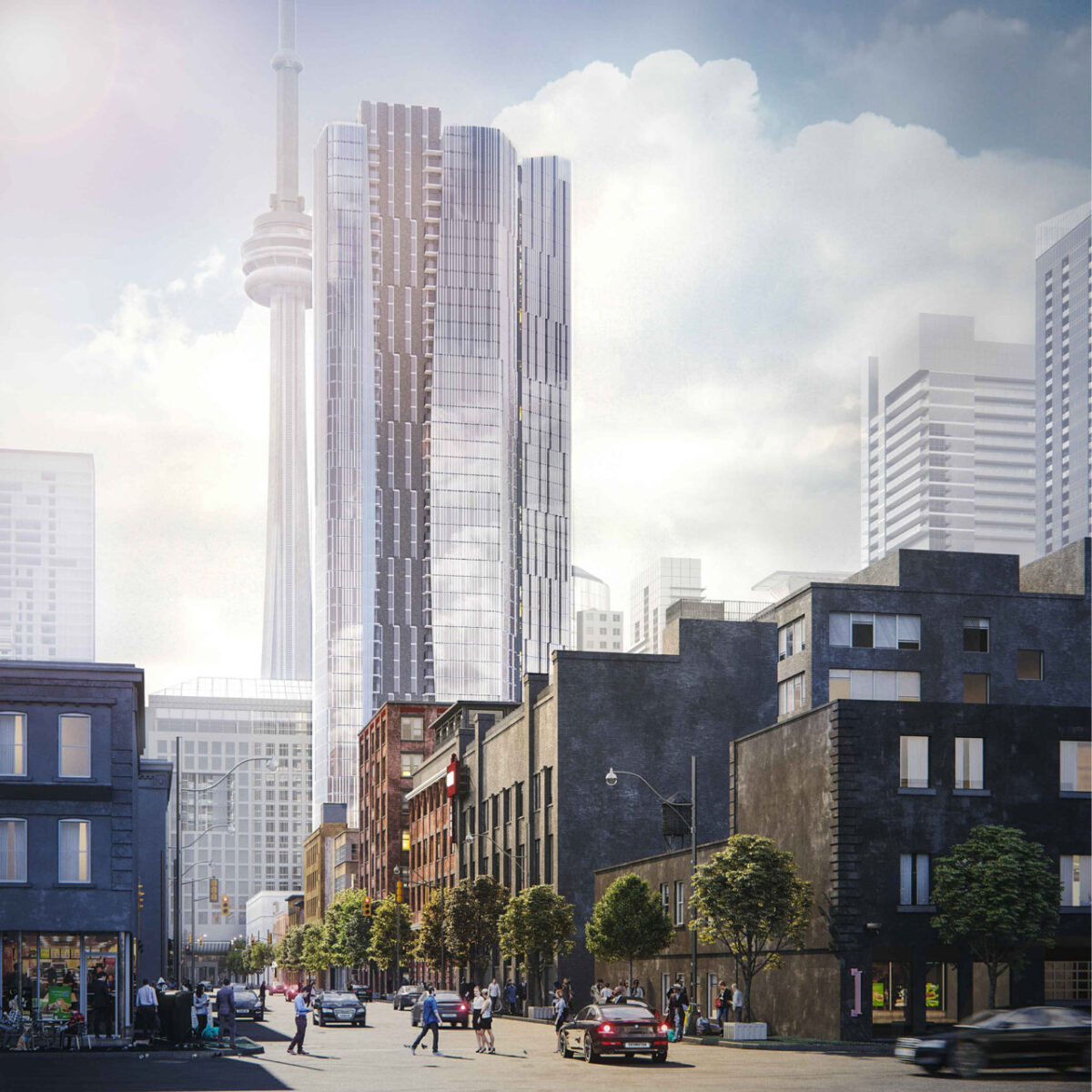
Greenwin Corp., which owns 14 Duncan Street, received City Council approval in July 2022 for a 48-storey, 369-unit condo tower designed by Quadrangle Architects. The plan would preserve the Duncan and Pearl Street facades of the Telfer Paper Box Building while reconstructing the interior to accommodate residential units above.
This is facade retention — a preservation approach that’s become standard in Toronto’s heritage districts. The exterior brick walls facing the street would remain in place and be restored, but everything behind them gets demolished: interior floors, structural elements, roof, everything. The heritage facades essentially become the front wall of a new building. It’s controversial among heritage purists who argue it saves the shell while losing the substance, but it’s the compromise Toronto has settled on to balance development pressure with heritage protection.
The proposed tower would step back 6 metres from Duncan Street with an 8-metre recess at the “waist” levels — the fourth and fifth floors — designed to reduce visual impact on the heritage streetscape. City heritage staff supported these setbacks because Duncan Street is identified as an important heritage vista in the King-Spadina Heritage Conservation District Plan. The street’s collection of early 1900s factory buildings creates a consistent four-to-eight storey streetwall that the City wants to preserve visually, even as towers rise behind it.
The architectural concept describes the tower as “a corseted figure draped in glass fabric,” referencing the neighbourhood’s fashion district history. The glass tower would appear to emerge from the recessed waist section, visually distinct from the solid brick heritage base below. Quadrangle’s design also includes replacing the unsympathetic 1989 additions along Pearl Street with a new five-storey base building that would better complement the heritage facades in terms of materials, scale, and proportion.
The ground floor would be reconfigured for commercial use — likely retail or restaurant space — though what that would actually be hasn’t been determined. The upper floors of the heritage building portion would become residential units within the tower’s podium.
The project remains in pre-construction with no publicly announced construction timeline. Pre-construction can mean anything from “breaking ground next year” to “waiting indefinitely for market conditions to improve.” The building currently houses approximately 80,000 square feet of office space above the ground-floor pub in the brick-and-beam loft-style spaces that converted factories are known for. Greenwin continues to actively lease those office units, advertising them on the company’s website and showing them to prospective tenants.
That active office leasing suggests construction isn’t imminent. Landlords typically don’t sign new commercial tenants to multi-year leases if they’re planning to demolish the building in 12 months. The office tenants provide rental income while Greenwin waits for the right market conditions to proceed with the tower — whenever that might be.
Can Grace O’Malley’s Come Back?
A landlord termination notice for unpaid rent is serious, but it doesn’t automatically mean permanent closure. Tenants can negotiate payment arrangements, catch up on arrears, or work out amended lease terms. Some venues have reopened after similar notices once the financial situation was resolved. In Toronto’s hospitality industry, rent disputes aren’t uncommon — especially in high-rent districts like the Entertainment District where commercial lease rates have climbed steadily as the area has gentrified.
The difference between a termination notice and an actual eviction matters. A notice starts a legal process, but that process includes opportunities for the tenant to cure the default by paying what’s owed or negotiating new terms. Until a landlord obtains a court order and enforces it, the situation remains potentially reversible.
What complicates the picture is the approved redevelopment waiting in the wings. Greenwin has City Council approval for a 48-storey tower, which means at some point — whether in two years or five — they’ll need vacant possession to begin construction. Pre-construction projects can sit for years depending on market conditions and financing, but the building’s long-term future has already been determined. That creates an unusual dynamic: even if Grace O’Malley’s resolves the immediate rent dispute, they’re potentially negotiating a short-term extension rather than long-term security.
From a landlord’s perspective, a lease dispute with a struggling tenant might be an opportunity to clear the space sooner rather than later, especially if the redevelopment timeline is accelerating. From a tenant’s perspective, investing resources to catch up on rent and reopen only makes sense if there’s a reasonable runway ahead — not if eviction for construction is imminent anyway.
The maintained website and active OpenTable listings suggest the operators haven’t given up. If this were a definitive closure, those would typically be taken down, social media would announce a farewell, and reservation systems would be shut off. Instead, everything remains operational in the digital space even as the physical doors stay locked.
More tellingly, the pub’s event calendar currently shows scheduled performances resuming on March 4th, 2026 — just weeks away. Live music listings are posted for March, suggesting either optimism about resolving the dispute or a failure to update the calendar after the termination notice appeared. Either way, it’s not the digital footprint of a business that’s accepted closure.
The silence from the operators is notable. No social media post explaining a temporary closure, no statement about resolving a lease issue, no farewell message if this is actually the end. That silence could mean negotiations are happening privately, or it could mean the situation is too uncertain to make any public statement yet. In Toronto’s tight-knit hospitality community, word usually gets out when a venue is definitively done — and so far, that word hasn’t come.

What Grace O’Malley’s Has Been
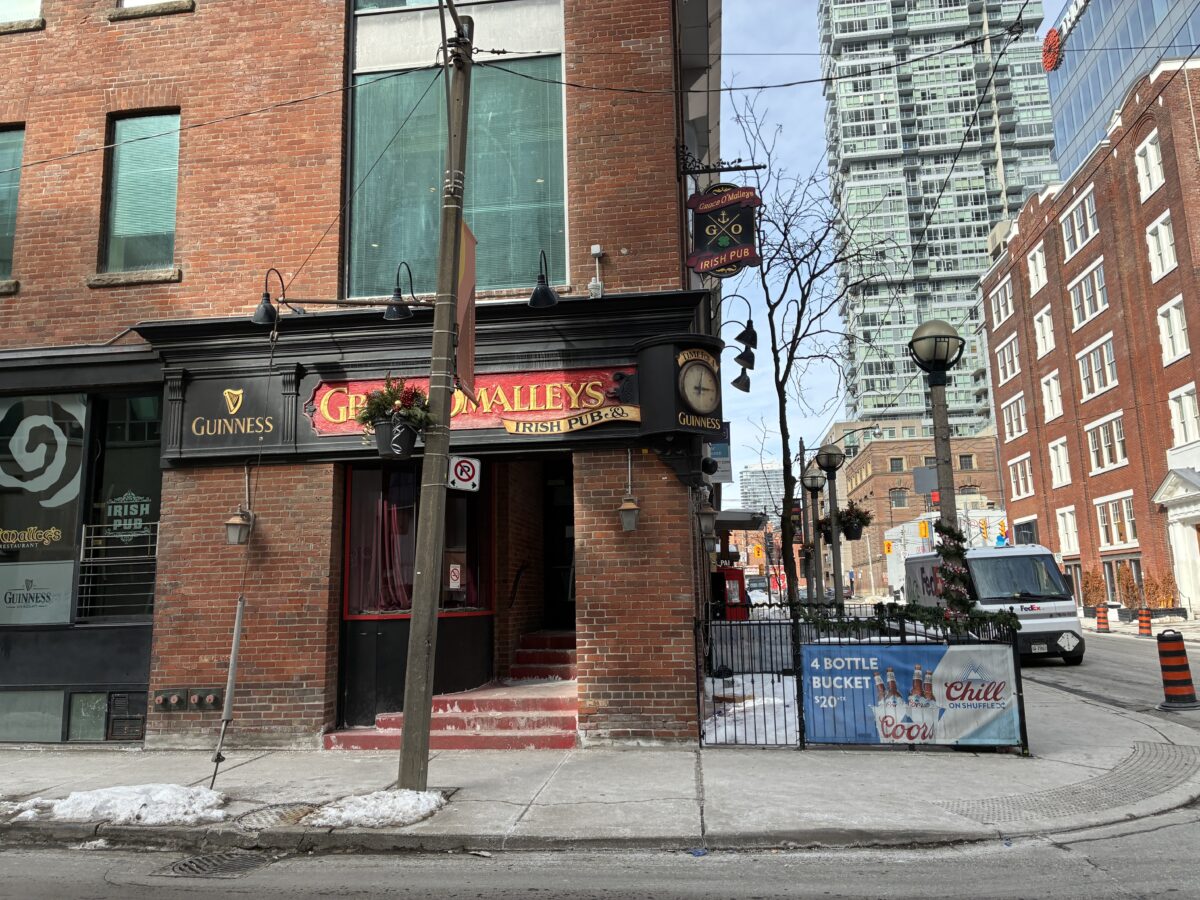
Since opening in May 2005, Grace O’Malley’s has served dual roles in the Entertainment District: daytime restaurant with 200 seats and $6 happy hour drinks from 3-6pm, transforming into a 420-capacity live music venue Thursday through Saturday nights.
The pub carved out its niche by being genuinely useful to different crowds at different times. Theatre-goers could grab fish and chips or Guinness Steak Pie before a show at the Princess of Wales, taking advantage of the 20% Mirvish ticket discount. Sports fans used it as a pre-game or post-game spot for Blue Jays and Leafs games. Wednesday trivia nights drew regulars, while the live music programming — Maritime acts, classic rock tribute bands, Friday country nights — gave the venue a personality distinct from the generic sports bars and upscale restaurants that dominate the district.
It was the kind of place that worked for a quick affordable meal before a show, a birthday party booking with the full stage setup, or just showing up on a Friday night because you knew there’d be a live band and $14 doubles. The 8,800-square-foot layout with two bars, a stage, and street-side patio gave it flexibility that many single-purpose venues lack.
If the venue doesn’t reopen, it removes one of the remaining moderately-priced, multi-use options in an area increasingly defined by either high-end dining or corporate chains. The Entertainment District has plenty of places to spend $80 on dinner — it has fewer places where you can have a decent meal for $25, catch live music, and not feel like you’re in a tourist trap.

The Heritage Building’s Story
The Telfer Paper Box Building was constructed in 1902 by architects Gregg & Gregg as a cardboard packaging factory. It’s a classic example of Edwardian Classical industrial architecture — red brick, round-arched windows, symmetrical design — built during Toronto’s manufacturing boom. A west wing was added in 1906, and a fourth storey in 1925 as the business expanded.
The building’s construction coincided with a pivotal moment in Toronto’s development. The 1904 Great Fire destroyed much of the downtown core east of Bay Street, pushing commercial and industrial development westward into what became the King-Spadina area. The Telfer building was part of that westward shift, joining a cluster of early 1900s factories that turned Duncan Street into an industrial corridor.
After 60 years as the Telfer Paper Box Company producing corrugated cardboard packaging, the building was sold in 1962 and converted for pillow manufacturing. Then came the major intervention: a 1989 renovation that gutted the interior, added metal cladding, enlarged windows, and reconfigured the ground floor for the Entertainment District’s nightclub boom. That’s when most of the building’s original interior was lost — what Grace O’Malley’s occupied was already a 1980s reconstruction behind heritage walls.
The City designated it as a heritage property in March 2017, recognizing its architectural significance and its role in the King-Spadina neighbourhood’s early 20th-century industrial character. The designation came as part of the redevelopment approval process, ensuring the building’s exterior would be legally protected even as the interior gets rebuilt again.
Under the approved development plan, the facades would be restored closer to their 1902 appearance — window openings reduced to original size, the missing cornice rebuilt based on historic photographs, and ground floor storefronts redesigned to be more historically appropriate than the current configuration. City heritage staff supported this approach because it would actually improve the building’s heritage character compared to the 1989 alterations.
This restoration work would only happen once construction begins, which could be years away given pre-construction timelines and market conditions.
What Happens Next
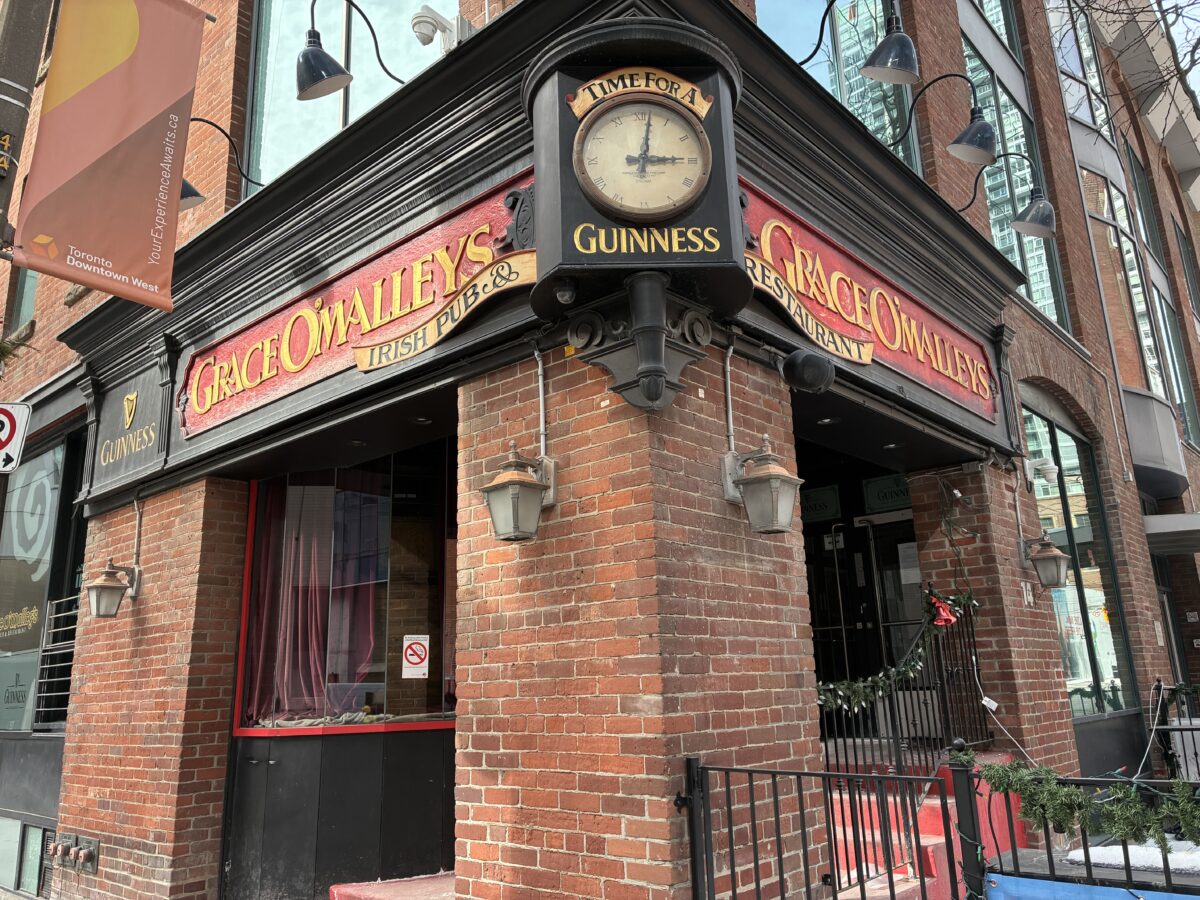
The building continues operating as office space above the locked pub, suggesting Greenwin isn’t rushing to clear the property for immediate construction. Pre-construction approvals often wait years for optimal market conditions — and as of early 2026, Toronto’s condo market is far from that position. Rising interest rates, slowing sales, and construction cost pressures have pushed multiple approved tower projects into indefinite holding patterns across the city.
That timeline ambiguity creates a strange limbo for Grace O’Malley’s. If the condo tower were breaking ground next month, the termination notice would be straightforward: the building needs to be cleared. But with construction potentially years away, there’s theoretically room for the pub to negotiate a resolution, catch up on arrears, and continue operating until Greenwin actually needs vacant possession.
The question is whether both parties see value in that arrangement, or whether the relationship has broken down beyond repair.
Whether Grace O’Malley’s resolves the lease situation, relocates, or closes permanently remains unknown. After 20 years serving the Entertainment District, the pub’s immediate future depends on negotiations that haven’t been made public. The operators haven’t issued a statement. Greenwin hasn’t commented. The website stays up, the doors stay locked, and the only public information is a termination notice taped to the window.
For the Entertainment District, the stakes are about more than one pub. The neighbourhood has transformed from an industrial area to a nightclub district to a residential neighbourhood with over 30,000 residents, but that transformation has come at a cost. The moderately-priced, community-oriented venues that give a neighbourhood character are increasingly squeezed out by high rents and condo conversions. Grace O’Malley’s wasn’t a landmark destination, but it was exactly the kind of functional, affordable, multi-use space that neighbourhoods need to feel lived-in rather than just developed.
The brick and mortar will survive either way — the City’s heritage designation ensures that. But the neighbourhood works best when its heritage buildings still house the kind of places that give people a reason to be there, not just something attractive to walk past on the way to somewhere else.
We hope this is just a minor bump in the long story of the Telfer Paper Box Building — a building that’s already survived 124 years of packaging factories, pillow manufacturers, nightclub conversions, and now hopefully, one Irish pub’s rough patch.

Dustin Fuhs is the founder and Editor-in-Chief of 6ix Retail, Toronto’s premier source for retail and hospitality industry news. As the former Editor-in-Chief of Retail Insider, Canada’s most-read retail trade publication, Dustin brings over two decades of expertise spanning retail, marketing, entertainment and hospitality sectors. His experience includes roles with industry giants such as The Walt Disney Company, The Hockey Hall of Fame, The Canadian Opera Company, Starbucks Canada and Blockbuster.
Recognized as a RETHINK Retail Top Retail Expert in 2024, 2025 and 2026, Dustin delivers insider perspectives on Toronto’s evolving retail landscape, from emerging brands to established players reshaping the city’s commercial districts.