
The BeaverTails location at 145 Queen’s Quay West does not advertise itself as a retail destination. From the outside it reads like what it has always been: a waterfront destination, a fryer, a lineup of people who want something warm in their hands. But step inside Pier 6 and look past the pastry counter. The grey mountain hoodie with Since 1978 on the back is hanging front and centre. Red crewnecks are stacked and sized. Tote bags, t-shirts, hoodies in multiple colourways, all merchandised like someone who actually thinks about retail. And a small, quirky beaver plush known inside the company simply as BEAV sits near the register doing quiet, consistent business.
It is easy to miss. That might be the point.
Restaurant merchandise has been part of the hospitality landscape for decades, but what is happening right now is different in scale, intention, and commercial impact. Brands are no longer treating merch as something that sits beside the register hoping for an impulse buy. They are treating it as a revenue line, one with margins that the food side of the business will never match. New data from Lightspeed Commerce captures the shift. Nearly 20% of hospitality businesses are now selling branded merchandise. For those doing it well, merch accounts for as much as 11% of monthly revenue. In the top-performing cases, that number reaches 27%.
That is not souvenir money. That is strategy.

As Lightspeed Commerce‘s Hospitality Ambassador, Leslie Ann Roberts brings something rare to an industry data conversation: she has actually lived it. Her career spans Four Seasons, Forbes Five Star properties, and Wine Spectator award-winning restaurants. The numbers she now works with are not abstract to her. They describe a world she spent years working inside.
For Roberts, the numbers tell only part of the story.

“Restaurants aren’t just serving food anymore. They’re building brands. People want to be loyal to their experiences, and that’s where this whole thing is coming from. Wearing a brand, representing a brand, it’s a reflection of that loyalty. And once you understand that, everything about how you think about merchandise changes.”
The difference between merchandise that moves and merchandise that sits, she says, is not design. It is not price point. It is something harder to manufacture.
“You’re not just wearing a logo from a place you happened to visit. If you bought a certain restaurant’s merch, it’s because you loved your experience. It’s a way to honour that experience and extend it beyond the meal, beyond the table, beyond the moment itself. Regional gastronomy is front and center now, and the brands that understand that are the ones putting something real into the world.”
The infrastructure question is where most operators stall. Roberts has watched it happen repeatedly: a great product, genuine community love, and a merchandise operation living in a completely separate system, a separate conversation, a separate headache.
“Montreal’s Mano Cornuto figured this out early. A full e-commerce site, limited drops, artist collaborations, they treat the merchandise side of the business with the same creative rigour as the menu. And what makes it work is the integration. When your merchandise inventory lives in the same system as your food and beverage, it stops feeling like a side project and starts feeling like a real line of business. What used to require two separate systems, two separate conversations, two separate headaches, that friction is gone. When the friction is gone, the opportunity becomes much easier to act on.”

The question she gets most from operators is where to start. Her answer is simpler than most expect.
“Make them visible. Show your amazing work. If you have one main point of sale, make sure merchandise is right there when guests are checking out, the same way you’d position any add-on. Use social media to its full effect. Start small, collaborate with the people around you. People come into your restaurant because they already like what you’re doing. Give them something they’ll love to take home, and they’ll do the marketing for you.”
Not every restaurant is speaking to the same person. Roberts sees that distinction showing up clearly in the product choices of the brands getting it right.
“A cafe gravitates toward accessories that make their products shine: beautiful takeaway mugs, cozy sweatshirts. A high-end hotel collaborates with a brand like Sporty and Rich. A wine bar puts out branded wine keys. I went into Pigeon Cafe in Montreal this winter and they had beautiful beanies in every colour with their logo. They knew exactly who was walking through that door. The key is observing your clientele. Your restaurant already knows who it’s catering to, and your merch should reflect that same instinct.”

The scale of what is possible when that instinct is sharpened shows up across Toronto right now. Scroll through any community forum and the question comes up regularly: where can I find good restaurant merch in this city? The answers fill pages. Bellwoods Brewery and Blood Brothers for the west end crowd. BEAR Steak Sandwiches and Famiglia Baldassarre for the sandwich and deli faithful, with one commenter noting being stopped in France by someone who recognized the Baldassarre logo. Sam James Coffee, Found, Jimmy’s. Sneaky Dee’s and The Cameron House for the dive bar loyalists. Sugo, Imanishi, Ramen Raijin, Dough Bakeshop on the Danforth.
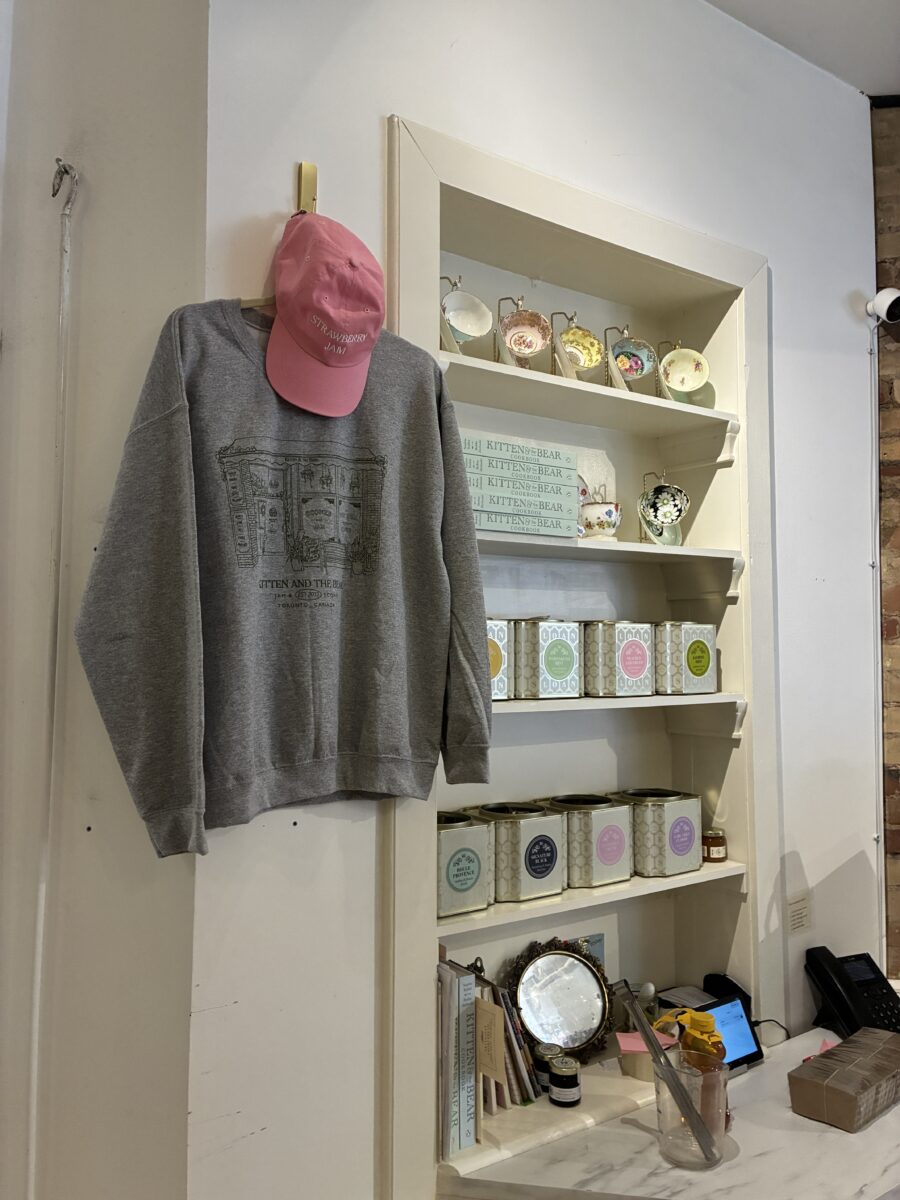
Walk into Kitten and the Bear on Queen Street West and Roberts’ point about intentionality is immediately visible. A grey crewneck with a hand-illustrated rendering of the storefront hangs beside the register. A pink cap embroidered with Strawberry Jam sits above it. Cookbooks, vintage teacups, and tins of loose leaf tea fill white shelves like a carefully considered general store. Bottega Volo on College takes it further still, stocking not just their own apparel and glassware but Famiglia Baldassarre and St-Viateur Bagel through a curated program they call Bottega Friends. It is less a merch shelf and more a neighbourhood general store built around taste.

The most striking evidence of where this is heading sits on the UT wall at Uniqlo’s Toronto location, where RURU Baked and De Mello Coffee are displayed alongside Pokemon and international artists. Local food brands, on mannequins, in a global flagship. For Roberts, what the Uniqlo wall represents is not a ceiling. It is a direction.
“Larger businesses are trying to localize part of their offering to better tailor what they’re presenting to their audience. The way to do that is through obvious collaborations with the lifestyle tastemakers in the city: restaurants, cafes, hotels, artists. Look at what Kinton Ramen did with Uniqlo. That is a local food brand crossing over into apparel at the highest commercial level available to them. Local collaboration is the key, and the brands that understand that earliest will be the ones that last.”
She has one thing she wants every independent operator in this country to hear.
“Don’t be afraid to hop in, and don’t underestimate how people feel about you. Even if you think you’re too small for this, you’re not. This isn’t just marketing. It’s margin. The love that people have for their local spots is real, and it is waiting to be activated. Don’t leave it on the table.”


Pino Di Ioia has been with BeaverTails since 1987: store level manager, franchisee, master franchisee for Quebec, and eventually owner. Thirty-nine years inside one brand gives a person a particular kind of clarity. When Di Ioia talks about what BeaverTails is really selling, it does not sound like brand strategy. It sounds like something he figured out a long time ago and has been living ever since.
Ask Di Ioia when BeaverTails became a merchandise brand and he pauses, not because he doesn’t know the answer, but because the answer is not what you expect.
“What we’ve come to realize is that our pastry is food as merchandise. Every other brand in the world puts their logo on a t-shirt to prove you were there. We’ve been doing it with a twelve-inch pastry for decades without even realizing it. The moment someone photographs our product against a beautiful landscape, that image is doing exactly what a souvenir does. It’s the proof. It’s the memory. It underlines the moment. It says, ‘Yes, I was there, and it was worth it.’ We were natively part of this strategy before the strategy even had a name.”
The number one tourist item in BeaverTails stores is not the hoodie. It is not the hat. Di Ioia lets that land before he explains it.
“People are always surprised when I tell them. It’s our little mascot. Not a hoodie, not a t-shirt. BEAV. Either as a plush toy or the little stress beaver you can hold in your hand. And what makes that significant isn’t the sale. It’s what happens after. That little plush toy ends up on a child’s bed for ten years. It travels with them to university as a memento of their childhood. That kind of emotional staying power is something most brands spend their entire existence chasing. We stumbled into it by just being authentic to who we are.”
Every product decision at BeaverTails runs through a filter Di Ioia calls the urban cottage. It is two words that do a lot of work.
“Everything we create has to live within what we call the urban cottage, our visual and emotional interpretation of modern Canada. It has to feel cozy, considered, and genuinely Canadian. But the second filter is equally important, and that’s quirky. Quirky is quintessentially Canadian. We go around the world, we’re polite, we’re lovable, and that makes us unexpected. Our merchandise has to reflect all three of those things. There’s always a detail, always something a little surprising. A logo placement, a hidden element, a product that makes you smile before you even put it on. That’s the BeaverTails standard, and we never compromise it.”

The brands that earn a seat at that table, Di Ioia says, share one quality before they ever make their pitch.
“When the right brands approach us, they don’t arrive informed in the research sense. They arrive informed in the lived sense. They grew up with BeaverTails. They understand viscerally what this brand stands for before they ever walk into the room, because they’ve lived it. And that changes everything about how a collaboration comes together. When someone genuinely understands that you’re in the business of emotions, not just pastries, the creative work almost does itself. That’s the only kind of partnership worth having.”
The BeaverTails Market is where that philosophy has arrived commercially. Launched as a curated platform of food, lifestyle, and specialty products, it now includes cookie dough at select grocery retailers, a branded ice cream sandwich, signature spreads, a candle collection developed with partner Seracon, and an open call for vendor and retail partners who align with the brand’s spirit. The candle story is one Di Ioia tells with particular affection. BeaverTails pushed back when the partner first pitched it. Then they said one thing that changed the conversation entirely.
“They said, we don’t just want to do a pastry-scented candle. We want to do a candle that smells like your cottage when you were growing up. Because that’s the nostalgia that BeaverTails stands for. And they were right. If we could pump a scent into our stores, it would never be cinnamon sugar. It would be the smell of a Canadian summer, a dock, a fire. There is a discipline required to let a brand live at a non-transactional level. If you just want to sell, you pump the vanilla. That moves product. But it doesn’t light up the emotions. It doesn’t reach into someone’s memory and pull out something real.”

From the plush toy near the register to the grocery shelf in British Columbia to the spirits collab to the Market platform, Di Ioia sees one thread running through all of it.
“We remind ourselves constantly that yes, we are in the business of preparing and selling pastries. But that’s not really what we’re doing. What we’re really doing is creating memories. We’re in the business of the emotions that drive those memories. Our hero product is iconic, but everything that surrounds it, the merchandise, the collaborations, the extensions, all of it exists to serve that emotional truth above all. That’s what we’re actually transacting in. And once you understand that, every decision becomes clearer. Every partnership makes sense or it doesn’t. Every product earns its place or it doesn’t. The standard doesn’t move.”
Back on the waterfront, BEAV is still on the counter. On Queen Street, the Kitten and the Bear sweatshirt is hanging by the register. At Uniqlo, a De Mello Coffee t-shirt is on a mannequin in a global flagship. In grocery stores across British Columbia, BeaverTails cookie dough is on the shelf.
The product was always more than food. The question now is whether the rest of the industry is ready to act like it.

Dustin Fuhs is the founder and Editor-in-Chief of 6ix Retail, Toronto’s premier source for retail and hospitality industry news. As the former Editor-in-Chief of Retail Insider, Canada’s most-read retail trade publication, Dustin brings over two decades of expertise spanning retail, marketing, entertainment and hospitality sectors. His experience includes roles with industry giants such as The Walt Disney Company, The Hockey Hall of Fame, The Canadian Opera Company, Starbucks Canada and Blockbuster.
Recognized as a RETHINK Retail Top Retail Expert in 2024, 2025 and 2026, Dustin delivers insider perspectives on Toronto’s evolving retail landscape, from emerging brands to established players reshaping the city’s commercial districts.