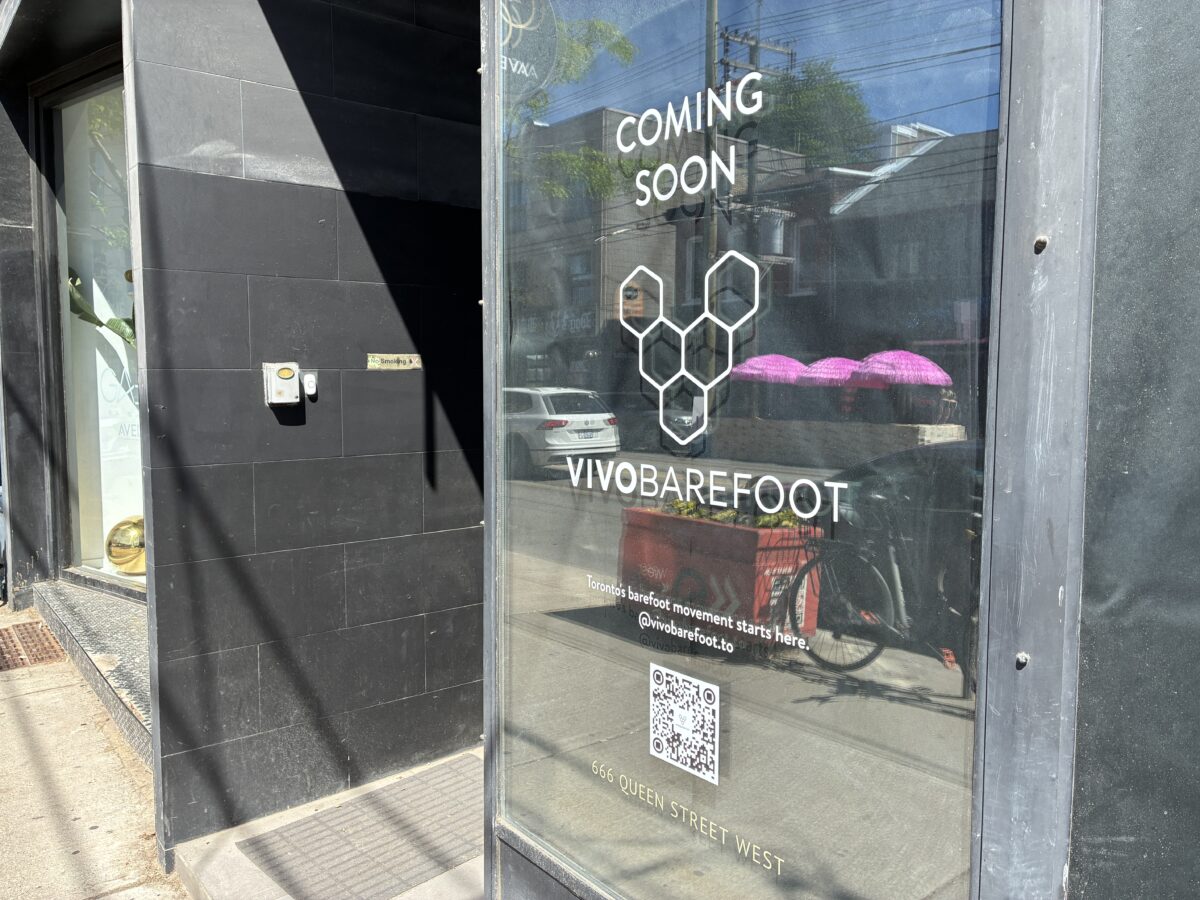

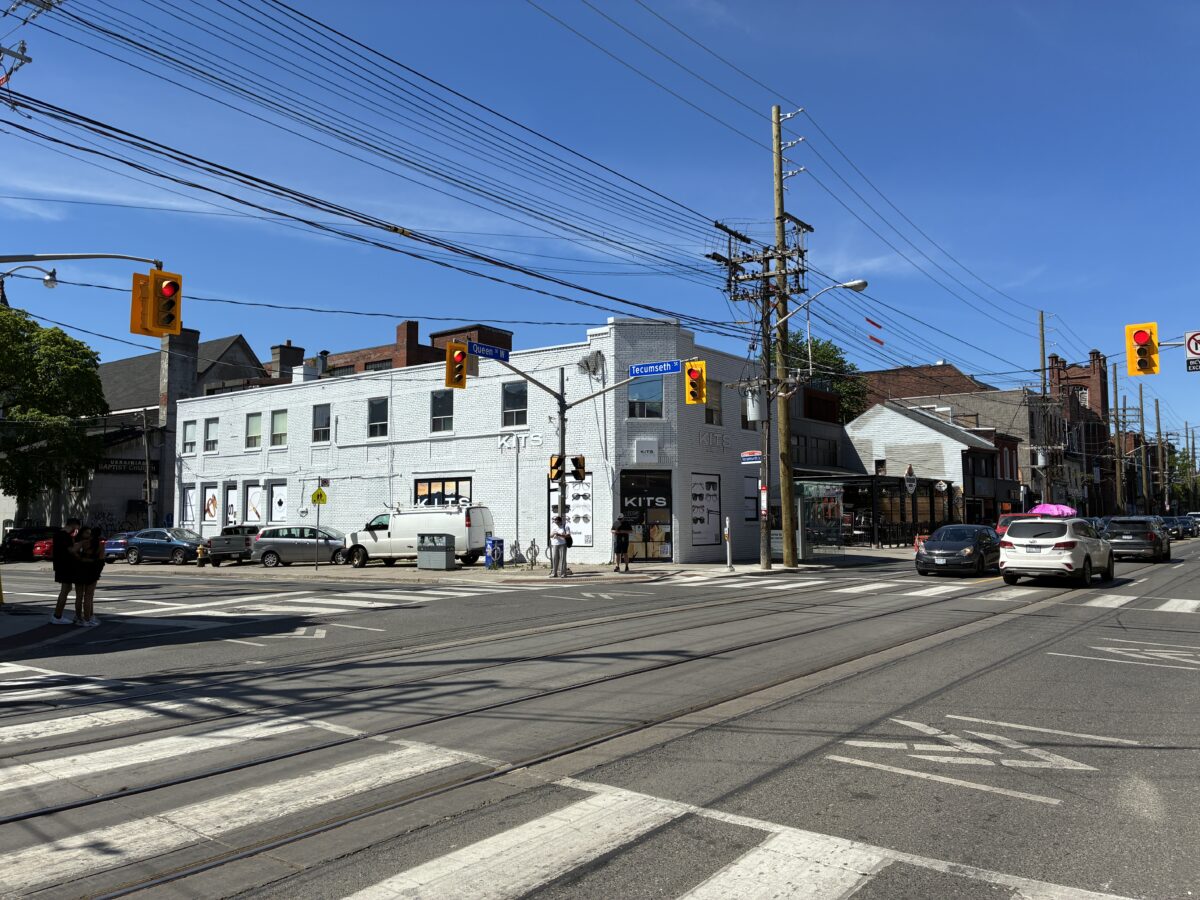
Vivobarefoot is opening its first Toronto location at 666 Queen Street West. The 1,200 square foot store, with a full basement, takes over the former Oak + Fort space and marks the brand’s second Canadian concept store after its 2023 Kitsilano debut. A New York Soho flagship is expected later this summer, as the brand continues to build out its North American presence following the recent opening of its Americas headquarters in Austin, Texas. KITS Eyecare has also announced plans for a Toronto flagship directly across the street.
Founded in 2012 by cousins Galahad and Asher Clark, seventh generation cobblers from Glastonbury, Somerset and descendants of the family behind the Clarks shoe brand, Vivobarefoot is headquartered in London and sells primarily direct to consumer online. The brand posted £91.4 million in global revenue in its most recent fiscal year, selling 1.2 million pairs of shoes across more than a dozen countries. Physical concept stores are deliberately few, currently operating in London, Bristol, Prague, Freiburg, and Vancouver, each one designed to educate consumers on the brand’s core philosophy that wide, thin, and flexible footwear is regenerative to human health. Toronto is the newest addition to that list.
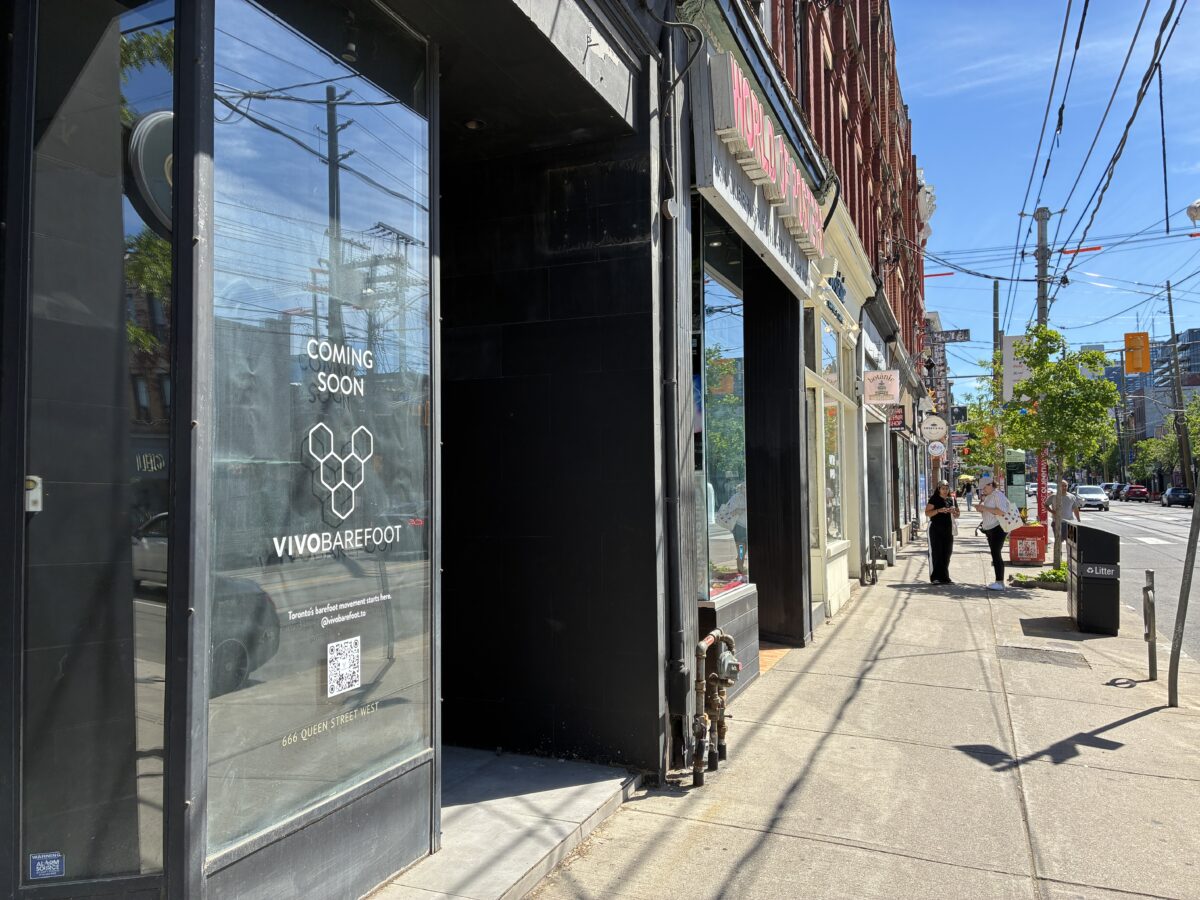
Andrew Bentley, CEO of Vivobarefoot Canada, said the decision to sign at 666 Queen West came quickly once the space was identified, less than a month from first viewing to execution.
“We looked at a number of spaces and this one stood out because of the community access and the footfall,” he told 6ixRetail. “We also wanted to be near spaces where people are out moving in the natural environment. The Trinity Bellwoods area draws people who want to connect with nature. We have enough concrete around us in Toronto.”
Once Toronto opens, it will join Vancouver as only the second Vivobarefoot concept store in North America, with New York to follow later this summer.
The Queen Street West lease was brokered by Julie Seo of Re/Max Ultimate Julie Seo Realty, Brokerage.
What Vancouver Taught Them
The Kitsilano store at 2190 West 4th opened in June 2023 at 800 square feet. Three years of operating it shaped how Bentley is approaching Toronto, and the biggest lesson was one most footwear brands would never say out loud.
“What we’ve learned most prominently is that minimalist footwear is a category onto itself,” he said. “People don’t fully appreciate the benefits or the use case. When they actually put the shoe on their foot, their predisposed bias gets seriously smashed.”
The Vancouver store has continued to attract customers who are discovering the brand for the first time, which Bentley takes as a signal that awareness in Canada is still early. He recalled one family visiting from Mexico City who FaceTimed relatives while shopping before purchasing around a dozen pairs. That kind of moment, he said, does not happen online, and it is precisely why physical retail remains central to how Vivobarefoot grows.
Toronto at 1,200 square feet with a full basement is a meaningful step up from Vancouver, and Bentley said the space will be used to program community events, movement classes, and fittings. But he is measured about how quickly that takes shape.
“We have a point of view on the educational piece and what we can do to help people,” he said. “But we want to hit the ground and see what the community responds to.”
The Education Model
Bentley opens almost every in-store conversation with the same question. When you get home from work, do you reach for another pair of shoes, a slipper, or do you go stocking feet or barefoot?
“About 80 to 90 percent of people say they go stocking foot, barefoot, or reach for a slipper,” he said. “What that tells us is that people have a great relationship with their feet. They don’t have a great relationship with their shoes. What if we could marry those two things together so that the barefoot experience you already enjoy at home could be married with function and style? That is what Vivobarefoot represents.”
Research out of Liverpool University supports that position, showing approximately a 58 to 59 percent increase in foot strength just from wearing a minimalist shoe during the day, not for training, but simply from engaging the full foot through natural movement.
To bring that education to life in store, the Queen Street West location will feature pressure plate technology that generates a real-time heat map of a customer’s feet, showing exactly where they are carrying weight and which parts of the foot they are failing to engage.
“In an ideal world you stand on the pressure plate and see a symmetrical, balanced foot,” Bentley said. “But inevitably we see big hotspots where people’s heels are really red and their toes don’t even register on the screen. I worked with someone in the Vancouver store who couldn’t get their toes to show up at all. I asked them to imagine putting their hand down and their pinky finger not registering any pressure. Would that be acceptable?”
He connected that to aging and long term health. “Balance is about proprioception, knowing where you are in space. That sensory feedback comes from our feet. When we abstract ourselves from that feedback through over-engineered footwear, we lose our connection to balance and natural movement.”
The brand has also partnered with Dr. Courtney Connolly, author of the recently released book Walk, to bring a clinical framework to its in-store education around foot health and natural movement.
Performance Credibility and the Competition
Asked whether larger brands entering the minimalist footwear space concerns him, Bentley was direct.
“When larger brands enter this category, we see that as a compliment, not a competitive threat. More people learning about the benefits of barefoot footwear and why our feet need to be free is good for people’s health.”
The brand’s performance credentials back that confidence. NHL teams have incorporated Vivobarefoot into training and return-to-play protocols, using the minimalist sole to remove variables during injury rehabilitation below the waist. NFL wide receiver Mack Hollins is a brand ambassador with a limited edition collaboration planned for 2026. A Wimbledon mixed doubles champion recently walked onto Centre Court to collect his trophy in his Vivos, not as a paid placement but because he trains in them.
“There are 33 articulations in the foot and 25 percent of the bones in our body are in our feet,” Bentley said. “Virtually everyone you speak to expresses some concern about foot pain, knee pain, or lower back pain. We keep adding cushioning thinking it helps, but what it is actually doing is abstracting us further from the ground and changing the biomechanics of our entire body from the foot all the way up the kinetic chain.”
Wholesale, Entry Points, and What Comes Next
Vivobarefoot already works with wholesale partners across Canada, including Cool East Market on the Danforth, which has carried the line in Toronto for years. Rather than pulling back on those relationships ahead of the flagship opening, Bentley said the brand leaned into them.
“About a month ago we held a warehouse sale with Cool East Market. We knew we were opening in Toronto and could have easily withheld that inventory for our own launch. But we brought them into that opportunity. We don’t view this as a zero-sum game. The GTA is more than large enough to support one, two, or three minimalist footwear locations.”
For new customers, Bentley outlines four entry points into the brand: train, perform, recover, and repair. “The question we ask is simple. What are you trying to solve for? If you want to strengthen your kinetic chain, start with a training shoe. If you are coming back from an injury, that is a different entry point. There is a starting place for everyone.”
On sustainability, the brand operates a Canadian resale platform called Reloved, which allows customers to list previously owned pairs and gives Vivobarefoot a channel to move returned product in resellable condition. Globally, its ReVivo program accounts for up to 15 percent of sales. “There are billions of pairs of shoes entering landfills every year,” Bentley said. “We want to think differently about how footwear is made, repaired, reused, and kept in circulation longer.”
Rather than directing Toronto customers to the national account, the brand launched a dedicated Instagram, @vivobarefoot.to. Bentley said the decision came down to relevance. “Why follow accounts that don’t speak to your community? We want people in Toronto to have a feed that talks about barefoot health and movement in their own neighbourhood and space.”
With Toronto on deck and Montreal identified as the next Canadian market on the radar, hiring for the Queen Street West location is still underway.
“Come in and have a conversation with us,” Bentley said. “We would love to introduce people to what Leonardo da Vinci called a biomechanical miracle at the end of their legs, and what it actually needs to perform the way it was designed to.”

Dustin Fuhs is the founder and Editor-in-Chief of 6ix Retail, Toronto’s premier source for retail and hospitality industry news. As the former Editor-in-Chief of Retail Insider, Canada’s most-read retail trade publication, Dustin brings over two decades of expertise spanning retail, marketing, entertainment and hospitality sectors. His experience includes roles with industry giants such as The Walt Disney Company, The Hockey Hall of Fame, The Canadian Opera Company, Starbucks Canada and Blockbuster.
Recognized as a RETHINK Retail Top Retail Expert in 2024, 2025 and 2026, Dustin delivers insider perspectives on Toronto’s evolving retail landscape, from emerging brands to established players reshaping the city’s commercial districts.