
The decision that would shape Sam Wadera‘s career came down to a family vote at his dining room table. He had options—other companies, other opportunities—but when he told his sons about the offer to join Second Cup Café, they didn’t hesitate.
“Both of them jumped in and said, ‘Dad, Second Cup. Second Cup. You have to do Second Cup,'” Wadera recalls. His wife backed them up immediately. She went there every day, she told him someone needed to take care of it.

Three years later, as the chain marks its 50th anniversary, that familial passion has become Wadera’s business philosophy. In an industry racing toward ghost kitchens and order kiosks, toward efficiency and transactions, Second Cup is betting on something decidedly old-fashioned: that people still want to talk to each other over coffee.
“I want customers to come to the counter and have a real conversation,” says Wadera, who serves as Vice President of Franchising and Development. “Not just ‘Here’s your coffee, thank you, goodbye.’ I want baristas asking about your day, your family, what you did on Thanksgiving. That’s what the brand is about.”
It’s a philosophy born from survival. Second Cup opened as a single kiosk in a Scarborough shopping mall in August 1975, selling six blends of whole bean coffee. Fifty years later, it operates 182 locations across Canada with nine more opening by December—a remarkable feat in an industry littered with the corpses of once-prominent Canadian chains. The anniversary puts Second Cup in rare company, having outlasted countless competitors who couldn’t adapt to American giants or changing consumer habits.

The secret to that longevity, according to Wadera, isn’t complicated. “We’ve always been called a neighborhood café,” he explains. “This is your second home outside of your actual home. That’s carried through generations now—we have Gen Z customers drinking coffee next to their grandparents who’ve been coming for decades.”
Wadera knows this history intimately. He started as a Second Cup franchisee in 2002, eventually operating multiple locations before leaving to work with other brands including Aroma Espresso Bar. When Foodtastic—the Quebec-based restaurant franchisor that acquired Second Cup in 2021—offered him the VP role in 2022, he came back to a brand he’d never really left behind. His sons’ enthusiasm merely confirmed what he already knew: some places matter more than business metrics can capture.
The Foodtastic Calculation
When Foodtastic bought Second Cup, it added Canada’s largest specialty coffee retailer to an empire that now includes more than 1,200 locations across brands like Freshii, Quesada, Pita Pit, and Milestones. Peter Mammas, Founder and CEO of Foodtastic, framed the 50th anniversary in terms that emphasized continuity over disruption.

“The Second Cup brand and its values are extremely precious in our eyes, but the key is the people behind the brand,” Mammas said in marking the milestone. “This has been made possible by Canadian passion and talent, working hard to meet one of our most basic needs—a cozy place to enjoy good company and a good cup of coffee.”
For Wadera, the acquisition opened strategic possibilities. He implemented a mandate across Foodtastic’s entire portfolio: every restaurant would serve Second Cup coffee. Walk into a Milestones or Shoeless Joe’s, order a cup of coffee with your meal, and you’re drinking Second Cup—even if the branding doesn’t say so. It’s a quiet form of market penetration that gives Second Cup something most independent cafés can’t match: scale without losing identity.
The approach reflects a broader strategy about what it means to be Canadian-owned in a market dominated by American chains. “All our major suppliers are Canadian—coffee roasting, food prep, deliveries, equipment,” Wadera says. “Yes, beans come from Colombia and other countries, but everything else is sourced, prepared, and delivered by Canadian companies. That’s where we live.”
It’s more than patriotic rhetoric. During the pandemic, when supply chains collapsed and fresh food deliveries failed, Wadera installed 200 freezers across the system and switched to frozen items that could be prepared on-site using Cambio ovens. The trade-off—admitting to customers that much of the menu is frozen—hasn’t hurt business. “In a food business, we have almost no waste now,” he notes. The decision prioritized operational stability over culinary idealism, a calculation that kept franchisees viable when competitors struggled.
Now he’s reintroducing fresh items—croissants, cookies, eventually muffins—aiming for a balance of 20% fresh and 80% frozen. It’s the kind of granular operational thinking that comes from having lived on the other side of the counter, from knowing what works when you’re the one responsible for the lease payment.
The Chair Test
Wadera doesn’t rely on consultants or market studies to evaluate potential locations. Instead, he uses a folding chair. “When I’m assessing a site, I take a chair, sit in front of that location, and watch traffic flow and customer patterns,” he explains. “When I’m satisfied, then I propose it to a franchisee. I want us all successful for the next 10 to 20 years.”
It’s an old-school method that would seem quaint if it didn’t work. The approach reflects Wadera’s fundamental belief that real estate decisions should be made by someone who understands what it’s like to operate a café, not by someone optimizing for maximum store density. “I can’t compete with Starbucks on location selection—they do that better than anyone,” he admits freely. “My obligation is to my franchisees. Taking a dollar less in rent and being worry-free for the next 10 years matters more to us than landing trophy locations.”
That franchisee-first mentality extends to menu innovation, where Wadera has pushed Second Cup to move faster than larger competitors. On November 4th, the chain will launch pistachio milk, a move he believes demonstrates Second Cup’s ability to identify and capitalize on emerging trends. “If you look at the menu items I’ve brought in over the last two years, Starbucks followed,” he says without apparent ego. It’s simply a fact, in his telling: being smaller allows for faster pivots.
The 191 locations that will be operating by year-end include strategic expansion into non-traditional spaces. Hospitals have become a particular focus, drawing on connections Wadera built during his franchisee days when community involvement led to relationships with mayors and municipal leaders. “My son is a doctor. A lot of doctors are friends,” he explains. “I knock on doors at hospitals like Trillium and Osler, sit down with administrators, and explain why Second Cup makes sense for their space.”
At St. Michael’s Hospital in Toronto, Second Cup is planning a major renovation of its existing location—nearly gutting and rebuilding the space as part of a lease extension. Construction timing depends on hospital schedules, but the project represents the kind of committed, long-term presence Wadera believes differentiates Second Cup from more transactional competitors.
Four new drive-thru locations are in development. Airport expansion is on the table, potentially through joint ventures with operators like HMS Host. GO Transit stations represent another growth avenue, capitalizing on captive commuter audiences. But when the conversation turns to ghost kitchens—the delivery-only concept that has captured so much industry attention—Wadera’s answer is unequivocal.
“I’m not convinced they’re right for us,” he says. “It goes back to the core: come to Second Cup, make it your second home, enjoy the space. I want people to experience what we do, not just grab and go.”
Competing While Starbucks Retreats
The elephant in every Canadian coffee conversation is Starbucks. The Seattle giant has closed hundreds of locations across the country in recent years, creating opportunities for competitors but also raising questions about the viability of café-based business models in an increasingly digital economy.
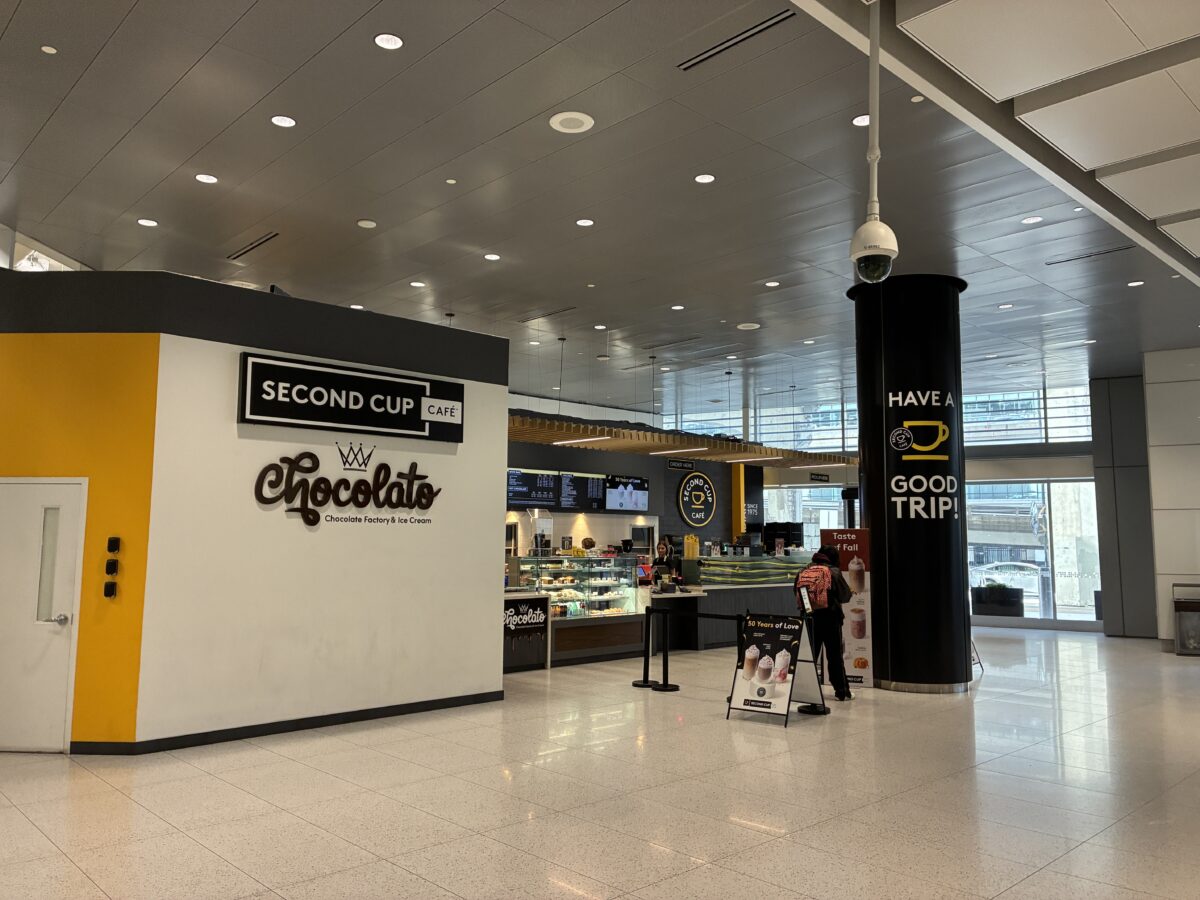
Wadera sees the Starbucks retreats not as an indictment of physical cafés but as a validation of Second Cup’s approach. Where Starbucks optimized for throughput and consistency, Second Cup is doubling down on experience. The brand is rolling out a refreshed store design emphasizing warmth—subtle colors, greenery, more seating. “I’m adding seats because I don’t want people to leave,” Wadera says. “I want them to see the energy behind the counter, the conversations happening. I don’t want long faces in my stores.”
It’s a pointed contrast with the direction much of the industry has taken. While competitors installed order tablets and chased mobile app transactions, Second Cup added seating and told employees to slow down, talk longer, ask follow-up questions. The café launched birthday cake-inspired beverages in September to mark the anniversary—Birthday Cake FroCho, Birthday Cake Latte, Iced Birthday Cake Latte—alongside exclusive merchandise. But the real celebration, in Wadera’s view, is the daily experience in each of the 182 (soon to be 191) locations.
“Coffee doesn’t travel. The experience doesn’t travel,” he says with the certainty of someone who has spent decades in the business. “The experience happens inside the café.”
What Legacy Looks Like
When Wadera talks about Second Cup’s next 50 years, he doesn’t project specific location counts or market share targets. Instead, he talks about legacy in surprisingly personal terms for a corporate executive.
“I want this brand to thrive for another 50 years,” he says. “Maybe someone will call me in 50 years and say, ‘Sam, come do a ribbon cutting’—even if I can’t walk. I just want someone to tell me: ‘Yes, you were part of a great Canadian brand.'”
It’s the kind of answer that would make a corporate communications team nervous—too emotional, too small-scale for a company operating nearly 200 locations. But it tracks with everything else Wadera has articulated about Second Cup’s survival strategy: stay rooted in community, focus on experience over transactions, play the long game even when quarterly thinking dominates the industry.
The approach assumes something that might seem radical in 2025: that despite all the technology, despite the convenience of mobile ordering and ghost kitchens and delivery apps, people still want places to go. They want to sit down, talk to someone behind a counter who asks about their day, and drink coffee that tastes like it was made for them rather than optimized for them.
From one Scarborough kiosk to 191 cafés across Canada, Second Cup has survived by betting on that assumption. As the brand enters its next half-century, Wadera isn’t changing the wager. If anything, he’s doubling down.
“This is your second home,” he says. “That’s what we’ve always been. That’s what we’re going to keep being.”

Dustin Fuhs is the founder and Editor-in-Chief of 6ix Retail, Toronto’s premier source for retail and hospitality industry news. As the former Editor-in-Chief of Retail Insider, Canada’s most-read retail trade publication, Dustin brings over two decades of expertise spanning retail, marketing, entertainment and hospitality sectors. His experience includes roles with industry giants such as The Walt Disney Company, The Hockey Hall of Fame, The Canadian Opera Company, Starbucks Canada and Blockbuster.
Recognized as a RETHINK Retail Top Retail Expert in 2024, 2025 and 2026, Dustin delivers insider perspectives on Toronto’s evolving retail landscape, from emerging brands to established players reshaping the city’s commercial districts.