
One week after Montreal-founded hospitality startup Sonder Holdings announced its immediate liquidation, Toronto’s downtown core is dealing with the aftermath. The company’s sudden collapse on November 10, following the termination of its partnership with Marriott International, has left more than 100 apartment-style accommodation units vacant across five prime locations.
The speed of Sonder’s downfall has caught the hospitality industry off guard. Just 15 months ago, the company signed what appeared to be a game-changing partnership with Marriott, giving the struggling startup access to one of the world’s largest hotel booking platforms and loyalty programs. The deal was supposed to provide the financial stability and customer base that Sonder needed to prove its business model could work. Instead, technical integration problems, mounting costs, and operational challenges turned the partnership into the final nail in the company’s coffin.
For Toronto, Sonder’s collapse represents both immediate disruption and unexpected opportunity. The five vacant properties sit in some of the city’s most desirable neighborhoods – from the Entertainment District to West Queen West to Liberty Village. These aren’t random locations; Sonder specifically chose buildings in areas with strong foot traffic, transit access, and the kind of urban energy that attracted their target market of tech-savvy travelers and remote workers. Now those same qualities make them attractive to a completely different set of potential operators looking to capitalize on prime Toronto real estate that’s suddenly available.
The implications extend beyond just hospitality. In neighborhoods where short-term rentals have contributed to housing pressures and changed community dynamics, the return of these units to potential long-term use could reshape local rental markets. Meanwhile, the sudden availability of fully-equipped, modern spaces in strategic locations has caught the attention of everyone from independent hotel operators to retail developers to residential conversion specialists.
The Immediate Impact

Sonder operated across five strategic Toronto locations, each positioned in neighborhoods that define the city’s hospitality landscape. The properties span from the Entertainment District to Liberty Village, representing a significant chunk of Toronto’s alternative accommodation inventory.
“We are devastated to reach a point where a liquidation is the only viable path forward,” said Janice Sears, Sonder’s Interim Chief Executive Officer, in the company’s final press release. The closure came after what the company described as “prolonged challenges in the integration of the company’s systems and booking arrangements with Marriott International.”
The collapse came just five months after Sonder co-founder and CEO Francis Davidson left the company. The Marriott partnership, announced in August 2024, was supposed to be Sonder’s lifeline. The deal allowed the struggling apartment-hotel operator to list properties on Marriott’s booking platform, giving access to one of the world’s largest loyalty programs. Instead, technical integration problems that cost the company nearly $3.7 million in the first half of 2024 caused what Sears called “significant, unanticipated integration costs” and a “sharp decline in revenue,” ultimately sinking the company.
Toronto’s Vacant Properties: Prime Real Estate Up for Grabs
Sonder The Slate – Entertainment District
348 Adelaide St W, Toronto, ON M5V 1R7
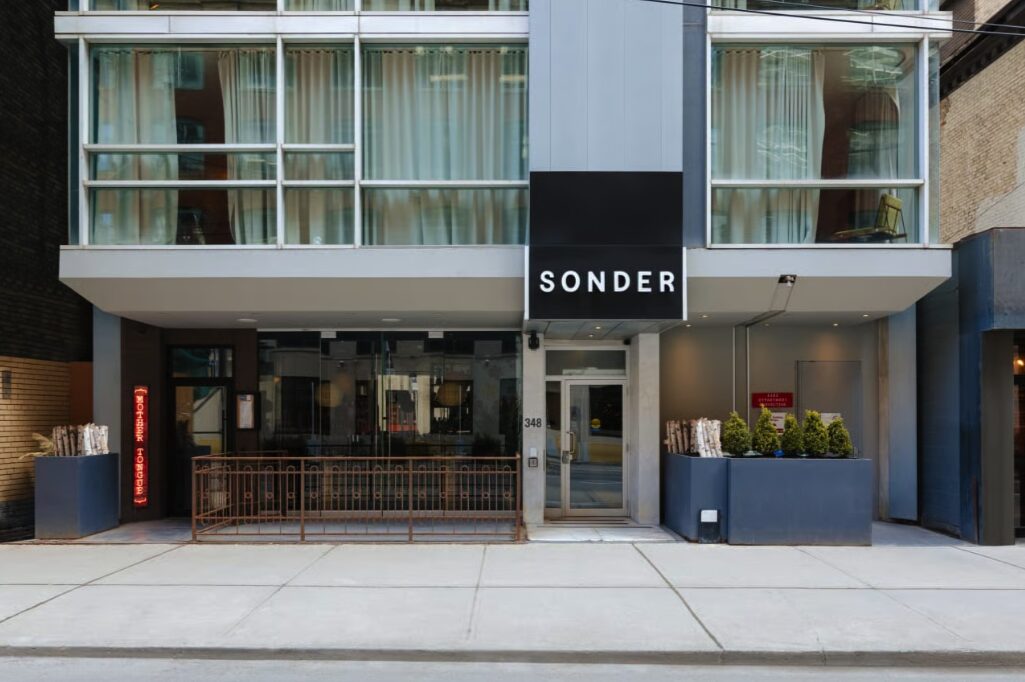
The Sonder Property Description
If you’re looking for a unique space in the heart of Toronto’s Entertainment District, The Slate has you covered. Take your pick from our selection of modern rooms and chic lofted suites – there’s something here for every style. Located in downtown Toronto, there are more restaurants, nightlife, and shopping than you could hope to see in one visit. Don’t worry; we’ve provided a noise kit to help keep the excitement out of your space. For a quick bite, the neighboring restaurant Haam offers hearty Japanese-Mexican dishes. We also recommend checking out Graffiti Alley, an urban art explosion only a few blocks away. When settling into The Slate, you’re in for an unforgettable Toronto experience.
Entertainment District
Nestled between Lake Ontario and the city of Toronto, the Entertainment District has become the center of attention for residents, visitors, and celebrities alike. Easily accessible and centrally located, it’s filled to the brim with lively concert venues, sports arenas, and famed restaurants. Visit the Princess of Wales Theatre for a once-in-a-lifetime experience, and see how this vibrant neighborhood comes to life after dark.

Sonder The Liberty Apartments – Liberty Village
1100 King St W, Toronto, ON M6K 0C6

The Sonder Property Description
A modern escape in the Toronto tech world — welcome to The Liberty. Natural light beams through the floor-to-ceiling windows. Pops of soft pinks and vibrant greens accentuate the contemporary appliances. The fitness center has free weights and cardio equipment and you can cool off in the rooftop pool. Want a snack? Longo’s grocery store is right downstairs. Sports lovers can catch a game at Lamport Stadium across the street. While foodies can sample a medley of international dishes from Mildred’s Temple Kitchen. Whether you’re getting down to business or hitting the town, the city is yours at The Liberty.
Liberty Village
West of Downtown Toronto, Liberty Village is a creative hub with industrial roots. Artists, entrepreneurs, and professionals make their mark in this tech community. In the heart of the neighborhood, the restored Liberty Market Building has spaces for everyone: fitness classes, breweries, and offices. Enjoy easy access to the vibrant street art and buzzing cafes.
Sonder Artesa Apartments – West Queen West
6 Brixton Wy, Toronto, ON M6K 0H6

The Sonder Property Description
Art galleries, lively bars, and eclectic boutiques. At the heart of West Queen West is Artesa. This building mirrors the sunrise with its floor-to-ceiling windows and illuminates it with light. Each space includes in-suite laundry and a fully equipped kitchen. Brew yourself a coffee and enjoy it outside, or get your energy from a workout in the fitness center. Step out onto the bustling city streets and explore the historic architecture and delicious eateries. Your Toronto adventure starts at Artesa.
West Queen West
One of Toronto’s most vibrant neighborhoods, West Queen West is an eclectic enclave that combines historic and modern architecture along quaint, tree-lined streets. Enjoy a night out at a wine bar or bistro as live music pours out of a concert venue nearby. Explore the thriving art scene through galleries, studios, and colorful graffiti murals by local artists. Or stop by an independent shop or cafe on a leisurely stroll through Trinity Bellwoods Park. West Queen West is a dynamic blend of art and culture that will leave a lasting impression.
Sonder The Nealon Apartments – Old Town
197 King St E, Toronto, ON M5A 1J5

The Sonder Property Description
Step back in time and experience the historic charm of Old Town at The Nealon. Built in 1888 and beautifully restored in 2024, this Romanesque building is one of Toronto’s oldest treasures. Inside, your stylish apartment offers modern comforts, including a fully equipped kitchen, in-suite laundry, and a Roku TV. Complimentary luggage storage is also available for your convenience. Wander the cobblestone streets of the Distillery District and snap a photo at the iconic Gooderham Building. Or find tranquility amidst the lush greenery of St. James Park. Let the captivating history unfold beyond your doorstep.
Old Town
Victorian architecture, cobblestone streets, and historic landmarks — immerse yourself in the rich history of Toronto’s Old Town. Wander through the Distillery District, where art galleries, unique boutiques, and cafés thrive in a beautifully preserved setting. Don’t miss the iconic St. Lawrence Market, a hub of fresh, artisanal delights and community spirit for over two centuries. Blending historic charm with modern vibrancy, Old Town promises an unforgettable experience.
Sonder The Elm Apartments – Downtown Core
159 Elm St, Toronto, ON M5T 3A7

The Sonder Property Description
The Elm offers the best of Baldwin Village. Your space features an elegant design with wooden accents and contemporary art pieces. Plus, there’s a fully equipped kitchen, in-suite laundry, and Roku streaming. Ready to immerse yourself in the Toronto melting pot? Swing by The Art Gallery of Ontario to admire the impressive permanent collection and rotating exhibitions. Picnic at Queen’s Park, or take your pick of delicious bites from around the world. We love Adega for seafood dishes and a taste of Iberia! And beyond Queen Street, explore the city’s buzzing nightlife and entertainment scenes. Sweeping cosmopolitan spirit packed with hidden gems, vibrant culture, and activities galore — settle into “The Six” at The Elm.
Baldwin Village
Located in the west of downtown Toronto, within the Grange Park neighbourhood, one block north of Dundas Street West, Baldwin Village is a commercial enclave in close proximity to Dundas Street West and the Toronto General Hospital. The former modestly sized homes on the street have been converted to restaurants and small shops selling arts, crafts and curios.
Strategic Locations Create Opportunity

Avi Behar, Chairman & CEO of The Behar Group Realty Inc., believes Sonder’s collapse presents a significant opportunity for Toronto’s real estate market, despite the immediate disruption it has caused.
“Sonder actually selected very strong real estate. Their locations are excellent,” Behar explained. “The net result is they’re gone, but these are prime spaces in desirable areas of Toronto and would be attractive to someone else.”
Behar emphasized that the key to maximizing this opportunity lies in the speed of transition for these properties.
“From a landlord perspective, the most seamless and quick transition would be of the greatest benefit,” he said. “If there was a plug-and-play concept where someone could come in, take the spaces over almost as-is, give it a little upgrade or refresh if they need to, and get it open and operational, that would be a huge benefit.”
The real estate expert sees broader implications beyond just the hospitality sector, noting the potential positive impact on surrounding businesses and the community.
“There’s a community benefit. These are valuable uses in prime areas of Toronto,” Behar said. “If we can get it reopened quickly, it’s probably better for the community and for the overall commercial ecosystem – nearby restaurants, shops, offices, everything else.”
When asked whether Sonder’s collapse reflects broader challenges facing Toronto’s hospitality market, Behar was emphatic that this was an isolated business failure rather than a market-wide issue.
“This is much less reflective of the demand for hospitality and hotel rooms in downtown Toronto as it is a reflection of the operations and the way that the business was being run, financed, capitalized and operated,” Behar explained. “I still think there’s lots of demand for hospitality in all of Canada’s major cities, specifically Vancouver and of course Toronto as well.”
Global Hospitality Disruption

Sonder’s collapse extends far beyond Toronto’s borders. The company operated approximately 9,000 short-term rental and boutique hotel units across more than 40 cities in 10 countries when it announced liquidation. From New York to London, Montreal to Mexico City, guests were similarly displaced with little warning as properties shut down immediately.
The scale of the disruption highlights how quickly a tech-driven hospitality company can unravel in today’s interconnected travel market. Sonder’s business model – taking long-term leases on premium urban properties and converting them to short-term rentals – was replicated across major cities worldwide, meaning the sudden closure creates vacancy and opportunity on a global scale.
Industry Expert: The Future of These Spaces

Lisa Hutcheson, Managing Partner of J.C. Williams Group, sees Sonder’s collapse as creating both immediate challenges and unprecedented opportunities for Toronto’s retail landscape.
“The collapse/closure of a major hospitality offering immediately reduces neighborhood foot traffic, particularly impacting restaurants, cafés, quick-service retail, and experiential services that relied on short- and medium-stay guests,” Hutcheson explained. “These visitors often contribute higher discretionary spending, support fitness studios, salons, and other experiences, and help activate streets that might otherwise see slower daytime and evening activity.”
However, Hutcheson believes the timing for transformation couldn’t be better.
“Toronto’s downtown commercial real estate market has picked up considerable strength in recent months. At the same time, the hospitality sector is enjoying renewed energy, boosted by major cultural and sporting events — from Taylor Swift’s tour to the World Series,” she said. “I think it is the perfect time to repurpose the properties.”
Rather than simply replacing Sonder with another hospitality chain, Hutcheson sees opportunity for innovative retail concepts that could revolutionize how these spaces are used.
“Typically it is another chain that steps in and adopts the location. However, I think there are better options,” she said, pointing to experiential retail and hybrid spaces where retailers create immersive environments, workshops, and mixed-use spaces integrating retail with wellness and community services.
Hutcheson’s vision for these properties goes far beyond traditional retail. For lifestyle brand pop-ups, “the rooms become mini showrooms; the lobby hosts brand events; integrated AR mirrors or smart tech lets visitors try or personalize products.”
Wellness retreat hubs could “convert some rooms into wellness studios, healing spaces for massage or therapy, or recovery suites; ground floor as a wellness retail store.”
She also envisions retail-as-hospitality models where “guests can ‘stay’ in a branded room that doubles as a retail showroom for furniture, design products, or art, and buy what they live with.”
Through her work with the international Ebeltoft Group network, Hutcheson has observed that “hospitality-to-retail transformations do not fully redevelop the entire hotel: instead, lower floors – lobbies, public areas – are converted to retail, while upper floors remain hospitality or are turned residential.”
For Toronto specifically, Hutcheson sees multiple pathways forward: “Spaces could support emerging hospitality concepts — from flexible-stay accommodations to boutique, experience-driven hotels — aimed at the same market Sonder once served, as this seems to be a management issue rather than concept failure.”
A Canadian Company’s Rise and Fall
Sonder’s story began in Montreal in 2014, co-founded by McGill University student Francis Davidson. The company aimed to bridge the gap between Airbnb’s flexibility and hotel reliability, offering apartment-style accommodations with professional service and tech integration.
Key Timeline:
- 2014: Founded in Montreal by Francis Davidson
- 2016: Moved headquarters to San Francisco
- 2019: Reached $1 billion valuation
- 2020: Quebec government promised $30-million loan for growth (later cancelled, loan never disbursed)
- 2022: Went public via SPAC merger during pandemic
- June 2024: Co-founder Francis Davidson departed
- August 2024: Announced partnership with Marriott International; CFO Michael Hughes departed
- September 2024: Co-founder Martin Picard left as chief real estate officer
- November 9, 2024: Marriott terminated licensing agreement
- November 10, 2024: Sonder announced immediate liquidation
The company’s stock price collapsed from roughly $200 USD per share to $0.17 USD by the time of closure. The asset-heavy model – signing long-term leases and taking operational control of entire buildings – proved unsustainable in a post-pandemic market that favored flexibility and lower capital requirements.
“We explored all viable alternatives to avoid this outcome, but we are left with no choice other than to proceed with an immediate wind-down of our operations and liquidation of our assets,” Sears said in the company’s final statement.
What Happens Next

The sudden availability of more than 100 accommodation units in prime Toronto locations presents both challenges and opportunities. These properties represent significant real estate value in neighborhoods that continue attracting business and leisure travelers.
For Toronto’s hospitality market, Sonder’s exit removes a major player from the alternative accommodation sector but opens space for more financially sustainable business models. The company’s focus on technology integration and apartment-style stays reflected genuine market demand that other operators may now address through more viable approaches.
The closure also highlights the risks of rapid expansion and complex technology integrations in hospitality – lessons that will likely influence how future accommodation companies approach growth and partnerships.
Moving Forward
As Toronto’s hospitality sector continues its post-pandemic recovery, the Sonder closure represents both an end and a beginning. The immediate disruption affects guests, employees, and partners, but underlying demand for quality accommodation in Toronto’s core neighborhoods remains strong.
The properties that housed Sonder’s operations sit in locations that will continue attracting hospitality investment. Whether they become traditional hotels, independent boutique accommodations, innovative retail concepts, or residential developments, they represent valuable assets in a city where prime real estate stays in high demand.
For Toronto’s retail and hospitality landscape, the Sonder story serves as a reminder of both opportunities and risks in rapid expansion and technology-dependent business models. As the city continues evolving its accommodation offerings, lessons from Sonder’s rise and fall will likely influence how future hospitality ventures approach sustainable growth in one of Canada’s most competitive markets.

Dustin Fuhs is the founder and Editor-in-Chief of 6ix Retail, Toronto’s premier source for retail and hospitality industry news. As the former Editor-in-Chief of Retail Insider, Canada’s most-read retail trade publication, Dustin brings over two decades of expertise spanning retail, marketing, entertainment and hospitality sectors. His experience includes roles with industry giants such as The Walt Disney Company, The Hockey Hall of Fame, The Canadian Opera Company, Starbucks Canada and Blockbuster.
Recognized as a RETHINK Retail Top Retail Expert in 2024, 2025 and 2026, Dustin delivers insider perspectives on Toronto’s evolving retail landscape, from emerging brands to established players reshaping the city’s commercial districts.