

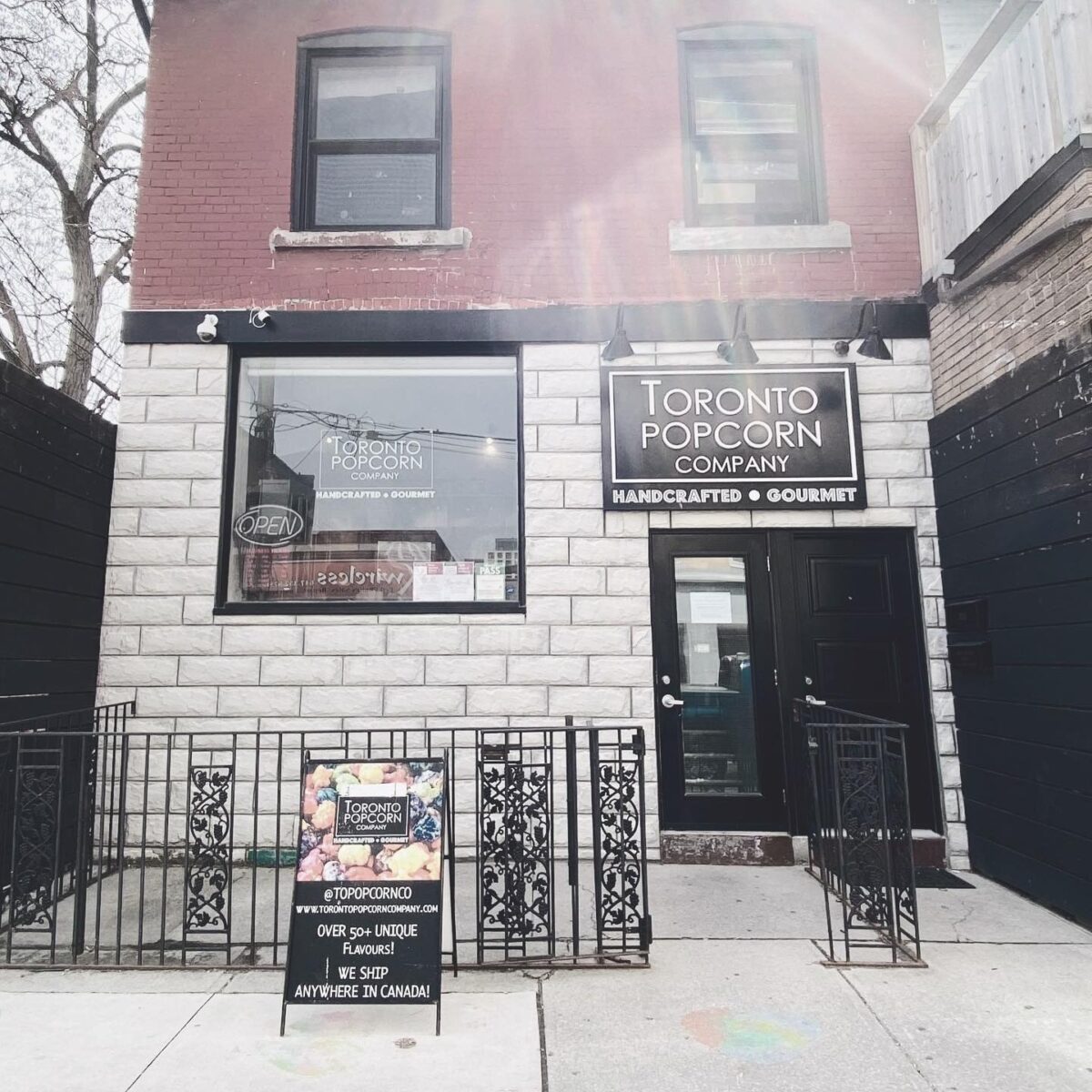
A year into Toronto Popcorn Company‘s Scarborough comeback, co-founder Joseph Villegas isn’t in any rush to return to the downtown core where the brand first made its name.
He recently checked out some of the old neighborhoods where the company used to operate.
“We did an ocular in one of the neighbourhoods where we used to be—rent is easily 4x what we used to pay, at the very least, and institutional names have closed,” Villegas told 6ix Retail.
Among those closures: Blue Banana, the gift shop emporium that held down 250 Augusta Avenue in Kensington Market for 17 years before shuttering last fall. The space didn’t sit empty—vintage shop Public Butter took it over—but the changeover illustrates how the neighborhood’s retail landscape is shifting.
It’s a familiar story for independent retailers across Toronto. The pandemic reset button didn’t bring rents down—it brought them up. And for mom-and-pop operations like Toronto Popcorn Company, the math that once made downtown viable has completely changed.
From festivals to survival
Toronto Popcorn Company’s journey reads like a case study in small business resilience. What started in 2013 as a one-kettle operation selling just two flavors at weekend festivals grew into a Kensington Market fixture with two retail locations and distribution in major grocers.
By early 2020, Villegas and his wife Caramhel—a trained pastry chef who developed the company’s now 100-plus flavor catalog—were working on a flagship location at Union Station. Then COVID hit, and the stores closed one by one.
What saved them was a pivot to wholesale and e-commerce. Toronto Popcorn Company now distributes through an extensive network spanning Alberta to New Brunswick—36 Fortinos locations, five Denninger’s stores, McEwan Fine Foods, Union Mercado at Union Station, and dozens of independent specialty retailers.

Modest growth in Scarborough
Since reopening the Lawrence Avenue East location in 2025, Villegas has been watching the numbers closely.
“While we haven’t seen the numbers that we were used to prior to the pandemic, having that retail avenue with higher margins has really helped. We weren’t expecting things to boom in the first year anyway, but the fact that we’re seeing familiar faces and hearing from new customers—either for corporate or personal orders—is a great indication that what we’re doing is promising.”
The Scarborough location combines production with retail—customers can watch the popcorn being made while they shop. It’s the theatrical element Villegas wanted when he first talked about reopening. But the downtown expansion that was supposed to follow? That’s been shelved indefinitely.

When asked about returning to downtown Toronto, Villegas laughed. “This one is a toss-up, actually.”
The quadrupled rents changed everything. But so did the experience of nearly losing the business entirely.
“I’d like to scale this gradually this time around, within the bounds of what keeps us liquid. There’s absolutely no rush. A lot of new startups in the industry we’re in have come and gone—at the end of the day, I think we’re still around because people trust the quality of what we’re doing.”

It’s a measured approach shaped by hard lessons. Pre-pandemic, Toronto Popcorn Company was expanding aggressively—two retail locations, exploring franchising, pushing into more wholesale accounts. That growth came with pressure and financial strain.
This time, Villegas is operating without outside partners, which gives him control over the pace. Staying liquid matters more than grabbing the next opportunity.
Why they opened a toy store
Faced with the reality that specialty food retail isn’t what it used to be, Villegas and Caramhel decided to hedge their bets. They opened The Brickery Canada in Markham—a toys, collectibles, and hobby shop.
But the origin story is more personal than just business strategy. According to the company’s website, The Brickery was “conceptualized post-pandemic, sprouting from one of the founders’ uphill battle with mental health.” During the pandemic uncertainty, building LEGOs became a lifeline. “Passing hours building little things brick-by-brick, the darkness slowly turned to light. The reconnection to the inner child was therapeutic—and life-saving.”
What started as a small LEGO shop evolved into something much bigger.
“We were looking into doing something with very little capital—again, as a side hustle just like Toronto Popcorn Company—so we ventured into used clothing. We ultimately got approved by a US-based franchise house for thrift goods, the biggest one actually. However, the barrier to entry was very high, not within our means right now. So we started our own brand on a shoestring budget in a flea market.”
The flea market location didn’t work out—not enough foot traffic to support the business model. So they relocated. Then customers started asking for different products.
“People then started looking for other stuff—being a collector of odd stuff since I was little, it has since evolved into a full-blown toys & collectibles and hobby shop. We also carry a line of premium apparel now. The two businesses are supported by one loyalty program, so customers of one end up being patrons of the other as well.”
The Brickery now operates out of Pacific Mall in Markham with a tagline that captures its purpose: “Everybody Needs a Hobby.” It’s become what the website calls “a curated destination for toys, games, hobbies, collectibles, and premium clothing & apparel.”
The Brickery represents a strategy you’re seeing more often with independent retailers in Toronto. Diversify the revenue streams. Build multiple businesses that can support each other. Don’t put everything into one category, especially when that category is artisanal food in an increasingly expensive city.
But there’s also something more fundamental at play. The Brickery’s mission—getting people into hobbies and self-care—reflects what Villegas and Caramhel learned during the pandemic. Sometimes survival isn’t just about revenue. It’s about finding something restorative when everything else feels uncertain.
What’s next
Looking ahead, Villegas has a clear sense of what he’s trying to do.
“Knowing what we know now, there’s no telling what’s in store for the future. All we’re doing right now is responding to what our customers are looking for and exceeding their expectations. It’ll definitely be a good mix of wholesale, retail, and e-commerce still. Barring another pandemic, I think we’re well on our way to where we were when we were rapidly expanding—but this time, we have absolute control of the tempo without partners.”
The Brickery is still early stages, but it’s gaining traction by pulling from Toronto Popcorn’s existing customer base.
“The Brickery Canada is currently at its grass-roots, but the brand is getting very good traction as we are able to leverage the customer base that we have for Toronto Popcorn Company. Toronto Popcorn Company remains the crown-jewel of these smaller businesses that we are building, though, that’s for sure.”
For independent retailers watching commercial rents climb and wondering how to stay viable in Toronto’s core, there might be a lesson here. Growth doesn’t have to mean more locations. Sometimes it means diversifying what you sell, where you sell it, and accepting that patience—not aggressive expansion—is the survival strategy.
You can find Toronto Popcorn Company at 4218 Lawrence Avenue East in Scarborough and online at torontopopcorncompany.com. The Brickery Canada is located at Pacific Mall, 4300 Steeles Avenue East, Unit E11, Markham.

Dustin Fuhs is the founder and Editor-in-Chief of 6ix Retail, Toronto’s premier source for retail and hospitality industry news. As the former Editor-in-Chief of Retail Insider, Canada’s most-read retail trade publication, Dustin brings over two decades of expertise spanning retail, marketing, entertainment and hospitality sectors. His experience includes roles with industry giants such as The Walt Disney Company, The Hockey Hall of Fame, The Canadian Opera Company, Starbucks Canada and Blockbuster.
Recognized as a RETHINK Retail Top Retail Expert in 2024, 2025 and 2026, Dustin delivers insider perspectives on Toronto’s evolving retail landscape, from emerging brands to established players reshaping the city’s commercial districts.