

The Ebeltoft Group’s 21st annual Retail Innovations report profiles 50 groundbreaking retail concepts from over 20 countries, with two Toronto companies earning spots in the global study. The comprehensive analysis reviewed over 100 submissions worldwide, with each member country presenting four to six cases for jury consideration.
Kind Karma, a social enterprise jewelry retailer employing at-risk youth, and Penguin Pickup, a logistics platform transforming transit stations into parcel hubs, represent Canada in this year’s report. Their inclusion highlights Toronto’s capacity for innovation, while experts warn that the broader Canadian market is falling behind international competitors on creating compelling in-store experiences.

Lisa Hutcheson, Managing Director at JCWG, who serves on the Ebeltoft board, identifies the most critical gap: “Engaging Destinations is the most relevant to the Canadian retail market at the moment, because it is lacking. This can be the biggest differentiator to the consumer, and yet many still try to entice customers with lowering prices.”
The report identifies three defining themes shaping retail’s future: A Better World, Easy Journeys, and Engaging Destinations. “While representation from each country is important, the jury is critical to present the best cases, no matter the location,” Hutcheson says of the selection process.
The findings come as Canadian retailers prepare for an influx of Chinese retail concepts expected to enter Toronto, Vancouver, and Montreal—intensifying competition in a market already struggling to keep pace with experiential innovations emerging in Europe and Asia.
Global Innovations Setting New Standards
The report’s “Engaging Destinations” category showcases how international retailers are transforming physical stores into experience-driven environments. BERSHKA’s 1,200-square-meter Manchester flagship combines augmented reality mirrors with real-time Snapchat filters and exclusive music partnerships with UK platform NTS. The store divides into three distinct zones—Bershka, BSK teen line, and Man—each with its own entrance and identity.
AREA15 in Las Vegas takes the concept further, expanding to 28,000 square meters of art, retail, entertainment, and immersive attractions including Meow Wolf’s Omega Mart and Universal Horror Unleashed. The destination functions as what the report describes as “an event center inspired by shopping malls and theme parks,” with retail intentionally intertwined throughout constantly evolving programming.
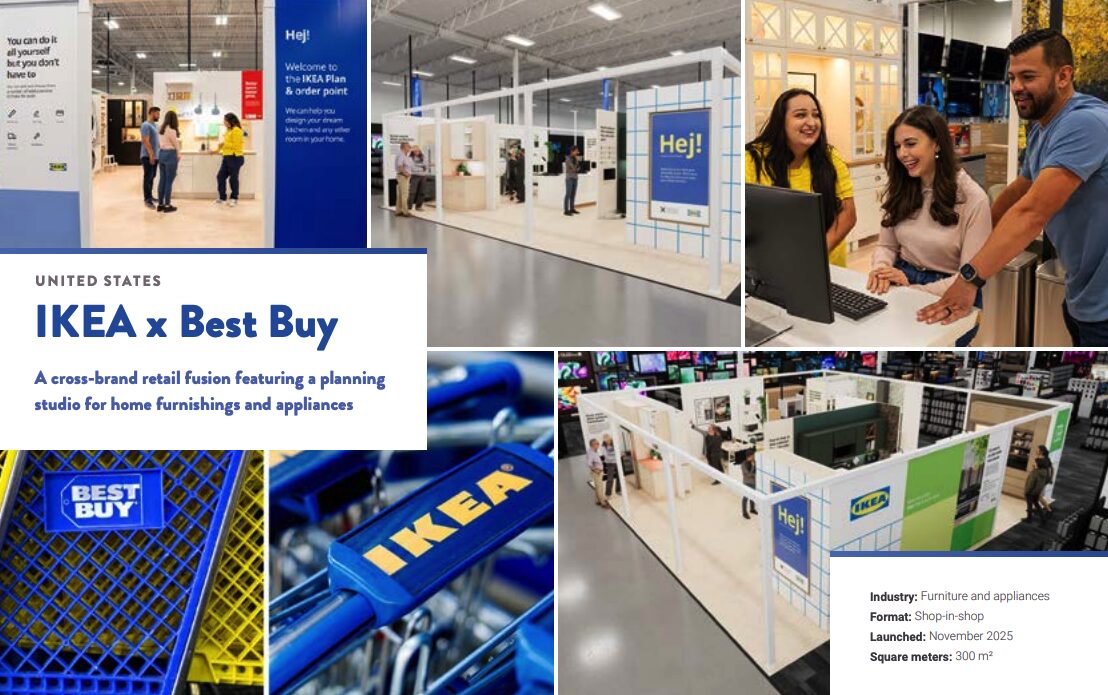
Cross-brand partnerships also emerge as a key strategy. IKEA partnered with Best Buy to create 300-square-meter shop-in-shops in select U.S. locations, featuring consultation-focused spaces where customers design complete kitchen and laundry solutions. “The space is built around consultation, not inventory,” the Ebeltoft commentary notes, highlighting how the format extends IKEA’s reach without full stores while driving incremental traffic for both brands. The collaboration demonstrates how retailers can solve complete customer problems rather than simply selling products.
Toronto’s Recognition: Purpose and Platform Transformation

Kind Karma earned its spot through an innovative employment model that addresses both social impact and retail viability. Founded by Laurinda Lee Retter, the 90-square-meter Toronto flagship employs at-risk and homeless youth as jewelry artisans through an art therapy-based program. Each handcrafted piece comes with a personalized card signed by the artisan who created it, establishing a direct emotional connection between customer and creator.
The business operates without public funding, demonstrating what Hutcheson calls “purpose-led commerce” that prioritizes human potential while sustaining commercial operations. Revenue from permanent jewelry, charm bars, custom engraving, and workshops directly funds youth wages and supports their education, housing, and personal development.

Penguin Pickup represents a different innovation path: platform business model transformation. The decade-old company evolved from traditional brick-and-mortar parcel pickup locations into a platform company by deploying solar-powered smart lockers at Toronto Transit Commission stations.
Working with Romania-based ARKA, Penguin Pickup developed lockers capable of operating at temperatures down to -40°C while maintaining cameras, lighting, and user interfaces. The innovation bridges logistics and public transit—sectors that traditionally don’t collaborate—demonstrating how partnership-driven network growth can replace capital-intensive physical expansion.
“The innovation represents a business model evolution from location- and asset-heavy retail operations to technology-enabled platform orchestration,” Hutcheson explains. “They became a trusted shipping address through infrastructure partnerships rather than owned real estate.”
The Canadian Experience Gap
While Toronto companies demonstrate innovation capacity, Graham Heuman, Research and Insights Lead at JCWG, sees broader market challenges. “Canadian retailers, while some are creating exciting experiences, are falling behind on creating engaging destinations,” he says. “There are not a lot of engaging destinations in Toronto or Canada. Europe and Asia—and pockets of the U.S.—are so far ahead of Canadian retailers on creating experiences.”

The contrast with global examples is stark. While BERSHKA creates AR-enabled music experiences and AREA15 transforms retail into entertainment, Canadian retailers largely rely on traditional formats and price competition.
Hutcheson emphasizes the missed opportunity: “While budgets are scrutinized, people are still spending on experiences. However, this has defaulted to hospitality, travel, and events rather than retail because there are not enough experiential elements to attract them.”
Heuman points to Hudson’s Bay as evidence that comfortable reliance on the status quo no longer works. “Retailers in Canada have had comfortable existences with the status quo, but giants like Hudson’s Bay are proving that this is no longer good enough. The consumer evolves as the stores stay the same.”
His prescription is straightforward: “People want to shop in stores, but they do not want to shop in boring stores. I think stores need to pilot some new experiences, events, models, etc. to make them more exciting.” The emphasis on piloting—rather than wholesale transformation—suggests incremental testing can yield results without requiring massive capital investment.
AI Disruption Reshapes Discovery
Beyond physical retail transformation, the report highlights how agentic AI is fundamentally changing product discovery. ChatGPT Shopping, featured as Best in Category for Easy Journeys, now enables 700 million weekly users to discover, compare, and purchase products without leaving the chat interface.
When asked whether this represents hype or a genuine threat, Heuman is direct: “This is not hype. While there may be attrition in AI discovery apps and websites, it is here to stay.”
OpenAI’s integration with Etsy and over a million Shopify merchants means discovery increasingly happens outside retailers’ own channels. Product ranking is based on relevance and structured data rather than paid placement, requiring retailers to ensure clean, accurate product information optimized for AI understanding.
Heuman’s advice for Canadian retailers reflects pragmatism rather than panic: “Canadian retailers do not need to worry if they are putting strategies together to work with AI, rather than against it, and find ways to move from search engine optimization to AI discovery optimization.”
The implications extend beyond technology. As AI moves into the decision layer of shopping, retailers must ensure their brands are properly represented when algorithms recommend products. Those who delay risk being bypassed entirely.
The Copy-Paste Mistake and Coming Competition
Hutcheson identifies a common error compounding Canadian retailers’ challenges: attempting to directly copy international concepts without adaptation.
“We have seen it time and time again where retailers copy something that works in other areas and attempt to copy it here,” she explains. “Canada doesn’t have a Dubai, Shanghai, Manhattan, or Tokyo. These places are known for incredible retail, but they are targeted at these demographics. Canadians are a mix of so many people that strategies need to be heavily targeted to local tastes, and international concepts cannot be simply copied—they need to be adapted.”
This insight takes on particular urgency given what Heuman sees coming. With improved Canada-China relations opening doors, he predicts Chinese retailers will enter Canadian markets starting with Toronto, Vancouver, and Montreal—and he’s watching with genuine interest rather than alarm.
“Chinese retailers are experts at creating engaging experiences, arguably better than anywhere else, and I can’t wait to see which of their concepts they bring to Canada,” he says. The statement reflects confidence in learning from new entrants rather than fear of displacement. But it comes with a timeline: “We are at a pivotal time in Canada. Now is the time to get consumers hooked on Canadian retailers, especially with U.S. brands falling out of favour.”
The competitive window is narrowing. Canadian retailers can’t simply copy Chinese experiential concepts when they arrive—that would repeat the exact mistake Hutcheson warns against. But they also can’t ignore what these retailers will teach the market about what compelling destination retail actually looks like. The opportunity exists now, before new competition raises consumer expectations even higher.
Sustainability as Table Stakes
While Kind Karma exemplifies the report’s “A Better World” theme—focused on sustainability and social impact—Hutcheson offers a critical perspective on how this theme has evolved over the report’s 21-year history.
“The most important element to consider is alignment with the overall strategy,” she says. “A Better World, while an important theme, today in my mind is ‘table stakes.’ Companies must be sustainability-conscious. It is the extension of other factors like Kind Karma has built into their model that expands the theme.”
The theme itself has transformed over the years. What once focused narrowly on sustainable practices has broadened to encompass circularity, social impact, and community responsibility. Past years featured separate themes around new business models and sustainability that have now merged into Easy Journeys and A Better World respectively.
Consumers now expect retailers to operate sustainably and ethically—it’s no longer a competitive advantage. What makes Kind Karma innovative isn’t just sustainability, but how the social enterprise model weaves into every business aspect, from employment to product creation to customer connection. It’s the integration, not the intention, that earns recognition.
What Comes Next
Looking ahead to the 2027 report, Heuman’s prediction is notably optimistic rather than cautionary. “Every year it gets harder and harder to find new cases,” he notes. “I think next year we will see many more engaging destinations than ever before. With global trade being tested, and wallets getting tighter around the world, experiences are going to be the biggest differentiator when prices become a challenge.”
That outlook suggests he believes the wake-up call is being heard. Retailers globally—and potentially in Canada—are recognizing that when price competition intensifies, experience becomes the escape valve.
For Toronto and Canadian retailers, the report offers both validation and warning. Innovation is possible—Kind Karma and Penguin Pickup prove it. But isolated success stories don’t indicate broader market health. The question isn’t whether to innovate—it’s whether retailers will move fast enough to lead rather than follow.
The complete Retail Innovations 2026 report serves as both inspiration and practical guide for retailers looking to participate in the market’s evolution, offering insights into successful innovation in an increasingly dynamic global landscape.
The full Retail Innovations 21 report is available for free download from the Ebeltoft Group.

Dustin Fuhs is the founder and Editor-in-Chief of 6ix Retail, Toronto’s premier source for retail and hospitality industry news. As the former Editor-in-Chief of Retail Insider, Canada’s most-read retail trade publication, Dustin brings over two decades of expertise spanning retail, marketing, entertainment and hospitality sectors. His experience includes roles with industry giants such as The Walt Disney Company, The Hockey Hall of Fame, The Canadian Opera Company, Starbucks Canada and Blockbuster.
Recognized as a RETHINK Retail Top Retail Expert in 2024, 2025 and 2026, Dustin delivers insider perspectives on Toronto’s evolving retail landscape, from emerging brands to established players reshaping the city’s commercial districts.