
The City of Toronto is hosting free public viewing parties for all remaining 2025 Blue Jays postseason games, creating unprecedented opportunity for restaurants, retailers, and hospitality venues across multiple neighbourhoods to benefit from the playoff run. With the Blue Jays advancing to the American League Championship Series after defeating the New York Yankees, the celebration continues across the city.
The ALCS viewing parties will be held at locations to be determined from Sunday, October 12 through Monday, October 20. If the Blue Jays advance to the World Series, all games will be shown at Nathan Phillips Square from Tuesday, October 21 through Saturday, November 1. Earlier ALDS viewing parties took place at Mel Lastman Square (5100 Yonge St.) and Albert Campbell Square (150 Borough Dr.).
“Toronto is a baseball city and when it’s the postseason, we want everyone to experience the excitement together,” Mayor Olivia Chow said in announcing the viewing party series. “These viewing parties are our way of turning every corner of the city into one big cheering section.”
The city’s strategy explicitly encourages fans to support local restaurants and venues before and after games, positioning the playoff run as both a civic celebration and an economic opportunity for Toronto’s business community. The distributed approach across North York, Scarborough, and downtown is creating multiple commercial districts positioned to benefit from concentrated foot traffic and community energy.

For the restaurant industry facing sustained pressure from inflation, supply chain disruptions, and tariffs, the extended playoff run provides welcome momentum. Adoniram Sides, SVP of Hospitality at Lightspeed, emphasizes that successful playoff operations require examining historical data to identify demand patterns, popular menu items, and staffing requirements.

“Playoff nights are high stakes,” Sides says in an exclusive interview with 6ix Retail. “Restaurants that succeed are the ones that look at past event data to forecast capacity and demand. By comparing sales from big sports events or playoff runs, operators can see which menu items sold fastest, when demand peaked, and how staffing levels shifted. With that knowledge, they can adjust schedules, inventory, and prep in advance.”
The operational complexity of managing simultaneous dine-in and delivery demand requires integrated technology systems. “In the kitchen, having all dine-in and delivery orders flow into a single display system helps staff prioritize and time dishes smoothly,” Sides notes. “When everything is in sync, guests feel the excitement of game night without seeing chaos behind the scenes.””

Lisa Hutcheson, Managing Partner at J.C. Williams Group, sees the distributed viewing party approach as addressing fundamental shifts in consumer behavior that extend across both hospitality and retail sectors.

“People are craving opportunities to gather with their friends and celebrate exciting things,” Hutcheson says. “This is a much-needed boost for food and beverage that’s really struggled over the last little while. This is a great way to bring fans in and create opportunities for them to gather, watch the game, celebrate together, and enjoy a beer and some food to go along with it.”
The playoff opportunity extends significantly beyond restaurants to Toronto’s retail sector, particularly businesses focused on Canadian products and local brands. “This is really an opportunity for Toronto-based retail, especially with Made in Canada products,” Hutcheson explains. “This is a nice complement for retailers that are promoting Made in Canada – they can jump on the Blue Jays wagon as well.”
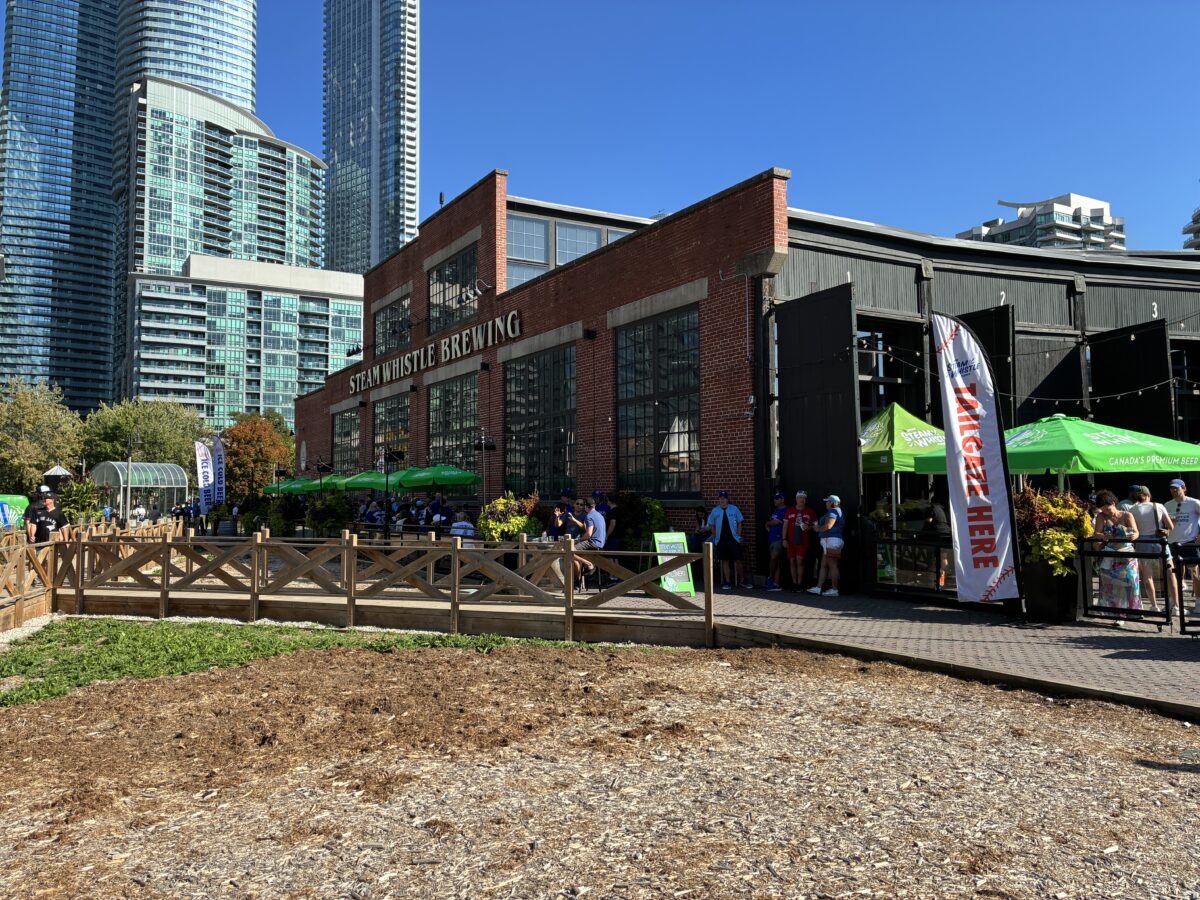
Steam Whistle Brewing, whose Roundhouse location sits across from Rogers Centre, has positioned itself as a natural gathering place throughout the playoff run. Catherine Oppedisano, VP of Marketing at Steam Whistle, explains how the brewery has capitalized on its unique location and Toronto heritage.

“All season long, we’ve been doing a tailgate three hours before each Jays game,” Oppedisano says. “That pregame tailgate experience is such an American thing that we saw a real opportunity to own it here in Canada. We’re so fortunate to have this heritage building attached to a park, right across the street from Canada’s only baseball stadium. It’s an incredible chance to get thousands of people in our building having beers and burgers, enjoying the energy of the crowd before they go sit in their seats.”
The strategy has proven effective both commercially and as community-building. “We’ve been able to capitalize on that captured audience, but we’ve also enhanced the ballpark experience as a whole by giving people a more financially accessible option to meet up with their friends before the game,” Oppedisano explains.
The approach addresses a fundamental challenge for fans attending games: finding accessible meeting points before entering the stadium. “We’ve kept our burger prices really suppressed because we know how expensive it is to just exist in the city, let alone a day out with your family,” she notes. “Keeping the experience accessible, keeping it as a place where you could easily meet up with friends—it’s kind of overwhelming to try to meet up right in the ballpark.”
The playoff environment creates opportunities for limited-time offerings across both restaurant and retail operations. Restaurants can test themed cocktails, shareable appetizers, and group packages during playoff games, tracking which offerings drive higher per-customer spending. Retailers can introduce playoff-specific product bundles, limited-edition collaborations, and event-driven promotions.
“Themed menus and playoff packages create memorable experiences that go beyond food and drink,” Sides says. “Operators can introduce limited-time bundles or promotional combos that are only available on game nights, then track their performance separately from regular items.”
Modern point-of-sale systems enable businesses to measure performance at granular levels, understanding which specific offerings drove profitability versus those generating volume without adequate margins. This data becomes valuable for planning future promotional strategies across sporting events, holidays, and other high-traffic occasions.
Delivery operations present particular challenges during playoff games as demand surges. “Delivery during playoff nights can be both a blessing and a challenge,” Sides acknowledges. “The key is to make sure delivery doesn’t overwhelm the dine-in experience.”
Integrated order management systems that consolidate multiple delivery platforms into unified workflows prevent operational chaos during high-volume periods. “With that foresight, operators can set up dedicated packing stations, stagger shifts, and pre-prep popular items,” Sides explains. “That way, both dine-in and delivery guests get consistent, quality service.”

Hutcheson emphasizes that customer acquisition during high-traffic events requires intentional engagement strategies applicable across both hospitality and retail operations.
“Customer acquisition is always a challenge, so we want to leverage this opportunity to gain a customer for life, not just for this little blip on the continuum,” she explains. “Engage with these people now that you have them in this environment. Whether that’s through gaining information for emails, following on social media, or welcome-back events, really understand who these customers are so they’ll come back.”
Beyond immediate revenue, playoff viewing parties provide businesses with customer acquisition channels that generate long-term value. Fans visiting establishments near viewing party locations for the first time represent potential repeat customers if businesses capture contact information and create compelling reasons for return visits across both restaurant and retail experiences.
“Sports bring people together, and restaurants become the natural gathering spot,” Sides observes. “From managing large group bookings to optimizing table layouts, the right setup can maximize capacity and atmosphere. The goal is to turn one-time playoff visitors into repeat customers, keeping that sense of community alive long after the season ends.”

The immediate business impact for Steam Whistle has been substantial. “We expanded our tailgate this year to take over one of our event spaces for any days we didn’t have bookings,” Oppedisano says. “Just by having space for more people, we’ve seen a pretty significant increase in sales volume and number of people through the door.”
Beyond short-term sales gains, Steam Whistle is capturing a crucial demographic through the playoff experience. “We’ve seen the attendance we’re getting and engagement with our socials starting to trend toward a younger audience—that 20 to 35-year-old demographic that has been increasingly hard for alcohol brands to capture,” Oppedisano observes. “Steam Whistle is a legacy brand with a core demographic that grew up with us in their twenties. Now we’re giving that next generation a space to come and enjoy the brand and the experience.”
As the Blue Jays advanced to the ALCS, Steam Whistle evolved its strategy beyond pre-game gatherings. “We didn’t really capitalize on watch parties early in the season—people used to clear out when the game started,” Oppedisano explains. “But as the season peaked interest and tickets got more expensive, we really started digging into making this a watch party destination.”
The brewery has positioned itself as “the Bird Nest” for both home and away games. “When they’re home, we’re close to the stadium. When they’re away, we’re a landmark destination,” she says. “What’s incredible about watching games here when the team is home is this very unique experience of being able to hear the crowd, hear the home run bell ring seconds before you see what’s about to happen on the screen. You know something amazing is about to happen—that excitement is unmatched. You can’t create that anywhere else.”
The Taylor Swift Eras Tour concerts that came through Toronto provided valuable lessons about leveraging major civic events for business benefit across multiple sectors. Hutcheson points to the Swift phenomenon as demonstrating the power of creating shared experiences and collaborative business opportunities.
“It really showed the power of having shared experiences and memories with people,” Hutcheson observes. “She built through friendship bracelets and the Swifty community – people wanting to be part of a whole experience. We saw complimentary businesses pop up: swap events, lineups for merchandise, story walls. Michael’s craft folks actually set up pop-ups where you could do beading and make your own bracelets. We saw a lot more collaboration and ways to celebrate as a community.”
The Taylor Swift model demonstrates how major civic events create opportunities for businesses to develop complementary offerings, collaborate across sectors, and build community experiences that extend beyond the primary event. Toronto businesses can apply these lessons to the playoff run by creating Blue Jays-themed experiences, collaborative promotions across restaurant and retail operations, and community gatherings that leverage the collective excitement.
The playoff momentum has also attracted brand partnerships for Steam Whistle. “As our profile has risen over the last few months, we’re getting more partners coming in, partnering with brands to enhance the experience,” Oppedisano notes. “It’s become more than just a brewery with beers and burgers—it’s a place where different brands can activate and engage with people trying to connect to baseball.”
Sides cautions that maximizing long-term value requires treating playoff events as strategic learning opportunities rather than simply capitalizing on temporary enthusiasm.
“Playoff events are about more than just riding the hype, they’re a chance to test ideas that can strengthen the business long term,” he emphasizes. “Operators should measure profitability at the item level, track spend per guest, and watch for repeat visits after the playoff period. Did bundles increase margins or only volume? Did new guests come back? The restaurants that benefit most are those that treat playoffs as both a celebration and a learning opportunity, refining what works so that the energy of game night translates into sustainable loyalty and growth.”
The analytical approach Sides advocates applies equally to retail operations and beverage companies. Businesses should track which playoff-related merchandise, promotional strategies, and customer engagement tactics proved most effective. This data informs future event-driven promotional strategies and helps businesses understand how to convert temporary traffic spikes into sustained customer relationships.

The city’s viewing party schedule spanning through November 1 provides businesses with an extended opportunity window for testing strategies, analyzing results, and refining approaches throughout the playoff run. With the Blue Jays now in the ALCS, businesses have already begun applying learnings from the ALDS games to optimize performance during the championship series and potential World Series games.
As Toronto rallies around the Blue Jays’ ALCS run, businesses that approach this opportunity strategically—using data to prepare, technology to coordinate operations, and engagement programs to capture customer information—are positioning themselves for success extending well beyond the postseason. For industries that have endured sustained economic pressure, the combination of municipal support, community enthusiasm, and extended playoff engagement offers both immediate financial relief and strategic positioning advantages that will benefit operations for months to come.

Dustin Fuhs is the founder and Editor-in-Chief of 6ix Retail, Toronto’s premier source for retail and hospitality industry news. As the former Editor-in-Chief of Retail Insider, Canada’s most-read retail trade publication, Dustin brings over two decades of expertise spanning retail, marketing, entertainment and hospitality sectors. His experience includes roles with industry giants such as The Walt Disney Company, The Hockey Hall of Fame, The Canadian Opera Company, Starbucks Canada and Blockbuster.
Recognized as a RETHINK Retail Top Retail Expert in 2024, 2025 and 2026, Dustin delivers insider perspectives on Toronto’s evolving retail landscape, from emerging brands to established players reshaping the city’s commercial districts.