

Sarah O’Reardon and her husband David couldn’t find the quality clothing they wanted in Toronto. When David moved from Dublin over a decade ago, he noticed something that never sat right with him—Canadians weren’t being offered the same fashion experience that European consumers enjoy. The options felt mass-produced, trendy for a season, then disposable. So they went to Portugal, found what they were looking for, and decided to open a store.
That store, Maison Sarava, opened in November at 100 King Street West in First Canadian Place’s PATH network. It occupies the former ECCO space—right at the base of the escalators to the food court—and it’s a deliberate departure from everything else around it. No fast fashion, no trend-chasing, no compromises on quality or sustainability.
“The brands we carry are the ones that stopped us in our tracks when we travelled to Portugal,” O’Reardon said during an interview at the boutique. “These are pieces you can’t find anywhere else. The slow fashion approach, buying with intention, and the sustainability aspect really drove our decisions.”
The store name combines Sarah with her daughter Ava’s name, keeping the family focus at the centre of the business. According to the company’s website, Maison Sarava represents “a living tribute to intention, grace, and quiet strength.” It’s not just branding—it’s the O’Reardons’ philosophy for how they want to approach retail.
A Different Approach to Retail
Walk into Maison Sarava and the first thing you notice is how different it feels from a typical PATH store. The space has what O’Reardon calls “a little slice of European boutique” aesthetic—art on the walls, carefully chosen colours, and a living room feel that’s far removed from sterile retail environments.
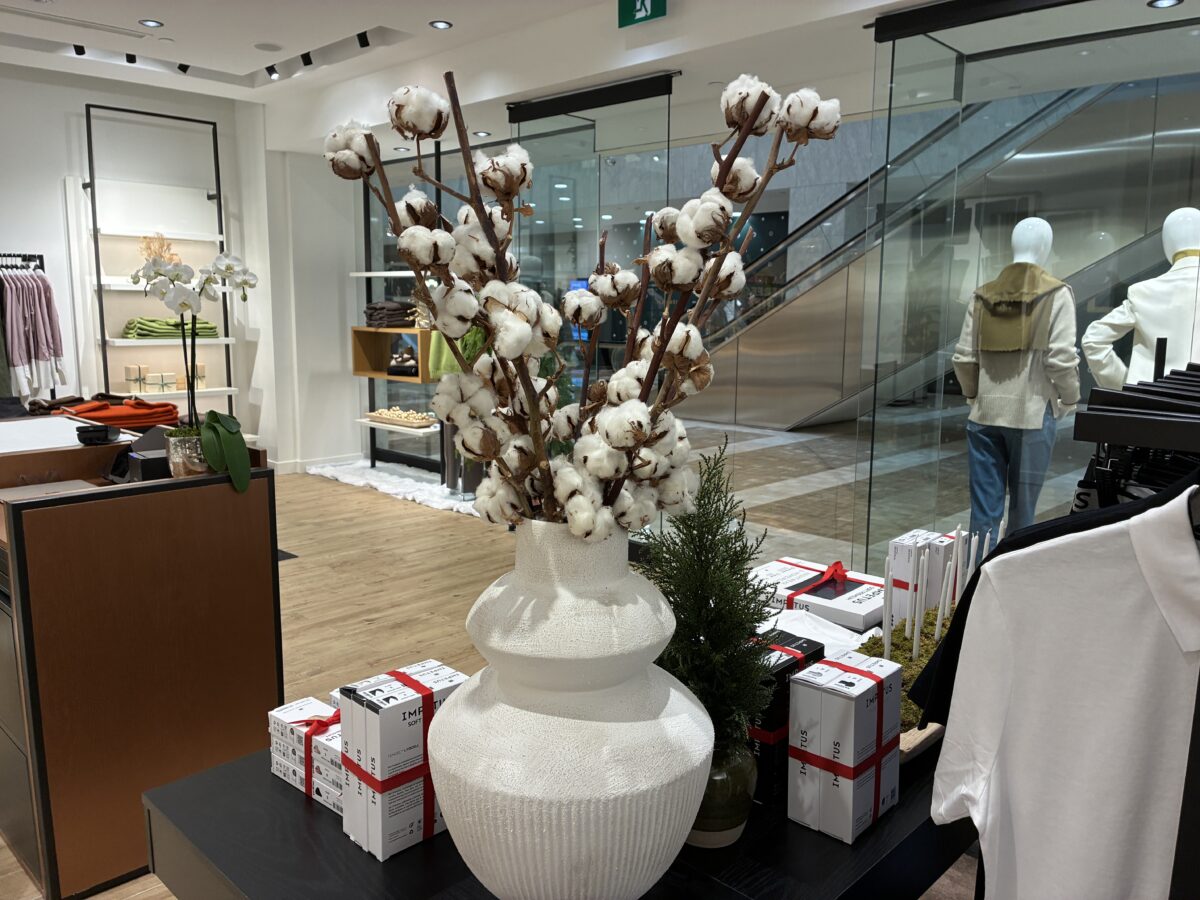
Interior stylist Niki Tsekareas (With Love By Niki) designed the transformation, keeping some of ECCO’s original fixtures—mostly because they’re extremely heavy and bolted to the walls—but completely changing the atmosphere. Natural elements are scattered throughout the space, and they’re not just decoration. Cotton sits on tables near garments made from the fibre. Eucalyptus represents lyocell production. Each element connects directly to the materials used in the clothing.
“Putting art and design at the centre resonates because the clothing we have in store are pieces of art in and of itself,” O’Reardon said. “The natural elements are there because of the clothing’s natural fibres. When you see cotton, it’s because the garments are made out of cotton. When you see eucalyptus, it’s because lyocell is produced from that. It’s a gentle nod to the production.”
The level of intention extends to the merchandise. O’Reardon isn’t carrying dozens of brands or hundreds of SKUs. The selection is deliberately small—a handful of Portuguese and Italian labels, all manufactured in Europe with strict quality standards. She’s turned away multiple brands that approached her, even when parts of their collections would have been a good fit.
“We’ve turned down brands where only part of their production is in Europe, or where quality control doesn’t meet our standards,” she said. “We set our expectations extremely high. When someone walks in and feels a garment, they immediately know the rest of the collection will have that same level of quality.”
The Farm-to-Table of Fashion
O’Reardon talks about her clothing the way a chef might talk about locally sourced ingredients. One example keeps coming up: a coat from NÄZ made with undyed wool, where every step from sheep to finished product happens within a 10-kilometre radius before the garment is delivered to Lisbon.
“It’s the farm-to-table concept, but for clothing,” O’Reardon explained. “The sheep is sheared, the wool is processed, it’s blended together skillfully to get the desired colour, then crafted into a coat. All within about 10 kilometres from where the sheep is to the final product.”
It’s a stark contrast to fast fashion supply chains that span multiple continents. For O’Reardon, that transparency matters. She wants customers to feel good about what they’re buying, knowing the people who made it were treated fairly and the environmental impact was minimized. European manufacturing provides that guarantee—the EU places strict operational and quality standards on production. When European brands say something is sustainable, the regulations back it up.
The relationship with Portuguese brand Impetus started over two years ago, well before the store opened. David put his vision to work developing connections and reaching out to manufacturers that aligned with his principles. Working with the Portuguese embassy helped the O’Reardons make additional connections. The research process involved years of online digging—who’s still manufacturing in Europe? Who’s truly sustainable? Who puts workers first?
Impetus was founded in 1973 by a husband and wife with a team of four. Today, the company is a certified B-Corp and emphasizes sustainability using materials like organic cotton and the ecological and biodegradable lyocell. They’re also pioneering technology that uses bacteria for textile dyeing, which significantly reduces water and energy consumption.
“When you buy something, it’s the fair trade approach to fashion,” O’Reardon said. “You want people to have products they can feel good about because those companies put people first. They’re not working in conditions where they’re exploiting people.”
The store currently carries the Fall Winter 2025 collection from Impetus and Impetus by Maison Sarava, a sleep and lounge line. But O’Reardon isn’t rushing to expand. The curation process is slow, deliberate, and focused on brands that meet her standards across the board—not just on a few hero products.
Bridging Two Markets

For David O’Reardon, Maison Sarava addresses a gap he observed when he first moved to Canada. He saw incredible craftsmanship, seasonal collections, and sustainable pieces launching in Paris, London, and Lisbon—yet those same products either never made it to Canada, arrived seasons too late, or were sold at prices far beyond what consumers in Europe or the U.S. would pay.
“I founded Maison Sarava because I believed there was a better way,” David said. “An opportunity to connect Canada and Europe—two markets that share common values around quality, integrity, sustainability, and craftsmanship. Europe has a long tradition of family-run ateliers, artisans with generations of experience, and brands that focus on the details—the stitching, the materials, the silhouette, and the story.”
The couple’s approach is built on one principle: Canadians deserve access to authentic, high-quality European fashion—sustainably made, beautifully designed, seasonally aligned, and fairly priced.
“I didn’t start Maison Sarava just because of passion,” David explained. “I started it because I believe in purpose, in connection, in the people who create—those working with dignity, skill, and tradition. Fashion shouldn’t be overly commercial or overinflated. It should be honest. Made thoughtfully, by skilled makers, using better materials—without needing to cost a fortune.”
Finding the Space
The PATH location wasn’t part of the original plan. The O’Reardons had been thinking about a permanent retail space, but they hadn’t started seriously looking. Then the First Canadian Place opportunity came through personal connections, and everything accelerated.
“We knew we had a great idea, but choosing a location was extremely challenging,” O’Reardon said. “The opportunity arose, and we would have been crazy not to take it. Everything happens for a reason. You meet people who present opportunities when you least expect it. We saw the space and fell in love with it.”
The location is prime real estate—literally in front of the escalators going up to the food court in one of Toronto’s busiest office towers. Thousands of people walk past every day. But the PATH also presents unique challenges that street-level or mall retailers don’t face.
Foot traffic is heavily concentrated Monday through Friday, mostly around lunch hours. Weekends are non-existent. That’s a much tighter window than traditional retail, and it requires a different approach to merchandising, staffing, and customer service. O’Reardon has adapted by positioning Maison Sarava as a brief escape from the office grind—a place where someone can step away for 10 or 15 minutes, browse quality clothing, and reset before heading back to work.
“This space lets people take a deep breath and step away from the office for a few minutes,” she said. “It provides a space where people can actually relax and get away from the office, even if it’s just for 10 minutes.”
The conversation shifts when O’Reardon talks about being in the PATH versus a street-level location. She acknowledges it’s unconventional—this type of carefully curated boutique could work anywhere. Most similar concepts would target Queen West or Yorkville, not an underground retail concourse dominated by lunch spots and convenience retail.
But O’Reardon sees advantages. The building’s values align with hers. The foot traffic is consistent, even if it’s concentrated. And there’s a sense of community among the retailers that she didn’t expect.
“I’ve met all of my neighbours,” she said. “Everybody’s really friendly. They like to know about new things, they like to feel the products, they like to come chat. And it’s not just the customers or the people who work in the building, but the other business owners as well.”
Part of a Larger Retail Push

Maison Sarava isn’t the only new face at First Canadian Place. The building has been actively adding and upgrading retail as downtown Toronto’s office population returns. Recent additions include Align Custom Fit, Steve Madden, and Sundays Pasta Lab. Harry Rosen also recently completed a significant renovation of its FCP location.
Leasing is handled by Beauleigh, and the activity signals confidence in downtown’s recovery. For landlords and retailers alike, the bet is that hybrid work has stabilized and foot traffic will continue improving as companies enforce return-to-office policies.
O’Reardon is watching that dynamic closely. Her business model depends on consistent weekday traffic, and she’s optimistic about what she’s seeing. “We’re all looking forward to people coming back to work,” she said. “I sympathize if you have to come back to work five days a week, but it means that liveliness, that neighbourhood, that camaraderie will reignite the financial district. You can see people meeting up for lunch, coming in, catching up.”
The retail mix at First Canadian Place is shifting. It’s not just about lunch spots and convenience anymore. The addition of boutiques like Maison Sarava, alongside established names like Harry Rosen and newer concepts like Sundays Pasta Lab, suggests the building is positioning itself as more than just a place to grab a sandwich between meetings.
The Challenges of Slow Fashion

O’Reardon is transparent about the operational challenges of her business model. New collections arrive in February and March, with smaller shipments trickling in through December and January. That timeline is significantly longer than typical retail, where fast fashion brands can go from design to store floor in weeks.
“We work with small, independent brands that don’t have warehouses to pull extra stock from,” O’Reardon said. “Everything is made to order, which requires a lot more notice but aligns with our values.”
That means planning inventory months in advance and accepting that she can’t quickly respond to trends or unexpected demand. If a particular item sells out, restocking takes time. For customers used to instant trend cycles, it’s an adjustment.
But O’Reardon believes there’s a market for this approach, especially among professionals who are tired of disposable fashion or overpaying for pieces that simply don’t last. She’s targeting customers who want to invest in pieces that will last years, not months. The price points reflect that commitment—when compared to popular brands at similar price points, Maison Sarava’s supply chain and quality construction stand out. The quality of yarn and durability of construction isn’t matched in most brands. The pricing reflects fair working conditions, impeccable construction, and minimal environmental impact.
The store is also launching complimentary styling sessions to help customers understand how to build a wardrobe around quality pieces. The sessions are quick—10 minutes—designed for busy professionals who want expert advice but don’t have time for lengthy appointments.
“Ten minutes is all we need to elevate an outfit and help someone feel confident,” O’Reardon said.
Shifting Consumer Mindset
O’Reardon talks about customer behaviour in a way that reveals both optimism and realism. She’s betting that there’s demand for an alternative to fast fashion, but she’s also clear-eyed about the challenge of changing habits.
“I don’t think people know what they want, to be honest,” she said. “I think when people see something special, it clicks in their brain to say, ‘I know exactly how I can wear that, why I want it.’ Even though it might not be something you were thinking about before, they certainly come back if they’re still thinking about it.”
The store’s windows play a crucial role. Several pieces have stopped people in their tracks—literally pausing mid-walk to look at the design and fabric. “It’s exciting for us when we see someone’s face light up at the window seeing something they have never seen before. It draws them in to want to feel the fabric,” O’Reardon said.
But she’s also pushing back against the broader culture of overconsumption. During the interview, she kept returning to a central question: Why are people buying clothes? Is it because they genuinely love something and will wear it for years? Or is it because they saw it trending online and want to fit in?
“There needs to be balance,” she said. “How often are you buying clothes? Why are you buying clothes? Are you buying it because you think it looks good? Or is it because it feels good and you genuinely love it? That’s the question we want people to ask themselves.”
It’s a philosophy that extends beyond the store. O’Reardon acknowledges that fast fashion moves too quickly for her to compete with. She’s not trying to keep up with TikTok trends or constantly refresh inventory to match what’s going viral. Instead, she’s carving out what she calls “our own little niche”—modern silhouettes in high-quality fabrics that won’t look dated in a year.
“We’ve got modern silhouettes from brands that you won’t really find trending online,” she said. “You will stand out in a crowd, but in the best way possible. This isn’t like eco-friendly fashion from 10 years ago where mostly everything didn’t translate into modern fashion. It was almost there—they had the fabrics, but it just couldn’t translate into office wear. Now it can.”
The Personal Connection to Retail
O’Reardon didn’t come from a retail background, but clothing has always been part of her life. “I can still remember when I got my very first paycheque—it went to clothing,” she said. “Whether I knew it or not, clothing has always been a part of what I like to do.”
She and her husband lived on different continents before settling in Toronto, and shopping was consistently something they enjoyed together. Opening a store lets them share that passion while creating a space for others to discover brands they wouldn’t find elsewhere.
What’s Next

The immediate focus is getting through the first few months and building a customer base. O’Reardon is watching foot traffic patterns, learning when people are most likely to browse, and adjusting accordingly. The complimentary styling sessions launching soon are part of that strategy—lower the barrier to entry, get people in the door, and let the product speak for itself.
Longer term, the brand evolution is still taking shape. For now, everything is sourced from Portugal, but the O’Reardons hint that could expand as the business grows. “We always have our eyes open for brands, and we can’t say we’re not excited to keep discovering more of what European countries have to offer,” O’Reardon said. “Many countries have been making the shift away from fast fashion, so that is very promising.”
The key is maintaining the standards they’ve set. Whether it’s Portugal, Italy, or elsewhere in Europe, the non-negotiables remain: ethical production, natural materials, quality construction, and transparency in the supply chain.
O’Reardon is realistic about the uncertainty. Downtown Toronto is still recovering. Hybrid work is the norm for many companies. Foot traffic is improving but hasn’t returned to pre-pandemic levels. Opening a boutique focused on slow fashion in the PATH is a calculated risk.
But O’Reardon keeps coming back to community—both the community of retailers at First Canadian Place and the community of customers she’s building. “The camaraderie, the neighbourhood feel—you can see people meeting up, catching up. It’s not just about transactions. It’s about creating a space people actually want to be in.”
Maison Sarava is located at 100 King Street West in the PATH at First Canadian Place. More information is available at maisonsarava.ca and @maisonsarava on Instagram.

Dustin Fuhs is the founder and Editor-in-Chief of 6ix Retail, Toronto’s premier source for retail and hospitality industry news. As the former Editor-in-Chief of Retail Insider, Canada’s most-read retail trade publication, Dustin brings over two decades of expertise spanning retail, marketing, entertainment and hospitality sectors. His experience includes roles with industry giants such as The Walt Disney Company, The Hockey Hall of Fame, The Canadian Opera Company, Starbucks Canada and Blockbuster.
Recognized as a RETHINK Retail Top Retail Expert in 2024, 2025 and 2026, Dustin delivers insider perspectives on Toronto’s evolving retail landscape, from emerging brands to established players reshaping the city’s commercial districts.