

In an era when Toronto restaurants face unprecedented labor challenges and razor-thin margins, Brasa Peruvian Kitchen has emerged as a contrarian success story by prioritizing what most competitors cut first: employee compensation. The fast-casual Peruvian concept reports a remarkable 7% annual employee turnover—a figure that stands in stark contrast to the industry standard of 100%—while maintaining labor costs at just 17% of revenue, well below the 25% benchmark.
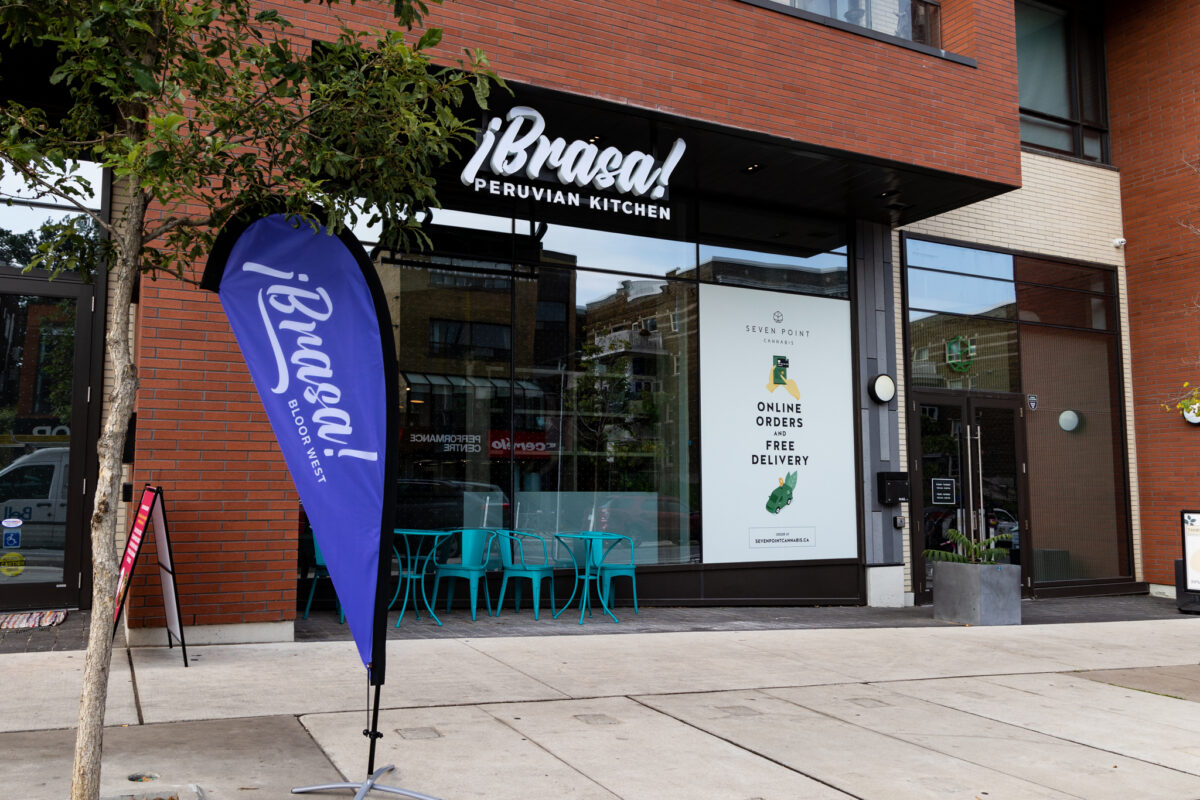
Founded in Toronto during the pandemic and now operating locations at First Canadian Place, Queen Street West, and Bloor Street West, Brasa has recently expanded to Manhattan, positioning itself as one of Toronto’s latest homegrown concepts to successfully enter the competitive New York market.
Toronto as Testing Ground for an Alternative Business Model

Founder and CEO Michel Falcon, a veteran of Toronto’s hospitality scene, developed Brasa’s distinctive model through methodical testing that began with a ghost kitchen in July 2021—a pandemic-driven necessity that proved fortuitous.
“The Ghost Kitchen presented value in product market fit. That was the first thing that I was trying to achieve by opening the Ghost Kitchen,” Falcon explained during an extensive interview at the company’s First Canadian Place location. “Not until we opened our first location with Brookfield Properties did we prove out our company culture, our performance metrics for our employees, and our guest experience by way of having unique steps of service and such.”
This staged approach represents a departure from Toronto’s traditional restaurant expansion patterns, where successful concepts often rush to open multiple locations without establishing operational sustainability. According to data from the Toronto Association of Business Improvement Areas, 41% of new restaurant concepts close within three years, often after premature expansion.
“Once I knew I had product market fit, and then we opened the first retail location, did I make a bet that we have something here? Then I signed two leases immediately after, which led to two more locations in a short period of time,” said Falcon, describing his calculated growth strategy.
Challenging Toronto’s Restaurant Labor Practices
In a city where hospitality workers increasingly struggle with housing affordability and unpredictable income from tips, Brasa has taken the unconventional step of eliminating tipping while paying significantly higher base wages than competitors.
“Pay people more, have less people,” Falcon stated, summarizing his approach to staffing. “Those individuals that we pay within our organization, we pay them 21% higher than similar roles at comparable restaurants without asking our customers for tips.”
This philosophy made headlines in 2023 when the company publicly disclosed all employee salaries on social media—a radical transparency move in an industry known for opaque compensation practices. The disclosure revealed starting wages substantially above Ontario’s $15.50 minimum wage, along with first-day benefits that most Toronto restaurants only offer after probationary periods, if at all.
“Verbatim, our mission statement has been reframed as why do we exist? And word for word, it goes like this: To build a company that the world needs more of, one where everyday people are empowered to make great money, achieve career growth, and help close the income equality gap,” Falcon shared.
This approach stands in contrast to the widespread staffing difficulties reported by Toronto restaurants post-pandemic. A recent survey by Restaurants Canada found that 80% of Toronto restaurant operators consider labor recruitment and retention their greatest operational challenge, with most responding primarily through schedule flexibility rather than wage increases.

Adapting Store Design to Toronto’s Evolving Food Delivery Landscape
Brasa’s three Toronto locations reflect careful consideration of neighbourhood dynamics while incorporating design elements that address the city’s growing reliance on third-party delivery—a segment that has grown 137% in Toronto since 2019, according to data from the City of Toronto’s Economic Development office.
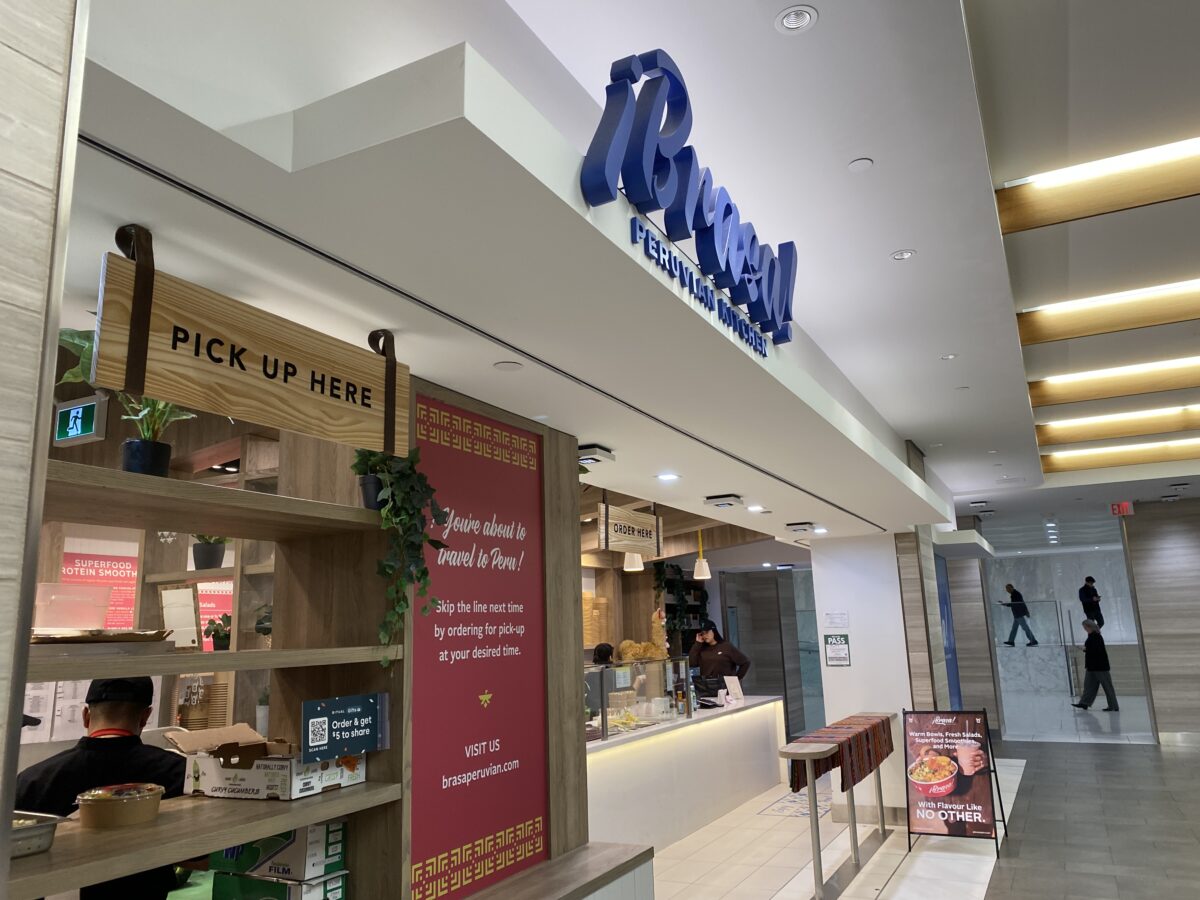
At the company’s First Canadian Place location, the space efficiency is immediately apparent. Unlike many Financial District eateries that prioritize dine-in seating, Brasa features a streamlined counter service model with a dedicated pickup area for digital orders, strategically positioned within reach of staff to maintain service quality.
“It’s segmenting customers in the real world,” Falcon explained. “We have our in-restaurant guests who may have more questions about our menu. We need to provide a path for them to be able to order in the way that they choose. There’s other customers who are more versed on our menu who may have less questions, who may not have the time to go down one path and choose a different path, which is the digital one.”
This approach varies slightly across locations. The Queen Street West restaurant accommodates a higher percentage of dine-in customers, while maintaining efficient service for the area’s substantial delivery volume. Meanwhile, the Bloor West location balances neighbourhood sit-down traffic with takeout service for nearby residents.
Revolutionary Approach to Toronto’s Delivery Ecosystem
Perhaps most distinctive is Brasa’s relationship with Toronto’s delivery couriers—a workforce that has grown substantially yet often remains marginalized by restaurant operators. The company has implemented policies that recognize these workers as essential partners rather than necessary evils.
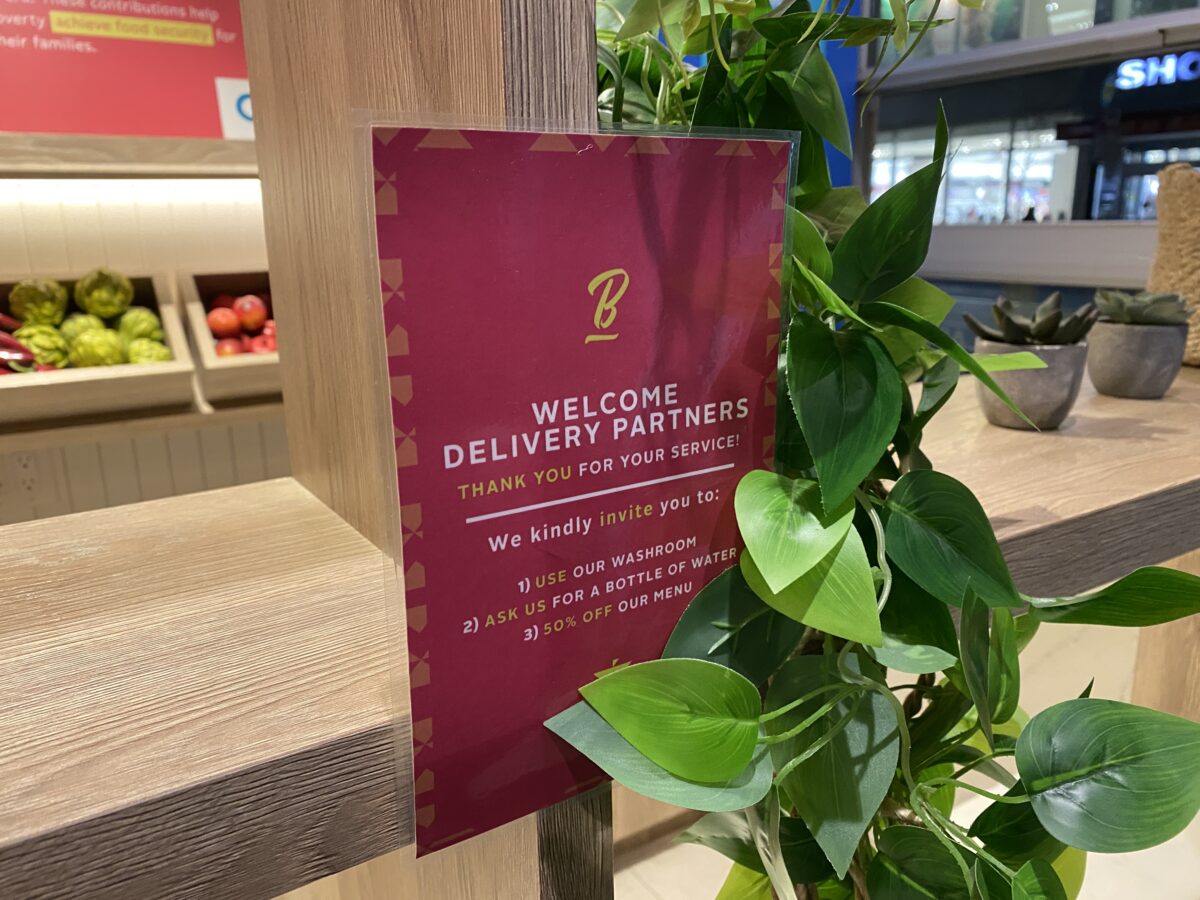
“I don’t call them delivery drivers, I call them delivery partners because they are an extension of our company,” Falcon said. “As soon as they have our meals in their bags and cycling or driving them to our customers, we are putting a lot of trust in them to handle it with care.”
Unlike many Toronto restaurants that provide minimal accommodation to couriers, Brasa offers them a 50% menu discount—matching the benefit provided to employees—along with washroom access and water. This policy represents a significant departure from practices at many downtown Toronto establishments, where delivery personnel often report being treated as nuisances rather than business partners.
“I’m betting on humanity that they’re going to take extra care with our food. I’m betting on humanity that they’re going to cycle a little bit faster and get that meal where it’s supposed to be in a shorter period of time,” Falcon explained.
The approach appears to be working. Analysis of Brasa’s delivery metrics shows an average delivery time 17% faster than competing restaurants in similar locations, potentially reflecting courier prioritization of the brand’s orders.

Integrating into Toronto’s Distinct Neighbourhoods
Beyond operational innovations, Brasa has developed a community integration strategy tailored to each Toronto neighbourhood it serves. This approach has become increasingly important as Toronto neighbourhoods express concern about the proliferation of chain restaurants at the expense of local character.
“Recently we posted in the neighbourhood Facebook group, asking residents what they would like from small businesses to be a part of the fabric of the community,” Falcon said, describing Brasa’s community outreach in the Bloor West area. “We received 50 replies, many thanking us for simply asking the question. We learned residents wanted businesses to support local food donation programs and help maintain neighbourhood cleanliness, even if just on their own block.”
This engagement strategy represents a departure from the franchised restaurant model common in Toronto, where corporate policies often prevent meaningful local adaptation. Brasa’s approach more closely resembles the community integration practiced by successful independent restaurants, despite operating multiple locations.
“We are invited guests for 10 years minimum, maybe more,” Falcon emphasized. “We’re invited guests into these communities and we need to remember that. And if that means shoveling the snow during the winter months or picking up garbage during the spring and summer, that’s the very least we can do.”
Selective Hiring in a Competitive Toronto Labor Market


In Toronto’s tight restaurant labor market, where competition for qualified staff has intensified since the pandemic, Brasa receives approximately 1,500 applications monthly across both countries but hires selectively—about one person per week.
The selection process focuses on two non-negotiable attributes: “The foundational principles of our team are two things, an incredible work ethic and a sunny disposition,” explained Falcon. “I can’t teach those things. You were taught those things when you were 10 years old by somebody that you should thank greatly.”
This selective approach has yielded tangible advancement opportunities within the company. Falcon highlighted an employee who progressed from a Toronto part-time position to a leadership role in New York: “One of our General Managers joined us as a part-time team member earning $20 an hour. They now live in New York working alongside of me earning 90,000 US dollars with great responsibility, tremendous growth with their leadership and people management.”
With over 10,000 reviews across platforms maintaining a 4.7-star average, customer satisfaction validates Brasa’s approach in Toronto’s competitive food landscape. As the brand continues to expand both within Toronto and beyond, Falcon maintains that financial success is merely a byproduct of more fundamental values.
“I don’t want to build an organization that just does well financially. That’s hollow to me. That’s table stakes,” Falcon concluded. “I want to be able to create careers and I want Brasa Peruvian Kitchen to be seen as an alma mater.”
As Toronto’s restaurant industry continues to face labor challenges, rising costs, and delivery disruption, Brasa’s contrarian model offers a potential blueprint for sustainable growth—one that began in Toronto and now carries the city’s entrepreneurial spirit to new markets.

Dustin Fuhs is the founder and Editor-in-Chief of 6ix Retail, Toronto’s premier source for retail and hospitality industry news. As the former Editor-in-Chief of Retail Insider, Canada’s most-read retail trade publication, Dustin brings over two decades of expertise spanning retail, marketing, entertainment and hospitality sectors. His experience includes roles with industry giants such as The Walt Disney Company, The Hockey Hall of Fame, The Canadian Opera Company, Starbucks Canada and Blockbuster.
Recognized as a RETHINK Retail Top Retail Expert in 2024, 2025 and 2026, Dustin delivers insider perspectives on Toronto’s evolving retail landscape, from emerging brands to established players reshaping the city’s commercial districts.